
Habits worth discussing
These are common sources of strain on front-tooth edges.
- Chewing pens, pencils or glasses arms.
- Biting nails or the skin around them.
- Crunching ice or hard candy.
- Opening packaging, bottles or tape with your teeth.
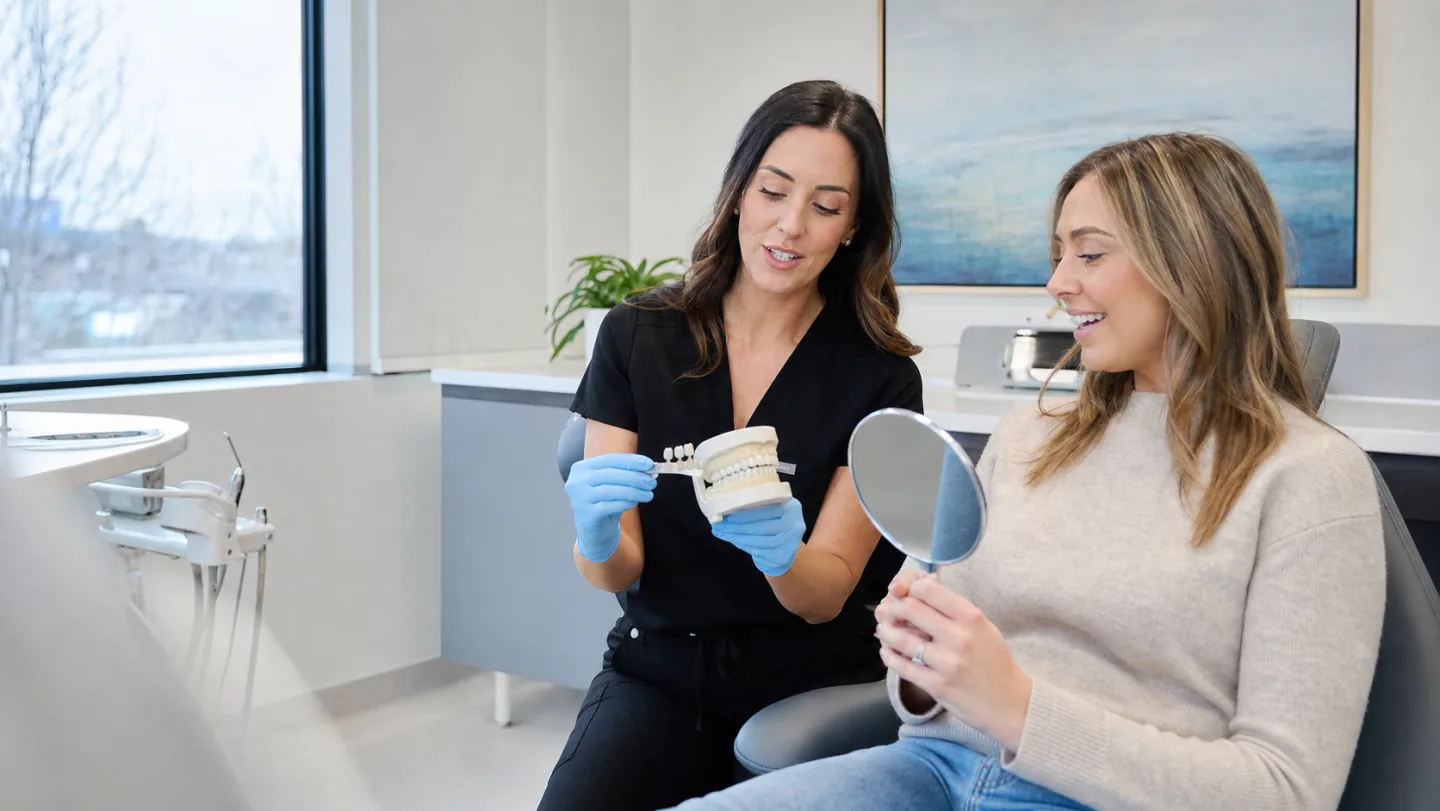
Pens, ice cubes, fingernails and stubborn packaging all put force on the edges veneers would cover. Pembina residents can talk through how those habits fit with veneers at our McPhillips Street clinic in Winnipeg.
Let's find a time
Front teeth are designed for biting food, yet many of us also use them as tools. Chewing on pen caps, crunching ice, biting nails or tearing open bags all load the thin edges of the upper front teeth, and those are exactly the edges a veneer would be bonded to.
How long a veneer lasts is never set in advance. Habits, bite, grinding, hygiene and maintenance all affect how likely chipping, debonding or staining become. Being open about what your teeth go through helps the dentist choose material and design sensibly. If you live in Pembina, that discussion takes place at our Winnipeg clinic.
Explore veneers
Biting on hard objects concentrates force on the thinnest part of a veneer.
Porcelain and composite respond differently when chipped, which affects repair.
Small changes in what you bite can help protect the work afterward.
Knowing how each material behaves under stress helps you weigh which is likely to suit your routine.
These are common sources of strain on front-tooth edges.
Neither one suits every mouth, and each behaves in its own way.
Grinding or clenching, especially at night, is a separate source of force worth mentioning even if you are not sure you do it.
Habits are not just a warning at the end. They inform choices from the first conversation to the bonding visit.
Request your visitMention what you tend to bite or chew, along with what you want to change about your teeth.
Wear, chips and bite contacts are examined and recorded with photos, scans and bite records.
Proposed edge length and shape are checked digitally or in a model against how your teeth meet.
Enamel is reduced only to the degree that the chosen material and design need.
Before final bonding, fit, colour and contacts are checked so edges are not overloaded.
Many habits are automatic, so spending a few days paying attention can reveal more than you expect.
Existing chips or flat spots on your front teeth can be a clue to habits you no longer notice.


A light blue reclining chair with wooden drawers, and a desk with a keyboard and a painting.
Admitting to nail biting or chewing pens can feel embarrassing. These habits are common, and hearing about them simply lets the plan account for how your teeth are actually used.
You can ask how a chip would be handled with each material.
If you suspect night grinding, ask how that would be checked.
Bonding or reshaping may suit some cases, and you can ask whether yours is one.
Protecting the edges
A few practical substitutions can reduce the stress on new veneer edges day to day.
Keep scissors or a bottle opener handy so packaging never goes to your mouth.
Biting very hard foods with your side teeth spares the thinner front edges.
Call the clinic about a chip or rough spot rather than leaving it to worsen.
Daily brushing, cleaning between teeth and routine examinations remain essential, since natural tooth at the margins can still decay.
Talk with our team
Winnipeg North Dental
Unit-5 2358 Mcphillips Street, Winnipeg, MB R2V 4J6Get directions (opens in a new tab)People who live in Pembina, an area in Winnipeg, are seen for veneer consultations at Winnipeg North Dental, Unit 5, 2358 McPhillips Street.
Feel free to mention any chipping history in the request form. The clinic checks your request and gets in touch about an appointment.
Questions about coverage?
Talk with our team before your visit or learn about CDCP.
Helpful details about veneers in Pembina.
Ask our teamIt adds force to the edge and can contribute to chipping over time. Mentioning the habit helps the dentist consider design and material with that in mind.
Ordinary food is generally fine. Very hard items, and biting them with your front teeth, place more strain on the edges, so care is sensible.
There is no universal answer. Porcelain resists staining well but can be harder to repair if chipped, while composite is often easier to fix or add to.
Small chips may be difficult to repair without showing, and replacement may sometimes be the more reliable option. An examination shows what is possible.
Habits alone do not usually rule veneers out, but together with grinding or a difficult bite they may shift the plan toward another option. That is decided at assessment.
Force from habits or grinding, changes at the margins and general wear can all play a part. A loose veneer should be reported to the clinic by phone.
Mention them when you call (204) 338-3003 or write them in the form here. They will be discussed during your consultation at our McPhillips Street clinic in Winnipeg.
Depending on your habits and bite, a repairable or reshaping-based approach might be worth comparing.
Learn how dental bonding in Winnipeg uses tooth-coloured resin to repair small chips, close minor spaces and refine tooth shape, often in one visit.
Explore serviceLearn how conservative tooth reshaping in Winnipeg can smooth small chips, uneven edges or minor shape differences, including candidacy and enamel limits.
Explore serviceBook dental check-ups and cleanings in Winnipeg for preventive exams, tartar removal, gum monitoring and personalized home-care guidance.
Explore serviceHave an urgent concern? Call (204) 338-3003 to discuss availability.
Teeth doing double duty?
Pembina residents can send a consultation request and mention the habits that worry them. The clinic looks at it and replies about a suitable time.
Patient testimonials
Winnipeg North Dental
“Excellent experience at Winnipeg North Dental. Recommended by my friend Gagandeep. The whole staff is professional and attentive. Special thanks to my friend there. Highly recommend!”
Winnipeg North Dental
“Had a great experience at Winnipeg North Dental. My hygienist, Haven, was thorough, professional, and gave really useful recommendations. Watching Netflix during the cleaning was an awesome bonus. Dr. Elzayat was great as well. Overall, a smooth, comfortable visit. Highly recommend!”
Winnipeg North Dental
“I really enjoyed the treatment at this clinic. I had my teeth treated by Dr. Sukhpreet. Everything went great. Thank you so much for your professionalism!”
Winnipeg North Dental
“Dr harpreet and Dr. Sidhu both were very nice during the job , full professional, very knowledgeable and Dr Harpreet was really polite during all time .”
Winnipeg North Dental
“I had a great experience at Dental North in Winnipeg for a teeth cleaning. The staff was friendly and professional, and the hygienist was gentle yet thorough. I left with my teeth feeling amazing and will definitely be returning!”
Winnipeg North Dental
“Very quick, efficient and friendly. Very happy to have found this place.”
Winnipeg North Dental
“I did called them in 2020 October they were not opened at that time. I give them my number, email and name so that when they open they can give me call to book appointment. They might have forgot that. I had a first appointment for dental in Canada. It went really good. They explained every single bit what they gonna do, What is best for me, Doctor was really nice. It was completely satisfying experience. Didnt smell like a clinic. I mean like any walk in doctor clinic. Even they helped me to understand my dental benefits to use them in best possible way. I would definitely recommend to others.”
Winnipeg North Dental
“Excellent experience! The dentist and staff were professional, friendly and were very welcoming!”
Winnipeg North Dental
“I had a great experience at this place, dr Sidhu and all the team was great.”
Winnipeg North Dental
“They are honest and know what they are doing. i came here for my 7 year old dental treatment and Dr sukhpreet guide us very nicely and did perfect job .Its a feeling in safe hands. Reception and staff are polite .”
Winnipeg North Dental
“My recent visit at the Winnipeg North Dental was excellent. The staff was friendly, the cleaning was thorough yet gentle, and the dentist took the time to explain everything clearly. I highly recommend them! Dr Sidhu is awesome:)”
Winnipeg North Dental
“It was really great experience with Dr. Jiwan on my first visit. She treated me very nicely and professionally . Staff were very nice and friendly.”
Winnipeg North Dental
“Excellent clinic with a warm and welcoming atmosphere. Dr. Sidhu handled my tooth issue very gently and in a friendly, professional manner — truly one of the best!”
Winnipeg North Dental
“Friendly staff, clean clinic, and a dentist who really cares. Everything was explained clearly and I felt comfortable the whole time. Highly recommend”
Winnipeg North Dental
“I had great experience at this place all the staff was really helpful and professional.”
Winnipeg North Dental
“I have had nothing but wonderful experiences with Winnipeg North Dental. I have brought my child here for teeth cleaning and she loves how kindly the entire staff treat her. Dr. Sidhu is kind, professional, and extremely thorough. I highly recommend!”
Winnipeg North Dental
“Dr. Sidhu is so kind and caring. Her gentle approach makes going to the dentist a pleasure especially for a child. My daughter and I are so happy we found Winnipeg North Dental. The staff are great too! Highly recommend.”
Winnipeg North Dental
“This place is immaculate, friendly, helpful and the people working there are wonderful! Dr. Sidhu is the BEST!!!! She really cares about you and making your dental experience a positive one! Forever a patient!⭐️⭐️⭐️⭐️⭐️”
Winnipeg North Dental
“Dr. Sidhu exhibits a high level of professionalism and offers exceptional accommodation. She is an outstanding physician who consistently provides assistance with any dental pain or issues that I have encountered. I am grateful for her expertise and support.”
Winnipeg North Dental
“Dr Sidhu is very friendly and kind she takes care of her patients very well. I have my first visit yesterday and she listen and understand my problems and have done a good examination. Also suggested me many things which can improve my teeth situation. The staff is also very good and helpful. I will be visiting there again for sure.”
Winnipeg North Dental
“I had wonderful experience at this place. Thanks to the whole team.”
Winnipeg North Dental
“I have always found Dr. Sidhu to be very patient and comforting as well as gentle and makes for a totally painless visit, when ever I have dental issues. She is a very up beat and positive person which makes for great dental work experience every time.”
Winnipeg North Dental
“I had a wonderful experience! Dr Sidhu and her team are always so friendly. It was also my 1 year old daughters first check up and Dr. Sidhu was so kind and patient with her. I highly recommend Winnipeg North Dental. Kind, passionate, professional and very well managed. So happy I found such a great dentist!”
Winnipeg North Dental
“Recently, i had received two treatments and feeling very good and would like to thank the doctor for explaining in details about the problem and procedure . I would like to thank the staff and doctor for their professionalism for providing the kind service.Thank you.”
Winnipeg North Dental
“My experience here was amazing. Dr. Jiwan Sidhu is very nice and kind! She's overall a great dentist and I recommend others to come here!”
Winnipeg North Dental
“Dr. Sidhu and her Winnipeg North Dental Team are AWESOME!!! They always make their client feel comfortable and explains everything that need to be done in every visit. I also like that she is very caring, always connect with us after our visit to ensure that all is well with our teeth. Very highly recommended.”
Winnipeg North Dental
“Dr Sukhpreet has great and professional knowledge . God bless”
Winnipeg North Dental
“Dr. Sidhu is an amazing doctor who makes her patients feel comfortable and guides through the process. Me and my family had a great experience. I love the way she shares all details about dental health. Thank you”
Winnipeg North Dental
“Amazing place. It is always clean. And Dr.Sidhu takes very good care of her patients. Every time I am there she goes above and beyond to make my stay a pleasant one. Dr.Sidhu truly cares about her patients as do the other staff working with her. They are all very professional. I highly recommend this place and dentist.”
Winnipeg North Dental
“I can't wait to get in the chair with Dr. Sidhu looking down on me with that super powerful freezy needle. Oh yeah, nicest dentist I've ever been to in all of my 79 years. She makes pain fun!”
Winnipeg North Dental
“Dr. Sidhu and her team are amazing. Everyone is very welcoming and know how to make a client comfortable. She explains everything about the procedure and follows up after every session. I am glad I visited her for regular check ups.”
Winnipeg North Dental
“Called first thing in the morning for an emergency and my 4 year old son was taken in within an hour. Dr. Sukhpreet was so nice and gentle and my son just adored her. Just the best dental office for my family..!!!”
Winnipeg North Dental
“My wife and I have been going to Dr.Sidhu and Maribeth for a very long time now. Over 10 years. And when Winnipeg North Dental started we followed them there. The care we get there is the best. From the front desk staff, to the hygienist and dental assistants and the dentists they’re the best group. Thank you guys.”
Winnipeg North Dental
“Knowledgeable staff and easy to get appointments! Thanks”
Winnipeg North Dental
“Just started going to this Clinic and so far my experience are all positive. Staff are friendly. Clinic is super clean. Very organized and always on time. Plenty of parking.Highly recommended”
Winnipeg North Dental
“Dr. Sidhu and her staff are amazing! They don't rush, ask questions, and take the time to answer. I was impressed that Dr. Sidhu spent more than 10 minutes doing my check-up; the last dentist I went to spent 2 minutes and didn't even ask my name! I will definitely be going back.”
Winnipeg North Dental
“I’ve been seeing Dr.Sidhu at Winnipeg North Dental since it opened! Always a 10/10 experience there! She and all her staff exceed my expectations every time! Extremely friendly and will go the extra mile for you to ensure you receive the best dental care possible!”
Winnipeg North Dental
“My experience in Winnipeg North dental was amazing and thankyou to Dr. Sidhu and her team , they also ensure that the patient in their care always feel comfortable. They provide the best quality service to their patients and Dr. Sidhu is amazing , very friendly. Highly recommended.”
Winnipeg North Dental
“Wonderful experience with Winnipeg North Dental Clinic. Dr. Sidhu was a wonderful dentist, and the staff was always helpful and kind. They ensured I had a smooth process and follow-up. I am so glad I chose Winnipeg North Dental clinic and would highly recommend to anyone.”
Winnipeg North Dental
“Had a cleaning that was great! All staff are awesome also had a filling done with Dr Sidhu her bed side manner and pt care is top notch! When she did the freezing needle I could not feel any pain! Absolutely none! If you have any fear of dentists Dr. Sidhu is for you!!”
Close to home
Convenient dental care on McPhillips Street for families across northwest Winnipeg and nearby communities.
Explore all service areasNeighbourhoods & communities
Nearby streets & corridors
A healthier smile is one visit away