
Face
Lip movement and facial proportions frame the smile.
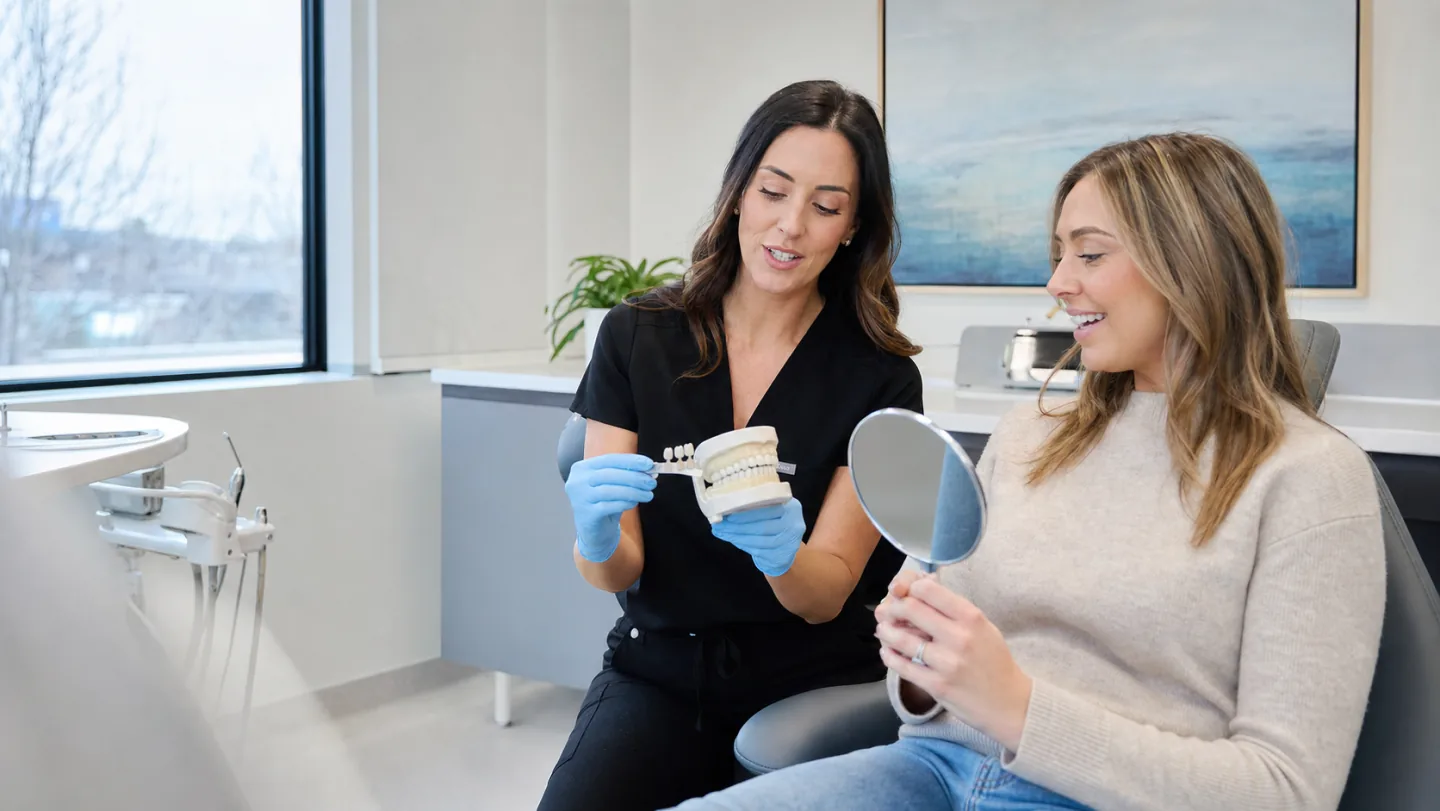
Thoughtful cosmetic planning for a balanced, natural-looking smile.
Let's find a time
Veneers are thin restorations placed over the visible surfaces of selected front teeth. They can refine shape, proportion, colour, texture and small spaces, but the best results begin with healthy teeth, stable gums and a clear understanding of what you want to change.
Lip movement and facial proportions frame the smile.
Tooth display, midline and gum levels create the overall rhythm.
Width, length, texture and shade are planned together.
Contacts must allow the restorations to function safely.
We first decide whether adding material to the front of a tooth is the most conservative and predictable option—or whether whitening, bonding, orthodontics or a stronger restoration would better address the concern.
Both can alter the visible tooth surface. Their fabrication, repairability, stain behaviour and enamel preparation are not identical, so the choice belongs to the specific smile—not a universal ranking.
PorcelainCustom-fabricated outside the mouth from a scan or impression.
CompositeLayered and sculpted directly on the tooth by the dentist.
PorcelainHighly polished ceramic with strong colour stability.
CompositeNatural-looking resin that can stain or lose polish over time.
PorcelainChips may be difficult to repair invisibly and replacement may be needed.
CompositeLocalized additions, reshaping or polishing may be more straightforward.
PorcelainUsually requires planning, preparation, fabrication and bonding visits.
CompositeOften completed in a direct clinical workflow, depending on scope.
Define what bothers you and what should remain recognizably yours.
Photos, scans, shades and bite records establish the starting point.
Proposed shapes and proportions are evaluated digitally or in a model.
Enamel is altered only as required for the selected design and material.
Fit, colour and bite are checked before the veneers are secured and finished.
Many veneers require removal of some enamel to create room, define margins and avoid an over-contoured result. Once a tooth is prepared, it will continue to need a restoration even if the veneer is replaced later.
Many veneers require some enamel preparation, but the amount varies with tooth position, material and design. We explain the proposed reduction before treatment.
They can visually alter selected minor alignment differences, but they do not move roots or correct the bite. Orthodontics may be safer and more conservative for significant crowding or rotation.
They should be planned around your chosen shade, facial proportions and available space. Previewing shape and controlling preparation help avoid an artificial or over-contoured result.
The veneer itself cannot decay, but the natural tooth can develop decay at its margins or on uncovered surfaces. Brushing, interdental cleaning and examinations remain essential.
There is no fixed lifespan. Material, bite, grinding, habits, hygiene and maintenance all influence chipping, debonding, staining and eventual replacement.
If you want lighter natural teeth, whitening is commonly completed first. After the shade stabilizes, veneers or bonding can be matched to it.
Patient testimonials
Winnipeg North Dental
“Excellent experience at Winnipeg North Dental. Recommended by my friend Gagandeep. The whole staff is professional and attentive. Special thanks to my friend there. Highly recommend!”
Winnipeg North Dental
“Had a great experience at Winnipeg North Dental. My hygienist, Haven, was thorough, professional, and gave really useful recommendations. Watching Netflix during the cleaning was an awesome bonus. Dr. Elzayat was great as well. Overall, a smooth, comfortable visit. Highly recommend!”
Winnipeg North Dental
“I really enjoyed the treatment at this clinic. I had my teeth treated by Dr. Sukhpreet. Everything went great. Thank you so much for your professionalism!”
Winnipeg North Dental
“Dr harpreet and Dr. Sidhu both were very nice during the job , full professional, very knowledgeable and Dr Harpreet was really polite during all time .”
Winnipeg North Dental
“I had a great experience at Dental North in Winnipeg for a teeth cleaning. The staff was friendly and professional, and the hygienist was gentle yet thorough. I left with my teeth feeling amazing and will definitely be returning!”
Winnipeg North Dental
“Very quick, efficient and friendly. Very happy to have found this place.”
Winnipeg North Dental
“I did called them in 2020 October they were not opened at that time. I give them my number, email and name so that when they open they can give me call to book appointment. They might have forgot that. I had a first appointment for dental in Canada. It went really good. They explained every single bit what they gonna do, What is best for me, Doctor was really nice. It was completely satisfying experience. Didnt smell like a clinic. I mean like any walk in doctor clinic. Even they helped me to understand my dental benefits to use them in best possible way. I would definitely recommend to others.”
Winnipeg North Dental
“Excellent experience! The dentist and staff were professional, friendly and were very welcoming!”
Winnipeg North Dental
“I had a great experience at this place, dr Sidhu and all the team was great.”
Winnipeg North Dental
“They are honest and know what they are doing. i came here for my 7 year old dental treatment and Dr sukhpreet guide us very nicely and did perfect job .Its a feeling in safe hands. Reception and staff are polite .”
Winnipeg North Dental
“My recent visit at the Winnipeg North Dental was excellent. The staff was friendly, the cleaning was thorough yet gentle, and the dentist took the time to explain everything clearly. I highly recommend them! Dr Sidhu is awesome:)”
Winnipeg North Dental
“It was really great experience with Dr. Jiwan on my first visit. She treated me very nicely and professionally . Staff were very nice and friendly.”
Winnipeg North Dental
“Excellent clinic with a warm and welcoming atmosphere. Dr. Sidhu handled my tooth issue very gently and in a friendly, professional manner — truly one of the best!”
Winnipeg North Dental
“Friendly staff, clean clinic, and a dentist who really cares. Everything was explained clearly and I felt comfortable the whole time. Highly recommend”
Winnipeg North Dental
“I had great experience at this place all the staff was really helpful and professional.”
Winnipeg North Dental
“I have had nothing but wonderful experiences with Winnipeg North Dental. I have brought my child here for teeth cleaning and she loves how kindly the entire staff treat her. Dr. Sidhu is kind, professional, and extremely thorough. I highly recommend!”
Winnipeg North Dental
“Dr. Sidhu is so kind and caring. Her gentle approach makes going to the dentist a pleasure especially for a child. My daughter and I are so happy we found Winnipeg North Dental. The staff are great too! Highly recommend.”
Winnipeg North Dental
“This place is immaculate, friendly, helpful and the people working there are wonderful! Dr. Sidhu is the BEST!!!! She really cares about you and making your dental experience a positive one! Forever a patient!⭐️⭐️⭐️⭐️⭐️”
Winnipeg North Dental
“Dr. Sidhu exhibits a high level of professionalism and offers exceptional accommodation. She is an outstanding physician who consistently provides assistance with any dental pain or issues that I have encountered. I am grateful for her expertise and support.”
Winnipeg North Dental
“Dr Sidhu is very friendly and kind she takes care of her patients very well. I have my first visit yesterday and she listen and understand my problems and have done a good examination. Also suggested me many things which can improve my teeth situation. The staff is also very good and helpful. I will be visiting there again for sure.”
Winnipeg North Dental
“I had wonderful experience at this place. Thanks to the whole team.”
Winnipeg North Dental
“I have always found Dr. Sidhu to be very patient and comforting as well as gentle and makes for a totally painless visit, when ever I have dental issues. She is a very up beat and positive person which makes for great dental work experience every time.”
Winnipeg North Dental
“I had a wonderful experience! Dr Sidhu and her team are always so friendly. It was also my 1 year old daughters first check up and Dr. Sidhu was so kind and patient with her. I highly recommend Winnipeg North Dental. Kind, passionate, professional and very well managed. So happy I found such a great dentist!”
Winnipeg North Dental
“Recently, i had received two treatments and feeling very good and would like to thank the doctor for explaining in details about the problem and procedure . I would like to thank the staff and doctor for their professionalism for providing the kind service.Thank you.”
Winnipeg North Dental
“My experience here was amazing. Dr. Jiwan Sidhu is very nice and kind! She's overall a great dentist and I recommend others to come here!”
Winnipeg North Dental
“Dr. Sidhu and her Winnipeg North Dental Team are AWESOME!!! They always make their client feel comfortable and explains everything that need to be done in every visit. I also like that she is very caring, always connect with us after our visit to ensure that all is well with our teeth. Very highly recommended.”
Winnipeg North Dental
“Dr Sukhpreet has great and professional knowledge . God bless”
Winnipeg North Dental
“Dr. Sidhu is an amazing doctor who makes her patients feel comfortable and guides through the process. Me and my family had a great experience. I love the way she shares all details about dental health. Thank you”
Winnipeg North Dental
“Amazing place. It is always clean. And Dr.Sidhu takes very good care of her patients. Every time I am there she goes above and beyond to make my stay a pleasant one. Dr.Sidhu truly cares about her patients as do the other staff working with her. They are all very professional. I highly recommend this place and dentist.”
Winnipeg North Dental
“I can't wait to get in the chair with Dr. Sidhu looking down on me with that super powerful freezy needle. Oh yeah, nicest dentist I've ever been to in all of my 79 years. She makes pain fun!”
Winnipeg North Dental
“Dr. Sidhu and her team are amazing. Everyone is very welcoming and know how to make a client comfortable. She explains everything about the procedure and follows up after every session. I am glad I visited her for regular check ups.”
Winnipeg North Dental
“Called first thing in the morning for an emergency and my 4 year old son was taken in within an hour. Dr. Sukhpreet was so nice and gentle and my son just adored her. Just the best dental office for my family..!!!”
Winnipeg North Dental
“My wife and I have been going to Dr.Sidhu and Maribeth for a very long time now. Over 10 years. And when Winnipeg North Dental started we followed them there. The care we get there is the best. From the front desk staff, to the hygienist and dental assistants and the dentists they’re the best group. Thank you guys.”
Winnipeg North Dental
“Knowledgeable staff and easy to get appointments! Thanks”
Winnipeg North Dental
“Just started going to this Clinic and so far my experience are all positive. Staff are friendly. Clinic is super clean. Very organized and always on time. Plenty of parking.Highly recommended”
Winnipeg North Dental
“Dr. Sidhu and her staff are amazing! They don't rush, ask questions, and take the time to answer. I was impressed that Dr. Sidhu spent more than 10 minutes doing my check-up; the last dentist I went to spent 2 minutes and didn't even ask my name! I will definitely be going back.”
Winnipeg North Dental
“I’ve been seeing Dr.Sidhu at Winnipeg North Dental since it opened! Always a 10/10 experience there! She and all her staff exceed my expectations every time! Extremely friendly and will go the extra mile for you to ensure you receive the best dental care possible!”
Winnipeg North Dental
“My experience in Winnipeg North dental was amazing and thankyou to Dr. Sidhu and her team , they also ensure that the patient in their care always feel comfortable. They provide the best quality service to their patients and Dr. Sidhu is amazing , very friendly. Highly recommended.”
Winnipeg North Dental
“Wonderful experience with Winnipeg North Dental Clinic. Dr. Sidhu was a wonderful dentist, and the staff was always helpful and kind. They ensured I had a smooth process and follow-up. I am so glad I chose Winnipeg North Dental clinic and would highly recommend to anyone.”
Winnipeg North Dental
“Had a cleaning that was great! All staff are awesome also had a filling done with Dr Sidhu her bed side manner and pt care is top notch! When she did the freezing needle I could not feel any pain! Absolutely none! If you have any fear of dentists Dr. Sidhu is for you!!”
Close to home
Convenient dental care on McPhillips Street for families across northwest Winnipeg and nearby communities.
Neighbourhoods & communities
Nearby streets & corridors
A healthier smile is one visit away