Skip to content
Winnipeg North Dental
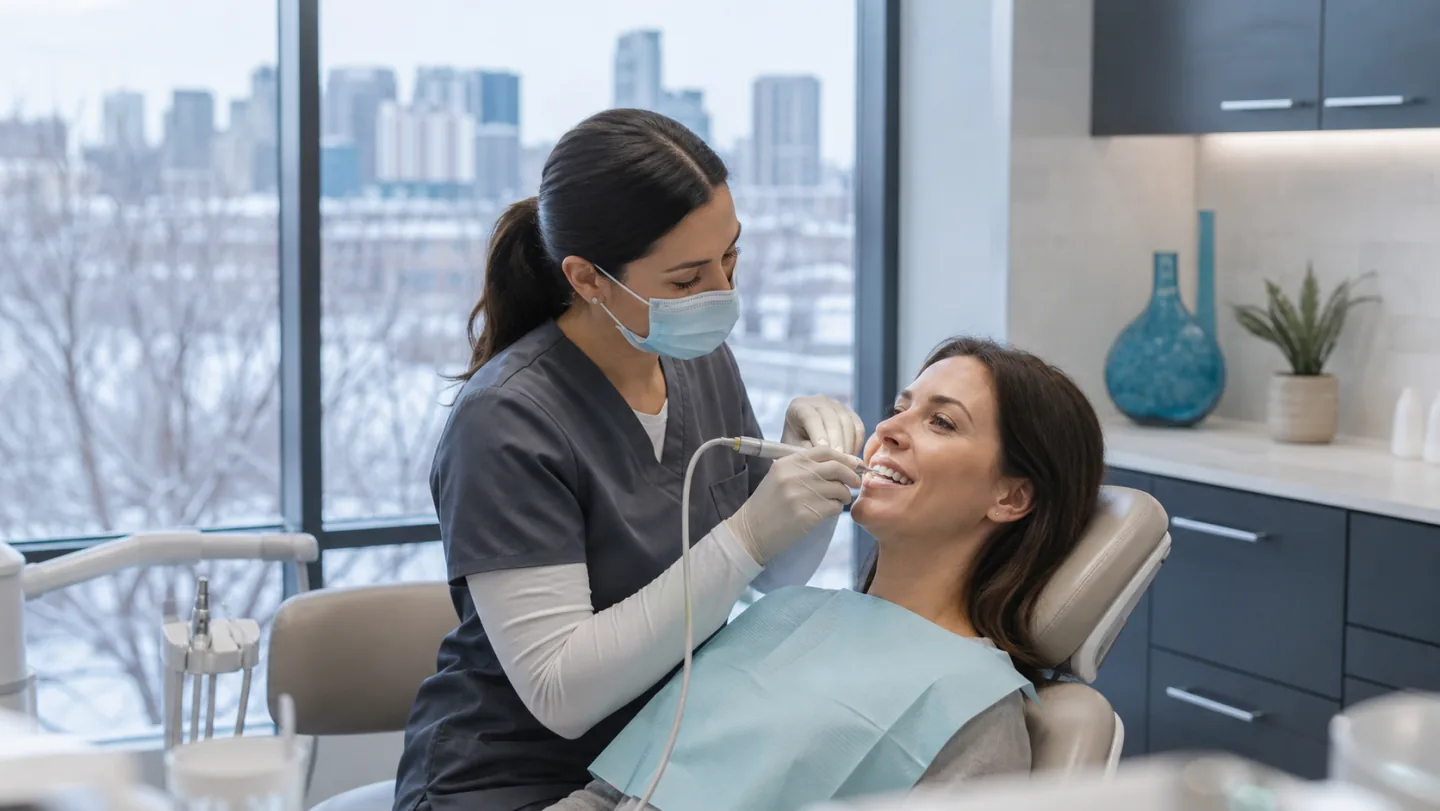
A dentist conservatively polishing the edge of a front tooth
For the curious

Tooth Reshaping for River Trail Residents

What actually happens to a tooth during enamel contouring? Here’s the method explained plainly, from the first marks to the last bite test.

Let's find a time

Request an appointment

We’ll call to confirm your appointment. For urgent care, please call us directly.

A look under the hood

How enamel contouring actually works

Some patients are perfectly happy to lie back and trust the process. Others want to understand the mechanics first. If you’re a River Trail resident in the second group, this page walks through the reasoning behind each stage of tooth reshaping.

The core idea is simple: enamel is the hard outer layer of a tooth, and a very small amount can be removed to refine an edge. Everything else in the procedure exists to keep that removal within safe limits. River Trail residents would have all of this done at Winnipeg North Dental, a clinic on McPhillips Street in Winnipeg.

Explore tooth reshaping
Dental chair, instrument arm and sink in a treatment room at Winnipeg North Dental
An instrument arm and sink next to a dental chair at our clinic.

Outer layer only

The planned change stays within enamel and away from the dentin underneath.

Measured in small passes

Working gradually lets each result be judged before more is considered.

Function gets tested

The finished tooth has to work in your bite as well as look balanced.

The logic of the method

Two limits govern every adjustment.

Every decision in contouring answers one of two questions: how much enamel can safely go, and what will that do to the way your teeth meet?

The structural limit

Enamel doesn’t grow back and shields the tooth, so the plan must leave it adequately protected.

  • Thickness at the planned area decides what’s available.
  • Getting close to dentin means choosing a different treatment.
  • Cracks and fillings can explain roughness that looks like extra enamel.
  • Sensitivity is treated as a reason to stop and rethink.

The functional limit

Front teeth guide your jaw as it moves, so even a small edge change can have effects elsewhere.

  • Edges can influence how the front teeth slide across one another.
  • Contacts are checked with the jaw in several different positions.
  • Shortening one tooth may solve a difference and start another.
  • Proportions are compared with the teeth to either side.

Removing enamel is the only thing this treatment does, so it can’t add length, width or lightness. Those goals belong to methods such as dental bonding.

Stage by stage

What happens, and why it happens in that order.

Evaluating first prevents an irreversible mistake. The later stages then alternate between doing a little and checking the effect.

Request your visit
  1. 01

    Evaluation

    Enamel thickness, overall tooth health and your bite are assessed. Without this step, no one can know whether there’s room for a change.

  2. 02

    Marking the contour

    The intended outline is identified by comparing neighbouring teeth, so the removal has a defined target before it begins.

  3. 03

    Controlled reduction

    Fine instruments take away minimal enamel. Shape and symmetry are viewed repeatedly since each pass can’t be reversed.

  4. 04

    Polish and verification

    Finishing removes roughness from the surface, and contacts are then reassessed in different positions of the jaw.

Questions to bring

Come ready to ask how and why.

If understanding the process helps you feel confident, make that your preparation. Here are some questions that tend to reveal a lot about your particular tooth.

You can also ask at booking how long the appointment should take, since that varies with what’s planned.

Good things to ask

  • How much enamel do you see on this particular edge?
  • What would change in my bite if this corner were smoothed?
  • What could make you stop partway through?
  • Which alternative would you consider if contouring isn’t suitable?
Two black chairs facing a white desk near window blinds at Winnipeg North Dental
Blue bench and framed artwork on a white wall at Winnipeg North Dental

Two black chairs in front of a white desk in our consultation room.

Why it’s usually comfortable

The anatomy explains the comfort.

Enamel contains no nerve supply, so treatment limited to that layer often needs no local anaesthetic. It’s one of the more reassuring facts about how this procedure works.

Sensation carries information

Feeling sensitivity could mean the work needs reassessing, so tell the dentist right away.

You can ask what’s happening

Wanting a running explanation is a fair request; mention it before treatment begins.

Your tongue is a good test

Once finished, you’ll be able to feel how the polished edge compares with before.

After the last pass

Why the surface and the bite still matter later.

Treatment ends with a polished edge, but enamel goes on doing its daily work. Knowing what to look for keeps small issues from going unnoticed.

01

Surface texture

Polished enamel should feel smooth. Sharpness that appears later has its own cause, such as a chip or wear.

02

Bite feel

If your teeth seem to meet differently than they did before, contact the clinic and describe the change in detail.

03

Keeping records in view

Ask what should be noted in your dental chart about the work that was done, for reference at future visits.

More questions occur to you after treatment? They’re welcome by phone.

Talk with our team
Exterior of the Winnipeg North Dental clinic on McPhillips Street

Winnipeg North Dental

Unit-5 2358 Mcphillips Street, Winnipeg, MB R2V 4J6
Get directions (opens in a new tab)
Where it’s done

Treatment at Winnipeg North Dental

For River Trail residents, every stage described here takes place at Unit 5, 2358 McPhillips Street, Winnipeg, MB R2V 4J6.

The form is a request and won’t reserve anything by itself. You’ll get a reply to settle timing, and curious callers can reach the clinic at (204) 338-3003.

Questions about coverage?

Talk with our team before your visit or learn about CDCP.

A little clarity before your visit

Your questions, answered.

Helpful details about tooth reshaping in River Trail.

Ask our team
What tools are used to take off the enamel?

Fine dental instruments remove the enamel in small amounts, and the surface gets polished afterward. If you’d like to know exactly what will be used on your tooth, ask to have it explained before starting.

Why not remove everything in one go?

Because nothing that comes off can be replaced. Working in increments means the shape can be judged repeatedly, and the dentist can stop as soon as the intended contour has been reached.

Why check my bite if only one edge changed?

A changed edge may alter how front teeth guide and contact each other when your jaw moves. Testing in several positions helps show whether the adjustment has had any effect beyond its appearance.

What separates enamel from dentin here?

Enamel is the outer shell and has no nerve supply, while dentin lies beneath it. Contouring is meant to stay in the enamel, and a plan needing removal near the dentin isn’t appropriate for reshaping.

How long does the procedure take?

That depends on how many areas are involved and what the evaluation finds, so no single figure applies. It’s easy to ask the clinic for an estimate of your appointment length when you’re booking.

How can River Trail residents ask detailed questions before booking?

A call to (204) 338-3003 is a good start, or use the form here and note what you’d like explained. Your appointment would take place at our clinic on McPhillips Street in Winnipeg.

See your own tooth’s answer

Bring your questions about how this works.

Ask for an assessment at our Winnipeg clinic on McPhillips Street. The clinic will get back to you to plan the visit.

Patient testimonials

Kind words from our patients

★★★★★ 5.0 from 440+ reviews on Google

Close to home

Areas we serve

Convenient dental care on McPhillips Street for families across northwest Winnipeg and nearby communities.

Explore all service areas

A healthier smile is one visit away

Ready for dental care that feels genuinely comfortable?

✓ New patients welcome ✓ Direct insurance billing ✓ Multilingual team

How can we help?

Our dental team is here for you.

Ready to book or have a question? Choose the option that works best for you.

For urgent dental concerns, please call us directly.

Send us a message

Our team will reply during clinic hours.



