Skip to content
Winnipeg North Dental
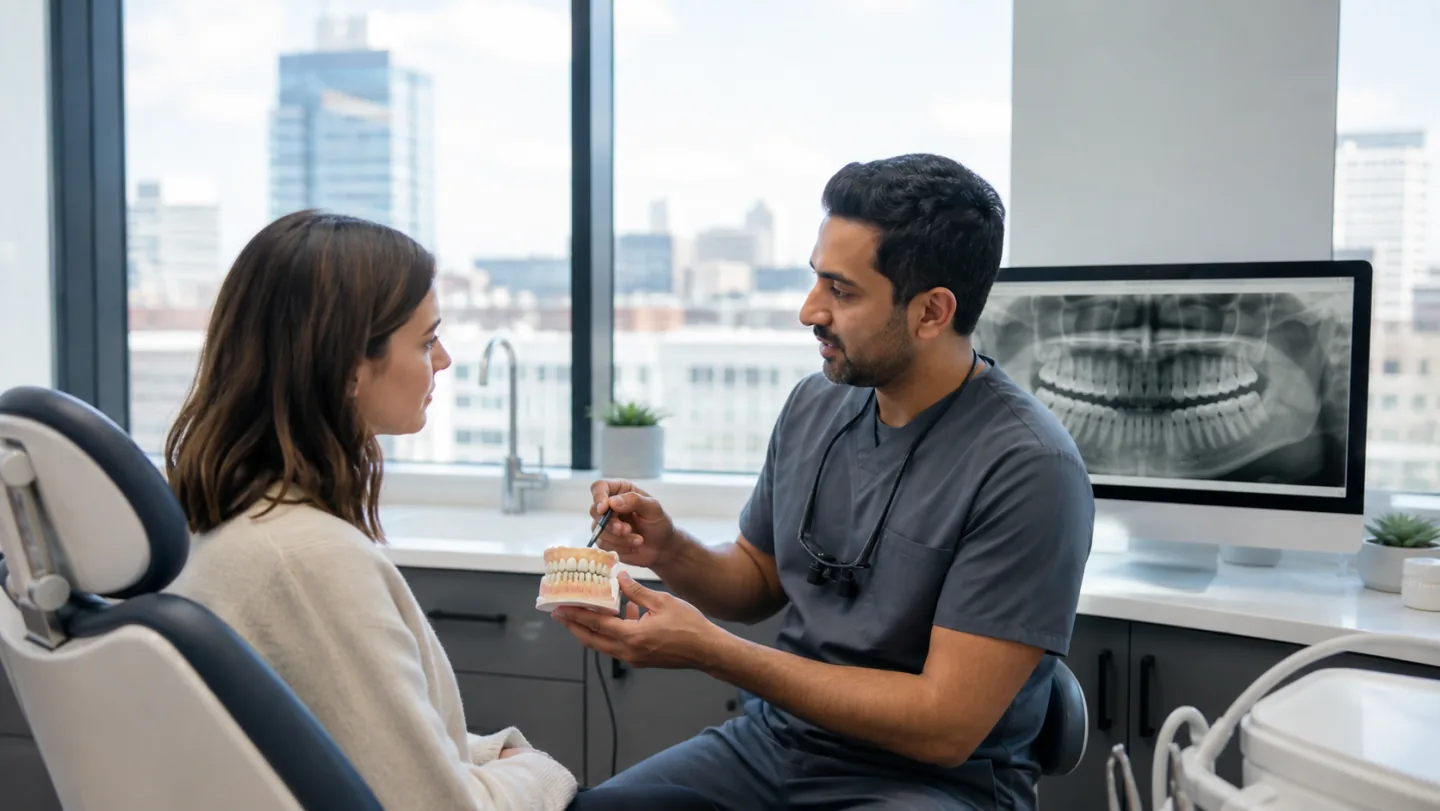
A dentist discussing an X-ray and tooth model before a possible extraction
Repaired again and again

Tooth Extractions for Meadows West Residents

When one tooth keeps bringing you back for repairs, it is natural to ask whether another fix is still worthwhile. Our McPhillips Street clinic can help you look at that question honestly.

Let's find a time

Request an appointment

We’ll call to confirm your appointment. For urgent care, please call us directly.

One more fix, or a different plan?

When Meadows West Patients Reach the Limit of Repairs

Every repair relies on the tooth underneath it. As fillings get bigger and fresh damage appears, less of the original structure may be left to anchor the next restoration, which is why a tooth with a long repair history deserves a careful look before more work is added to it.

A history of repairs is no verdict in itself, and many patched teeth can go on being restored. Removal enters the discussion when a further repair could not be counted on, and your dentist can show you on the X-ray and in your mouth what that judgment rests on.

Explore tooth extractions
Desk and chairs in a consultation room at Winnipeg North Dental
Consultation room with a seascape painting on the wall.

Looking past the latest break

The assessment covers what is left of the whole tooth, not merely the piece that failed most recently.

Your past treatment counts

Whatever you remember about earlier repairs helps explain how this tooth arrived at its present condition.

A comparison, not a sales pitch

Rebuilding and removing are set side by side, with what each would involve for you going forward.

The repair-or-remove question

What decides whether another repair makes sense.

Your dentist is asking whether a repair can be predictable for this particular tooth, which is a stricter question than whether it can be done at all.

Reasons to try restoring it

With enough support left, a tooth that has been repaired before may still be a good candidate for further care.

  • Sound tooth structure remains to hold a filling or crown.
  • Gum and bone around the tooth are in reasonable condition.
  • Any inflamed or infected pulp may respond to root canal therapy.
  • Your bite does not place heavy demands on the weak area.

Reasons removal may be raised

Each of these can make further repair hard to rely on. Your examination and X-ray show which, if any, apply to you.

  • Decay has left too little healthy tooth for a restoration.
  • A crack reaches under the gumline or somewhere unrepairable.
  • An infection cannot be predictably treated or retreated.
  • Supporting bone and attachment have been badly reduced.

Costs, future maintenance and your own goals are fair topics here as well, so bring them up when you compare the options.

Sorting it out

From a worn-out tooth to a settled decision.

This is how the process usually moves if you and your dentist conclude the tooth should be removed. The first two stages apply whichever way that decision goes.

Request your visit
  1. 01

    Reviewing the repair history

    Tell us what has been done to the tooth and how often it has needed attention. Your health history, medications and allergies are confirmed at this point as well.

  2. 02

    Weighing up the findings

    X-ray and examination results are explained, and you can ask what each realistic option would mean for chewing, appearance and later treatment.

  3. 03

    Numbing, then removal

    Local anesthetic comes first, with comfort checked before work starts. Heavily restored teeth vary, and some may need sectioning or a small incision to come out.

  4. 04

    Closing and going home

    Bleeding is controlled, the site is cleaned, and gauze or sutures are placed as needed. Your written instructions describe home care and which symptoms should prompt a call.

Put the story together

A tooth’s back story can shape the advice.

You do not need precise dates or old paperwork. A rough outline of what happened to this tooth gives your dentist useful context alongside the X-ray.

If the earlier repairs were done elsewhere, you could ask whether those records or images can be requested from the other clinic.

Pull together what you can

  • How many times you recall this tooth being repaired, and with what.
  • What failed most recently, such as a filling or a chipped edge.
  • Your medications, allergies and any recent health changes.
  • What you most want from the tooth or the space it might leave.
Reception desk with plants at Winnipeg North Dental
Dental chair and instrument arm in a Winnipeg North Dental treatment room

Front counter with a glass divider, and a blue dental chair beside a sink.

Repair fatigue is real

It is reasonable to be weary of this tooth.

Repeated appointments for a single tooth can be frustrating, and letting go of it can feel like defeat or like relief. Either reaction is fine to mention, and neither one obliges you to make a choice on the spot.

Say how you really feel about it

Being fed up with a tooth is useful for your dentist to hear, since your goals are part of the decision.

Find out what each path asks of you

Ask how many appointments and what kind of upkeep each option might involve, so you can compare them fairly.

Tell us about past visits

If an earlier repair was uncomfortable, mention it beforehand. That gives you both a chance to talk about what would help.

No more repairs on that tooth

A different kind of upkeep begins.

Once the tooth is gone, your attention turns to letting the area heal, then to deciding what, if anything, should fill the space. Early care follows your written instructions, because recovery depends on the procedure and on your health.

01

Protecting the socket

Steer clear of straws, smoking, vaping and forceful spitting for the time you are given. Brush and clean as usual, though not directly on the healing spot at first.

02

If things are not improving

Contact us if bleeding will not settle under directed pressure, if swelling keeps increasing, or if you notice fever, drainage or numbness you did not expect.

03

Options for the gap

An implant-supported restoration avoids relying on the teeth beside it. A bridge spans the space, and a removable partial denture can replace one or several teeth.

Should swallowing or breathing become difficult, seek emergency medical care.

Talk with our team
Exterior of the Winnipeg North Dental clinic on McPhillips Street

Winnipeg North Dental

Unit-5 2358 Mcphillips Street, Winnipeg, MB R2V 4J6
Get directions (opens in a new tab)
Bring the tooth in

McPhillips Street Assessments for Meadows West

For people living in Meadows West, an area of Winnipeg, the assessment and any extraction take place at Winnipeg North Dental, Unit 5, 2358 McPhillips Street, Winnipeg, MB R2V 4J6.

The online form sends us your request without holding a time. We confirm by reaching out to you, and (204) 338-3003 is there if you would like to phone.

Questions about coverage?

Talk with our team before your visit or learn about CDCP.

A little clarity before your visit

Your questions, answered.

Helpful details about tooth extractions in Meadows West.

Ask our team
How many repairs is too many for one tooth?

There is no fixed number. What counts is how much sound structure and support the tooth has left, along with whether another restoration can be expected to hold up.

Would a crown be stronger than yet another filling?

It may be an option if enough of the tooth remains to support one. An examination is needed to tell whether that applies, and your dentist can explain how the two compare for your tooth.

My filling fell out again. Is it an emergency?

Phone the clinic and describe what happened, including any pain or swelling, so you can be advised on what to do next. Please call instead of using the form for anything that feels urgent.

Is removing a heavily filled tooth more complicated?

It can be, depending on how much of the tooth is left, the shape of the roots and the bone around them. Your dentist reviews these on the X-ray, and some teeth are sectioned or need a small incision.

How do I compare long-term upkeep between keeping and removing it?

Ask to go through each option’s expected maintenance. A retained tooth could still need attention, and any replacement has its own care, so a treatment-planning discussion is the right place to compare them.

Can you tell me the cost of each option?

Costs depend on the findings and the treatment selected, so they cannot be set out on a web page. After an assessment, you can ask for estimates that let you compare the choices.

Where would someone from Meadows West go to discuss this tooth?

Your appointment would be at our clinic on McPhillips Street in Winnipeg. Phone (204) 338-3003 or submit the form here, and let us know the tooth has a history of repairs.

Stop guessing about it

Find out whether this tooth has another repair left.

Request an assessment at our McPhillips Street clinic in Winnipeg, and we will reply to arrange the details.

Patient testimonials

Kind words from our patients

★★★★★ 5.0 from 440+ reviews on Google

Close to home

Areas we serve

Convenient dental care on McPhillips Street for families across northwest Winnipeg and nearby communities.

Explore all service areas

A healthier smile is one visit away

Ready for dental care that feels genuinely comfortable?

✓ New patients welcome ✓ Direct insurance billing ✓ Multilingual team

How can we help?

Our dental team is here for you.

Ready to book or have a question? Choose the option that works best for you.

For urgent dental concerns, please call us directly.

Send us a message

Our team will reply during clinic hours.



