Skip to content
Winnipeg North Dental
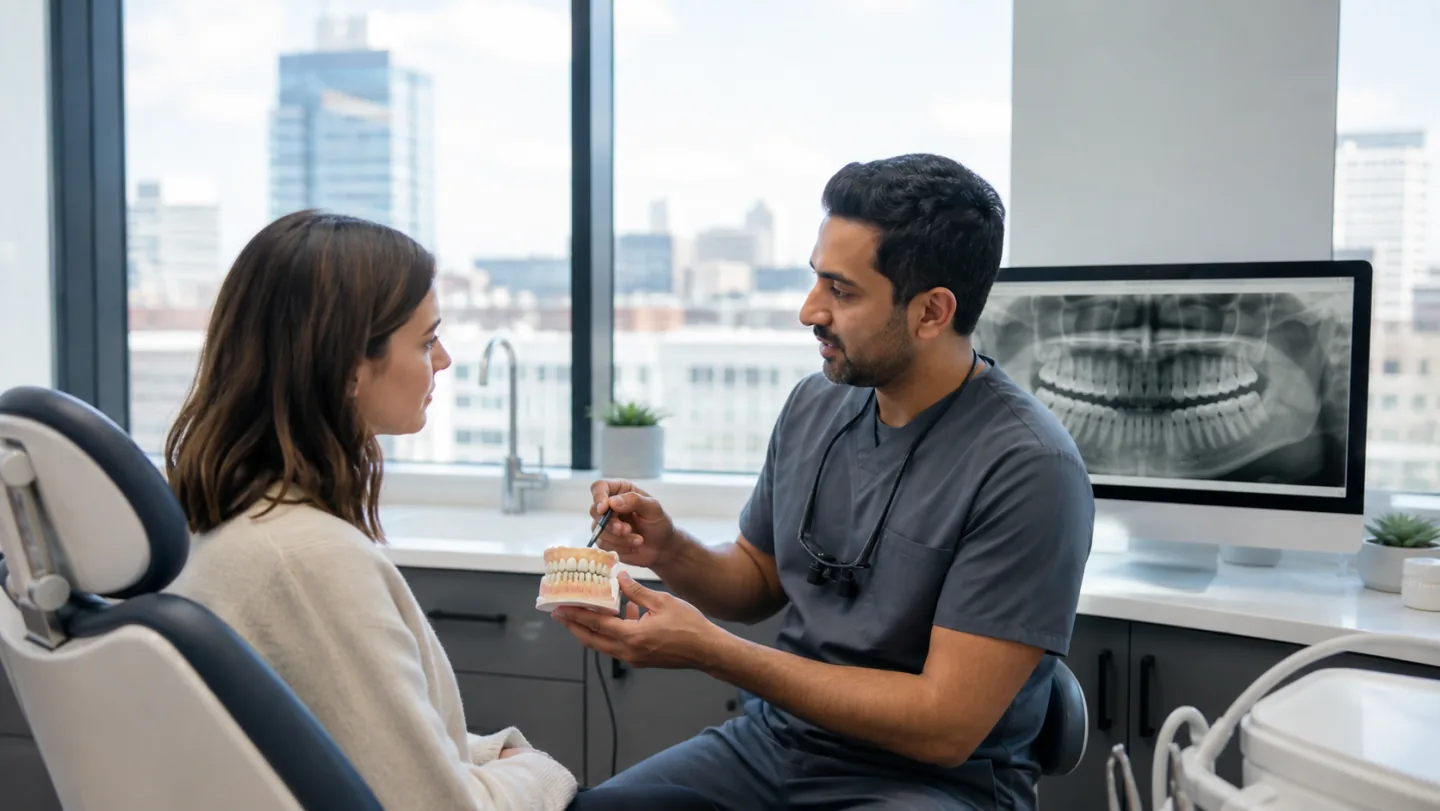
A dentist discussing an X-ray and tooth model before a possible extraction
Thinking of the teeth beside it

Tooth Extractions for Castlebury Meadows Residents

Sometimes the reason for removing a tooth has as much to do with what surrounds it as with the tooth itself. Find out how that assessment is made.

Let's find a time

Request an appointment

We’ll call to confirm your appointment. For urgent care, please call us directly.

Beyond the single tooth

Looking at the Whole Area Around a Problem Tooth

You may have a tooth that barely troubles you, yet it has come up as a possible concern for the healthy teeth and tissue around it. That can be a confusing thing to hear. Why lose something that is not causing you much pain? And what exactly is at stake if it stays?

If you live in Castlebury Meadows, your assessment would take place at Winnipeg North Dental, on McPhillips Street in Winnipeg. Protecting surrounding teeth and supporting tissues is one possible reason to recommend removal, and your dentist will explain whether it applies. Restoring, treating or monitoring the tooth remain on the table where they are suitable.

Explore tooth extractions
Reclining patient chair with instrument arm and sink at Winnipeg North Dental
Reclining patient chair beside the instrument arm and sink.

A wider view

Gum, bone and adjacent teeth are all considered alongside the tooth in question.

Risks spelled out

You can ask what specifically concerns your dentist, and how likely it is to become a problem.

Your goals included

Your long-term plans for your mouth are one of the factors that feed into the recommendation.

Keeping things in balance

What gets considered when other teeth are involved.

Some concerns are about a tooth on its own, and others involve the area around it. Your examination and X-ray help separate one kind from the other.

Concerns in the surrounding area

These are the kinds of findings that can bring neighbouring teeth and tissue into the discussion.

  • An ongoing infection that cannot be predictably treated or retreated.
  • Advanced gum disease with loss of supporting bone and attachment.
  • A crowded or poorly positioned tooth that creates a problem.

Questions that clarify things

You should come away knowing exactly what the worry is, rather than a vague sense that something might happen.

  • Which teeth or tissues do you think are at risk, and why?
  • Can you show me on the X-ray what you are seeing?
  • Would treatment, or monitoring, address the same concern?

Monitoring can be reasonable when a finding is stable and the risk is acceptable. Ask what would prompt a change of plan.

If the tooth does come out

Treatment that takes care of what is around it.

Your dentist works according to the position of the tooth, the shape of its roots, the bone that holds it and how much is visible. A typical appointment goes as follows.

Request your visit
  1. 01

    Rechecking the picture

    We pull together your X-ray, health background, allergies and medications, and confirm the planned tooth.

  2. 02

    Numbing the whole area

    Anesthetic takes effect locally, and comfort is confirmed before your dentist goes further.

  3. 03

    Careful removal

    Your tooth is loosened and lifted away. An incision or sectioning is occasionally the more predictable way to do this.

  4. 04

    Protecting the site

    The socket is cleaned, bleeding is managed, and you are given gauze or sutures if appropriate, plus directions on which symptoms need a call.

Ahead of your appointment

A good time to note every change in your mouth.

You know your own mouth better than anyone. Tenderness in the gum, food getting trapped or a shifting tooth may all be relevant, even if they seem minor or unrelated to the tooth in question.

Ask the clinic for an estimate, particularly if more than one area may need attention. Have your insurance or CDCP information on hand, as your costs vary with your plan and with the services you receive.

Things to note or gather

  • Any spots that bleed, feel tender or trap food.
  • A summary of past dental work in the same part of your mouth.
  • Your medication and allergy details, kept current.
  • Whatever you would most like to protect over the long term.
Consultation table with a keyboard near bright window blinds at Winnipeg North Dental
Blue upholstered bench against a white wall at Winnipeg North Dental

A consultation room and a bench in the waiting area.

When it does not even hurt

Feeling unsure about removal is understandable.

It can seem strange to treat something that causes little pain. Doubts like that are welcome, and the discussion can begin with why your dentist is concerned, not with booking a procedure.

Voice your doubts

If you are not convinced, it is reasonable to say that and to ask for the reasoning again.

Go at your own speed

Ask what timing means in your case, and whether there is room to think things over first.

Tell us during treatment

Should you go ahead, expect pressure rather than sharp pain, and flag any discomfort immediately.

Caring for what remains

Your other teeth stay part of the plan.

After the extraction, attention turns to healing the socket and then to keeping the rest of your mouth healthy. Gums recover over days to weeks, with bone changes taking longer.

01

Clean around, not into

Your other teeth still need regular care, so keep brushing and go carefully around the socket in the early period.

02

Keep the protective clot

For as long as you were advised, smoking, vaping, straws and strong spitting should be avoided.

03

Look at the space

The space, your bite and your remaining teeth all help determine whether a replacement is worthwhile, so ask about timing.

Give the clinic a call if bleeding will not stop with the pressure you were shown, pain grows notably worse some days later, or you notice mounting swelling, fever, drainage, a bad taste or numbness you were not told to expect. Breathing or swallowing difficulty needs emergency medical care.

Talk with our team
Street view of the Winnipeg North Dental entrance and sign

Winnipeg North Dental

Unit-5 2358 Mcphillips Street, Winnipeg, MB R2V 4J6
Get directions (opens in a new tab)
Finding the clinic

Your Assessment on McPhillips Street

Castlebury Meadows is in Winnipeg, and those who live there receive care at Winnipeg North Dental, Unit 5, 2358 McPhillips Street. Check the directions link for help mapping your way.

We need to confirm a time with you after your request comes through, as it is not an instant booking. If a problem feels urgent, please call and do not rely on the form.

Questions about coverage?

Talk with our team before your visit or learn about CDCP.

A little clarity before your visit

Your questions, answered.

Helpful details about tooth extractions in Castlebury Meadows.

Ask our team
How can one tooth affect the teeth next to it?

It depends on the problem. Ongoing infection, lost bone support or a badly positioned tooth can each raise concerns for the surrounding area, and your dentist can explain what applies to you.

What if the neighbouring teeth seem perfectly healthy now?

That is a good thing, and it is worth asking how your dentist expects the situation to develop. A clear explanation of the likely risk can help you weigh up removal against other options.

Will the teeth beside the gap move?

Ask your dentist to assess this for you, as the answer depends on your bite, position and remaining teeth. It is one of the considerations in deciding whether to replace the tooth.

Can treating my gums avoid the need for removal?

In some cases gum treatment may help a tooth, but severe loss of bone and attachment can limit what is predictable. Your dentist will look at the support around the tooth before advising you.

Could a bridge put stress on the teeth I am trying to protect?

A bridge uses support from neighbouring teeth or implants, whereas an implant does not rely on adjacent teeth. Ask how these options compare, given the condition of the teeth in your case.

I live in Castlebury Meadows. Who do I talk to about this tooth?

Our clinic on McPhillips Street can arrange an assessment for you. Call (204) 338-3003 or complete the request form, and note that you have questions about the surrounding teeth.

See the whole picture

Find out what this tooth means for the others.

Living in Castlebury Meadows, you can ask our Winnipeg clinic to take a look at this tooth and the ones around it. We will get back to you to set up a time.

Patient testimonials

Kind words from our patients

★★★★★ 5.0 from 440+ reviews on Google

Close to home

Areas we serve

Convenient dental care on McPhillips Street for families across northwest Winnipeg and nearby communities.

Explore all service areas

A healthier smile is one visit away

Ready for dental care that feels genuinely comfortable?

✓ New patients welcome ✓ Direct insurance billing ✓ Multilingual team

How can we help?

Our dental team is here for you.

Ready to book or have a question? Choose the option that works best for you.

For urgent dental concerns, please call us directly.

Send us a message

Our team will reply during clinic hours.



