Skip to content
Winnipeg North Dental
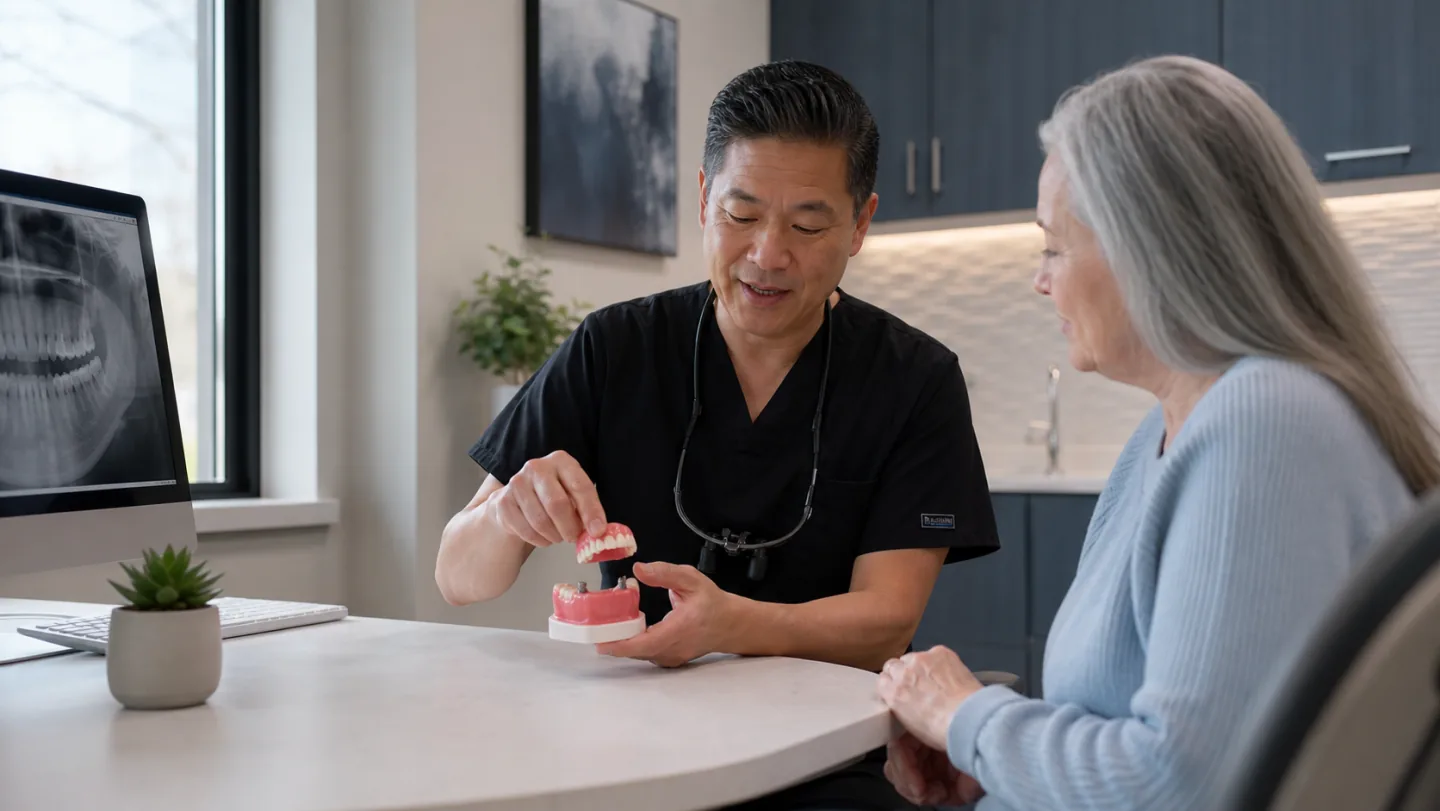
A dentist demonstrating how a snap-in denture connects to implant attachments
When your own muscles work against it

Snap-in Dentures for Waverley West Residents

A conventional denture partly depends on the muscles of your tongue, lips and cheeks, and sometimes those same muscles unsettle it. Waverley West residents can ask about implant attachments at our McPhillips Street clinic in Winnipeg.

Let's find a time

Request an appointment

We’ll call to confirm your appointment. For urgent care, please call us directly.

Muscle, fit and grip

Why a Lower Denture Can Feel Pushed Around

Wearing a conventional denture involves a quiet balancing act. The tongue, cheeks and lips help hold it in place, but each also moves constantly while you speak, chew and swallow. When fit or anatomy leaves less margin, that motion can be enough to lift or slide the denture, and the lower one is often affected most.

A snap-in denture adds a mechanical connection. Attachments on implants in the jaw give the denture extra resistance to lifting and sliding, so it relies less on muscle control alone. It remains removable and still takes some support from your gums, and an assessment decides whether it is an option for you.

Explore snap-in dentures
Consultation room at Winnipeg North Dental with black office chairs, a white desk and a snake plant in a dark pot
A snake plant in a dark pot next to a window with a striped blind.

Less reliance on muscle control

Attachments supply grip that a tissue-borne denture must find elsewhere.

Often the lower arch

Movement tends to be more noticeable in the lower denture.

Still removable

You take a snap-in denture out every day to clean it and your gums.

Where the hold comes from

Muscle and fit versus attachments.

Comparing the two kinds of denture shows why the extra connection can help, and also what it does not change.

A conventional denture

Its retention is shared among your anatomy, the fit of the base, saliva and muscle control.

  • Talking can shift it as the tongue moves.
  • Chewing may tip it on one side.
  • Learned muscle habits help keep it steady.
  • Lower dentures commonly move more.

A snap-in denture

It clips to attachments on healed implants, gaining resistance to the forces that lift or slide it.

  • Retention parts sit inside the denture base.
  • Some support still comes from the gums.
  • Chewing still depends on bite and adaptation.
  • Implants require surgery and healing first.

Implant attachments can reduce movement, but how much varies with your support, bite and denture design.

If treatment suits you

The route to a connected denture.

Implant numbers, timing and whether your present denture can be reused all differ from plan to plan.

Request your visit
  1. 01

    Look closely at the movement

    The dentist examines how your denture behaves, along with your bone, gums, bite, medical history, smoking and how easily you manage small objects.

  2. 02

    Decide on positions

    Three-dimensional imaging and the planned tooth arrangement guide where implants would go and which attachments would be used.

  3. 03

    Implants heal into place

    After surgery, the implants are given the integration time your plan requires before anything connects to them.

  4. 04

    Connect and fine-tune

    Bite and tooth records relate the denture to the implants. At connection the grip is set, sore areas are checked and you are taught how to release it.

Observe before you come

Notice what sets it moving.

Paying attention to which movements unsettle your denture can help the examination focus on the right things.

If the denture is causing sores or pain, call the clinic now instead of waiting until your assessment.

Pay attention to

  • Particular words or sounds that loosen it.
  • Whether it lifts more when you open wide.
  • Which side of your mouth you chew on.
  • Health conditions and medications to report.
Winnipeg North Dental waiting area with white chairs, a small child’s chair and plants on two side tables
Winnipeg North Dental reception with a white counter and a blue bench under an abstract print

Two white chairs, a child’s chair and small tables with plants.

It is not your fault

A moving denture is not a failure of effort.

Many people assume they simply have not learned to control their denture well enough. Muscle movement is natural, and asking about more stable options is entirely reasonable.

Describe it your way

Explain what the denture does in your own words, such as rocking, lifting or slipping forward.

Show the dentist

If it helps, demonstrate the movement or sound that tends to loosen it.

Ask what to expect

Ask how much steadier a snap-in denture might feel given your particular anatomy.

Living with the snap

Your part once it is in.

A more secure denture still needs daily attention, and the way you handle it affects how long the attachments perform well.

01

Release it as taught

Take the denture out using the technique you were shown, without pulling hard or twisting at the attachments.

02

Keep the parts clean

Clean the denture, housings, implants and gums every day with the recommended tools.

03

Report new movement

If it starts to shift again, the snap feels weaker or food collects, contact the clinic.

Retention inserts wear over time and may be replaced during regular examinations.

Talk with our team
Front of Winnipeg North Dental with grey and white siding and the clinic name in silver letters

Winnipeg North Dental

Unit-5 2358 Mcphillips Street, Winnipeg, MB R2V 4J6
Get directions (opens in a new tab)
Getting it assessed

Waverley West Residents Are Seen on McPhillips Street

Waverley West is in Winnipeg. Residents who come to us are assessed and treated at Winnipeg North Dental, Unit 5, 2358 McPhillips Street, Winnipeg.

A form request does not lock in an appointment. Expect the clinic to contact you to confirm a time.

Questions about coverage?

Talk with our team before your visit or learn about CDCP.

A little clarity before your visit

Your questions, answered.

Helpful details about snap-in dentures in Waverley West.

Ask our team
Why does my denture lift when I speak?

Your tongue and cheeks move a great deal while talking. With a conventional denture, which relies partly on muscle control, that motion can sometimes dislodge it, particularly in the lower arch.

Can attachments stop my tongue from pushing the denture?

They can add resistance to lifting and sliding, which may reduce movement. They do not stop your muscles moving, and results depend on your support, bite and denture.

Will I still need to learn to control a snap-in denture?

Some adaptation is still involved, since the denture takes part of its support from your gums and chewing depends on bite and adjustment. Ask what the adjustment period might involve for you.

Could a better fit solve the movement instead?

It might, depending on the cause. An examination can show whether fit, bite or anatomy is the main issue, and whether a conventional option could address it.

Are upper dentures affected by muscle movement too?

They can be, though movement with a conventional denture is often more noticeable in the lower arch. Each arch is assessed on its own.

How do Waverley West residents ask about a denture that will not stay down?

Send a request with the form or call (204) 338-3003, and describe when the denture moves. Assessments are held at 2358 McPhillips Street in Winnipeg after the clinic confirms a time.

Tired of it shifting?

Ask whether attachments could steady your denture.

Waverley West residents can request an assessment with this form, and the clinic will reply to arrange it.

Patient testimonials

Kind words from our patients

★★★★★ 5.0 from 440+ reviews on Google

Close to home

Areas we serve

Convenient dental care on McPhillips Street for families across northwest Winnipeg and nearby communities.

Explore all service areas

A healthier smile is one visit away

Ready for dental care that feels genuinely comfortable?

✓ New patients welcome ✓ Direct insurance billing ✓ Multilingual team

How can we help?

Our dental team is here for you.

Ready to book or have a question? Choose the option that works best for you.

For urgent dental concerns, please call us directly.

Send us a message

Our team will reply during clinic hours.



