Skip to content
Winnipeg North Dental
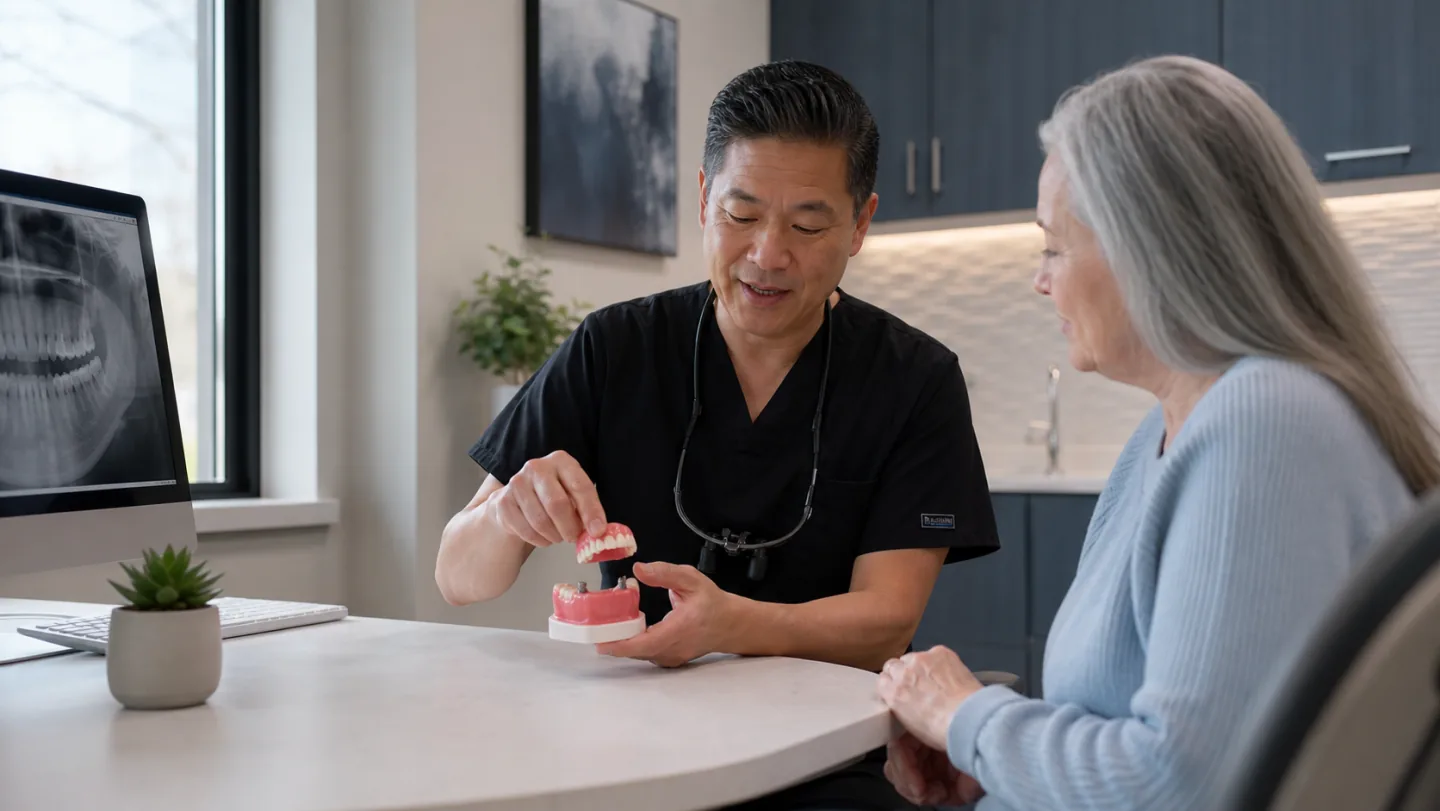
A dentist demonstrating how a snap-in denture connects to implant attachments
Keeping a week of notes

Snap-in Dentures for St. Boniface Residents

A loose denture is easy to feel and surprisingly hard to explain in an exam chair. If you live in St. Boniface, a few days of simple notes can make your conversation at our McPhillips Street clinic in Winnipeg far more useful.

Let's find a time

Request an appointment

We’ll call to confirm your appointment. For urgent care, please call us directly.

Turning a feeling into detail

Writing Down When and How Your Denture Moves

Many people arrive at a denture appointment knowing only that something is wrong. The denture lifts, or rocks, or lets food slip beneath it, but the moments blur together. Once you are sitting down with the dentist, the specifics can be hard to recall.

Jotting down what happens over a normal week gives the assessment something concrete to work from. It can point to whether movement is linked to particular foods, to speaking, or to the end of a long day. Those details sit alongside the examination of your bone, gums, bite and current denture when a snap-in option is being considered.

Explore snap-in dentures
Consultation room at Winnipeg North Dental with a white desk, black office chairs and a tall window with a banded shade
A white desk with black chairs and a keyboard, beside a window with a striped shade.

Notice the pattern

Mark down which meals, words or times of day seem to set the denture moving.

Bring it along

A page of notes can steer the discussion toward the problems that bother you most.

Let the exam fill gaps

Your notes describe the symptoms, and the assessment looks for the reasons behind them.

What your notes may reveal

Two kinds of hold, and where yours falls short.

A conventional denture and an implant-retained one stay in place by different means. Knowing the difference helps you decide what to watch for in your notes.

Resting on the tissues

A standard denture is held by the shape of your mouth, how well it fits, your saliva and the muscles around it.

  • The bottom plate is often the restless one.
  • Speech and meals each put that grip to the test.
  • A slow loosening can creep up without much notice.
  • Reaching for paste or powder hints at how secure it feels.

Connecting to implants

A snap-in denture clips onto attachments on implants in the jaw, which adds resistance to lifting and sliding.

  • You lift it out yourself for a daily wash.
  • Your gum ridges keep carrying a share of the load.
  • The clips inside the base are swappable when worn.
  • An examination decides if it fits your situation.

A note that your denture slips does not decide anything by itself. It is one piece of the information considered during examination.

From notes to a plan

How the conversation can unfold.

Treatment varies in the number of implants, the timing involved and whether your present denture can be adapted. These are the broad phases.

Request your visit
  1. 01

    Talk through your week

    Share what you recorded, then let the dentist examine your bone, gums, bite, current denture and medical history, including any smoking and how easily you handle small objects.

  2. 02

    Map out implant positions

    Three-dimensional imaging and the goals for your new denture guide where implants could go and which attachments would suit them.

  3. 03

    Allow time for integration

    If you proceed, the implants are placed and then left to bond with the bone for as long as your clinical plan specifies.

  4. 04

    Fit, adjust and practise

    Records of your bite and tooth positions relate the denture to the healed implants. Once it connects, the grip is tuned, sore spots are checked and you learn to take it out.

Your notebook

A few days of honest notes go a long way.

You do not need medical vocabulary. Short, plain entries such as lifted at lunch or clicked while talking are enough to start a useful discussion.

If something is painful or urgent while you are keeping notes, phone the clinic instead of waiting to write it up or using the online form.

Things worth recording

  • Foods you avoid now, and any you have stopped eating.
  • Moments the denture shifted while you were speaking.
  • How much adhesive you use, and how often.
  • A list of current prescriptions, any diagnoses and whether you smoke.
Winnipeg North Dental waiting area with white chairs by a shaded window and a blue bench beneath two abstract paintings
Reception desk at Winnipeg North Dental with a potted plant beside it and a blue bench along the wall

White chairs, a blue bench and two framed abstract prints in a bright room.

No wrong answers

Your observations count, even the small ones.

Some people feel their complaints sound trivial once they say them aloud. A detail such as avoiding certain foods at dinner with others can matter as much as anything seen in the exam.

Read straight from the page

There is no need to memorize anything, so feel free to refer to your notes as you talk.

Ask about each item

Go through your list and ask what could explain each problem you recorded.

Add to it later

New questions often surface after an appointment, and you can raise them next time.

If you go ahead

Keep noticing after the denture is in.

The same habit of paying attention helps once a snap-in denture is part of your day. Small changes caught early are usually simpler to deal with.

01

A daily cleaning routine

The denture, the housings inside it, the implants and the surrounding gums all need cleaning each day with the tools you are shown.

02

Signs to report

Food packing under the denture, more movement, a softer click or trouble getting it out are worth a call to the clinic.

03

Regular examinations

Checkups look over the denture, attachments, implants, gums and bite, and worn retention inserts may need replacing.

Ask whether the denture should stay out overnight, since that guidance depends on your appliance and gums.

Talk with our team
Front of the Winnipeg North Dental clinic with its sign and phone number above a glass entrance door

Winnipeg North Dental

Unit-5 2358 Mcphillips Street, Winnipeg, MB R2V 4J6
Get directions (opens in a new tab)
Bringing your notes in

Care for St. Boniface Residents on McPhillips Street

St. Boniface is in Winnipeg, and residents who choose our clinic are seen at Winnipeg North Dental, Unit 5, 2358 McPhillips Street, Winnipeg, MB R2V 4J6.

Sending the form starts a request, not a booking. The clinic will contact you with a time to confirm.

Questions about coverage?

Talk with our team before your visit or learn about CDCP.

A little clarity before your visit

Your questions, answered.

Helpful details about snap-in dentures in St. Boniface.

Ask our team
Is it worth writing down when my denture moves?

It can be. Specific notes about meals, speech and timing help the dentist connect what you experience with what the examination shows, rather than relying on memory alone.

What if my notes do not show a clear pattern?

That is still useful information. Random movement, constant looseness or problems only with certain foods can each point the assessment in a different direction.

Could my notes show that I do not need implants?

Possibly. Some problems may relate to fit or bite and could be handled another way. The examination is where that becomes clearer, and a conventional denture remains a reasonable choice for many people.

Will a snap-in denture let me eat the foods on my avoid list?

Greater stability can help, but chewing still depends on the denture itself, its support, your bite and how well you adapt. You would ease back into foods following the guidance you receive.

Does the number of implants depend on what I write down?

Not directly. The count is decided by your arch, bone, anatomy, the denture design and your goals, which is why imaging and planning are needed.

How can someone from St. Boniface bring their notes to an appointment?

Request a visit with the form here or by calling (204) 338-3003, then bring your notes along. Appointments are held at 2358 McPhillips Street in Winnipeg once the clinic confirms a time.

Notes ready?

Bring your observations to a denture assessment.

Use this form to ask for an appointment from St. Boniface, and the clinic will be in touch about a suitable time.

Patient testimonials

Kind words from our patients

★★★★★ 5.0 from 440+ reviews on Google

Close to home

Areas we serve

Convenient dental care on McPhillips Street for families across northwest Winnipeg and nearby communities.

Explore all service areas

A healthier smile is one visit away

Ready for dental care that feels genuinely comfortable?

✓ New patients welcome ✓ Direct insurance billing ✓ Multilingual team

How can we help?

Our dental team is here for you.

Ready to book or have a question? Choose the option that works best for you.

For urgent dental concerns, please call us directly.

Send us a message

Our team will reply during clinic hours.



