Skip to content
Winnipeg North Dental
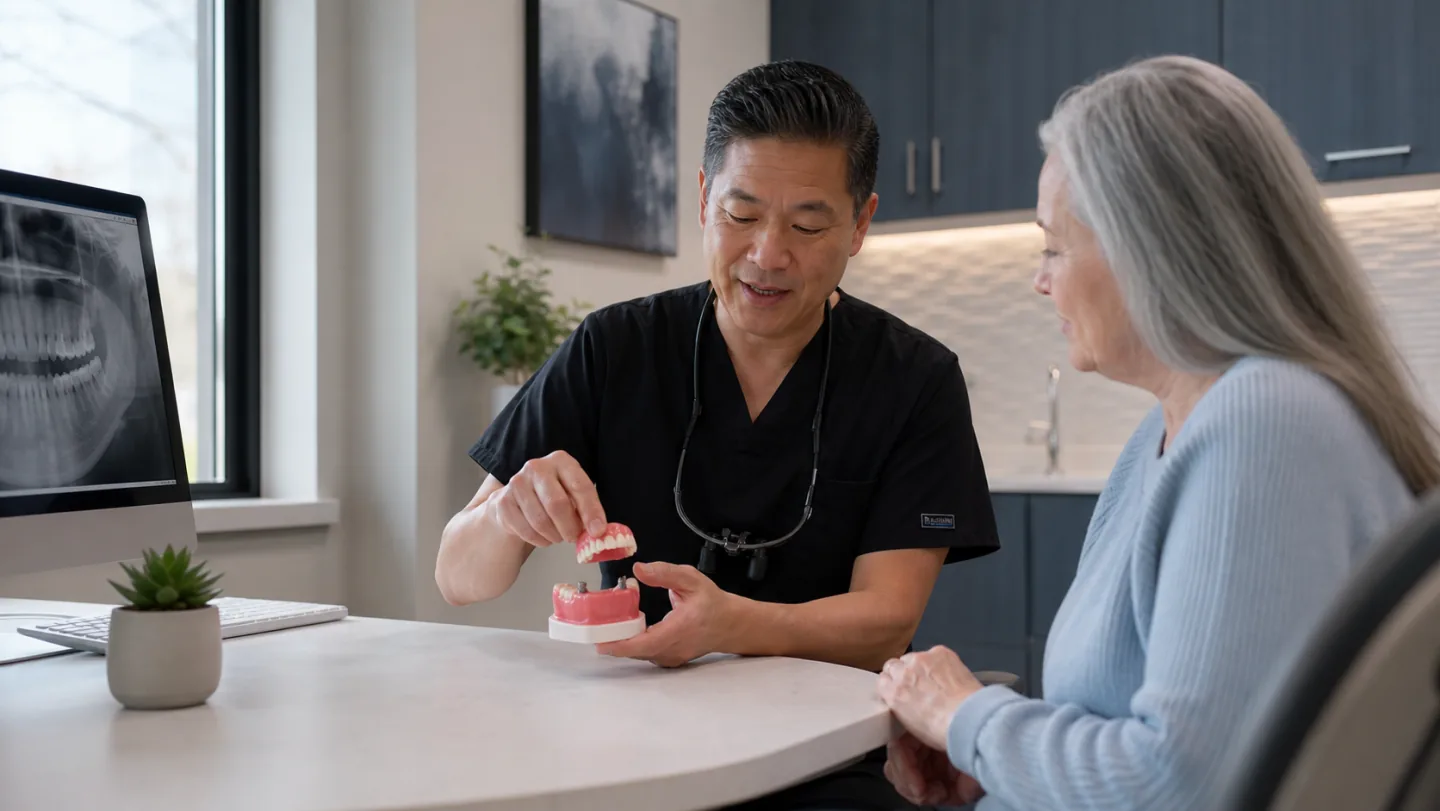
A dentist demonstrating how a snap-in denture connects to implant attachments
When meals have become a negotiation

Snap-in Dentures for Sinclair Park Residents

If you choose food by what your denture will tolerate, it is worth asking whether implant attachments could help. Sinclair Park residents can talk this through with us at our McPhillips Street clinic.

Let's find a time

Request an appointment

We’ll call to confirm your appointment. For urgent care, please call us directly.

Food comes first here

Why Chewing Can Be Hard With a Regular Denture

A conventional denture rests on your oral tissues, and the grip it has comes from anatomy, fit, saliva and muscle control. Biting into something firm can tip or lift it, which often explains why favourite foods slowly disappear from the plate.

With a snap-in denture, attachments on dental implants add resistance to that lifting and sliding. Stability can improve as a result. Your chewing ability will still rest on the denture itself, its support, your bite and how well you adapt, so we would rather talk about those honestly than promise a menu.

Explore snap-in dentures
White desk and black leather chairs in a Winnipeg North Dental consultation room
A white desk with black chairs and a landscape painting behind it.

Less tipping mid-bite

Attachments are planned to resist the lift and slide that can interrupt a meal.

Food limits discussed openly

Tell us which foods you have given up, so the conversation starts from your real meals.

Out after you eat

It remains a removable appliance, and you take it out for cleaning every day.

What affects your chewing

Two sides of the same mouthful.

Some of what happens at the table comes down to the denture and some comes down to what lies beneath it. Your assessment looks at both.

What the attachments contribute

Implants placed in the jaw become anchor points after healing, and the denture connects to them through replaceable parts.

  • Added resistance against the denture lifting as you chew.
  • Less sliding than you may notice with tissue support alone.
  • A connection whose grip can be adjusted when the denture is fitted.
  • Some support that still comes from your gums and oral tissues.

What still shapes every meal

Attachments cannot change every factor, and these ones stay relevant long after the denture is connected.

  • How your upper and lower teeth meet when you close.
  • The design of the denture and the position of its teeth.
  • The health of your gums and the amount of bone available.
  • How you adapt, with food introduced according to our guidance.

Whether this is suitable for you depends on an assessment with the dentist, and some patients may be better served by another approach.

From first talk to first meal

How treatment moves toward the table.

Each stage has a purpose, and your own plan sets the timing and how many implants are involved.

Request your visit
  1. 01

    Describe how you eat now

    Your account of what is difficult sits alongside an examination of your bone, gums, bite and health history, plus any denture you already wear.

  2. 02

    Map the implant positions

    Three-dimensional imaging and your restorative goals guide where implants would go and which attachments would suit the design.

  3. 03

    Allow healing, then build

    After surgery, the implants are given time to integrate. Records of your bite and tooth position then guide a new denture, or changes to your current one where that is suitable.

  4. 04

    Connect, then refine the fit

    The grip is adjusted, areas of pressure are checked, and you learn to remove the denture properly before you begin eating with it as advised.

A useful bit of homework

Keep a short food diary before you come.

Noticing your own habits for a few days gives us something concrete to discuss. Jot down what you avoid, what you cut up small, and which foods make the denture shift.

Cost depends on your plan, so ask for an estimate once the recommended treatment is clear, and raise any insurance or CDCP questions at that point.

What to bring along

  • Your notes on foods that have become difficult.
  • Every denture you currently use, including an older spare.
  • Names of the medicines you take, and any conditions you manage.
  • Whether you smoke, since this forms part of the assessment.
Teal treatment chair and wood cabinets inside Winnipeg North Dental
Reception counter and blue bench at Winnipeg North Dental

A teal chair beside wood cabinets in a treatment room.

No embarrassment required

Plenty of people quietly change what they eat.

You do not need to justify soft food choices or eating alone. Telling us about them plainly helps us understand what you would like to change.

Name the foods you miss

A specific craving is often more helpful to us than a general complaint about fit.

Mention sore spots from chewing

Places that hurt after meals are worth pointing out during your examination.

Ask what is realistic

An honest answer about your own mouth will be more useful than any general claim.

Eating, month after month

Mealtime clues worth reporting.

How the denture behaves while you eat can reveal a change early. Contact the clinic if meals start to feel different from what you have become used to.

01

Crumbs finding their way under

Food trapping beneath the denture more than it used to deserves a call to the clinic.

02

A snap that loses its firmness

Retention inserts wear with use and may occasionally need replacing, at a rate that varies.

03

Examinations that keep watch

Regular visits include the denture, attachments, implants, gums and the way you bite.

Has a food suddenly become harder to manage? Let the clinic know.

Talk with our team
Winnipeg North Dental storefront with glass doors below a large white sign

Winnipeg North Dental

Unit-5 2358 Mcphillips Street, Winnipeg, MB R2V 4J6
Get directions (opens in a new tab)
Where the planning happens

From Sinclair Park to Our McPhillips Street Clinic

Sinclair Park is in Winnipeg, and residents who ask about snap-in dentures are seen at Winnipeg North Dental, Unit 5, 2358 McPhillips Street. A directions link is here for planning your trip.

Your online request does not hold a time, since the clinic confirms the appointment with you afterward. For anything urgent, please phone instead of using the form.

Questions about coverage?

Talk with our team before your visit or learn about CDCP.

A little clarity before your visit

Your questions, answered.

Helpful details about snap-in dentures in Sinclair Park.

Ask our team
How do I ask about chewing problems if I live in Sinclair Park?

Fill in the form on this page or phone (204) 338-3003 and mention that eating is your main concern. We would see you at 2358 McPhillips Street in Winnipeg after the clinic settles a time with you.

Will I get back all the foods I have given up?

That cannot be promised. Greater stability may make some foods easier, while your chewing capacity continues to depend on the denture, its support, your bite and your adaptation.

Should I go straight back to tough foods once it is connected?

Please follow the guidance you receive at that appointment rather than testing your limits straight away. Beginning as advised gives you time to adapt to the new appliance.

Why does my lower denture struggle more at meals?

Movement can be more noticeable in the lower arch with a conventional denture. The shape of your mouth, saliva, muscle control and fit all play a part, and an examination can look at yours.

Do I still need to take it out after eating?

Ask for specific advice on this when your routine is demonstrated. Daily removal and cleaning are part of the care, and any food that collects underneath is worth mentioning to us.

Tell us what you miss eating

Start with the meals that matter to you.

Sinclair Park residents can send a request today, and the clinic will reply to arrange a time on McPhillips Street.

Patient testimonials

Kind words from our patients

★★★★★ 5.0 from 440+ reviews on Google

Close to home

Areas we serve

Convenient dental care on McPhillips Street for families across northwest Winnipeg and nearby communities.

Explore all service areas

A healthier smile is one visit away

Ready for dental care that feels genuinely comfortable?

✓ New patients welcome ✓ Direct insurance billing ✓ Multilingual team

How can we help?

Our dental team is here for you.

Ready to book or have a question? Choose the option that works best for you.

For urgent dental concerns, please call us directly.

Send us a message

Our team will reply during clinic hours.



