Skip to content
Winnipeg North Dental
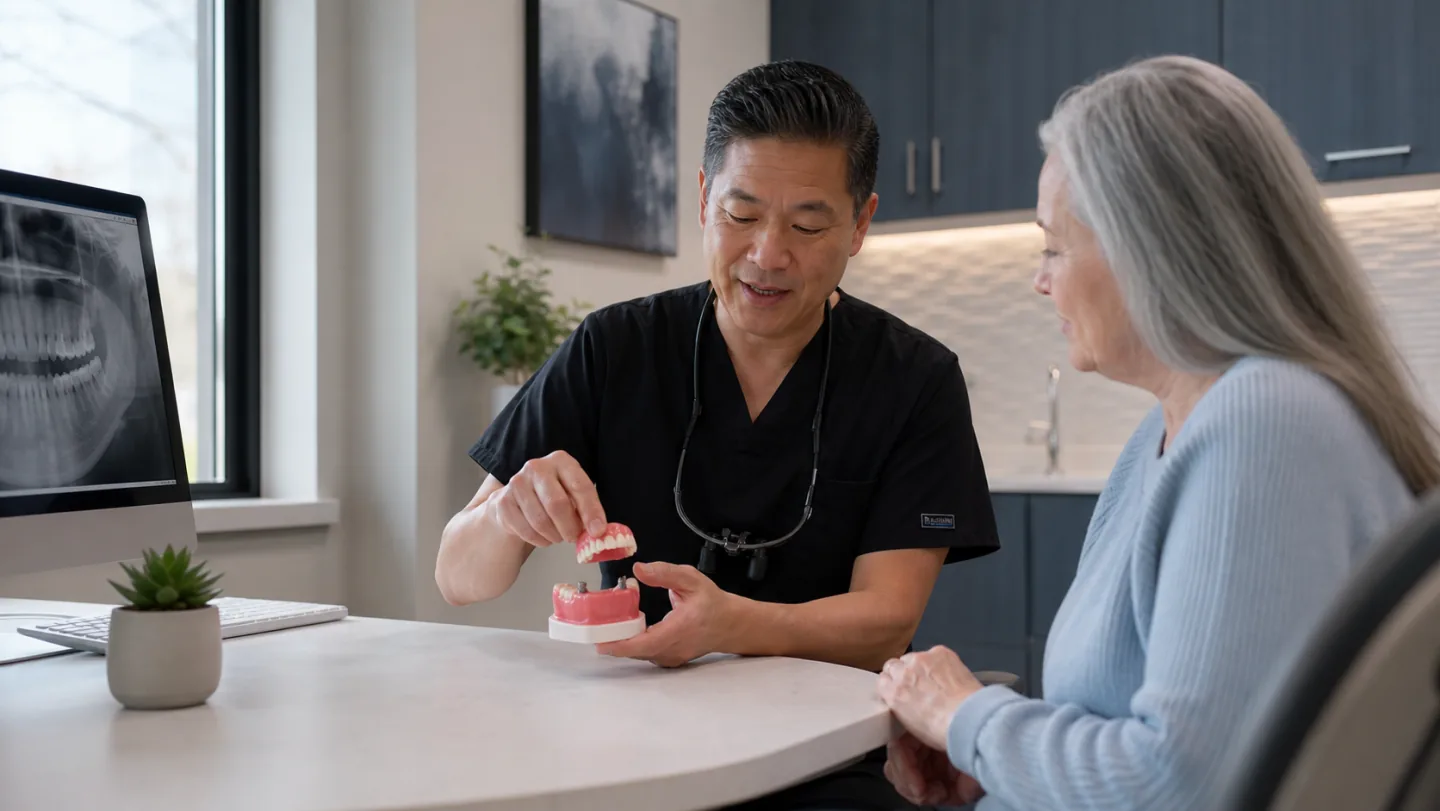
A dentist demonstrating how a snap-in denture connects to implant attachments
When the bite feels off

Snap-in Dentures for Meadows West Residents

Stability gets the headlines, but how your teeth meet also matters a great deal. Meadows West residents wondering how bite affects implant-retained dentures can ask at our McPhillips Street clinic.

Let's find a time

Request an appointment

We’ll call to confirm your appointment. For urgent care, please call us directly.

The overlooked factor

Why the Way Your Teeth Meet Deserves Attention

Bite comes up repeatedly in snap-in denture care. It is examined at the assessment, recorded before the denture is made or adapted, and looked at again during later examinations. Chewing capacity depends partly on it, and so does how a current denture might be judged for conversion.

Attachments add resistance to lifting and sliding, but they do not correct the way upper and lower teeth contact one another. That is why a denture that feels uneven when you close deserves a separate look, whichever kind of denture you end up with.

Explore snap-in dentures
Winnipeg North Dental treatment room with a monitor above wood-toned cabinets
An instrument arm extending over a light blue dental chair.

Assessed at the start

How you close is examined along with your bone, gums, health history and existing denture.

Recorded for the denture

Bite records help set tooth position in relation to the implants once they have healed.

Revisited over time

Later examinations include your bite as well as the implants, attachments and gums.

What bite touches

It reaches further than you might expect.

A few parts of snap-in treatment depend on how the teeth come together. Here is where it matters, and what you may notice if something is not quite right.

Where bite plays a role

These are the parts of the process that take your bite into account.

  • Deciding whether implant-retained treatment is appropriate at all.
  • Judging whether an existing denture could be adapted.
  • Setting tooth position for a new or adapted appliance.
  • How much chewing capacity you may have afterward.

Things you might notice

None of these has one single cause, so they are simply useful observations to pass along.

  • Teeth touching on one side before the other.
  • A denture that tips when you close firmly.
  • New sore spots appearing after chewing.
  • Difficulty finding a comfortable place to close.

These observations are not a diagnosis. An assessment with the dentist will establish what is going on, and whether snap-in treatment is a suitable answer.

Bite along the way

How contact is handled at each stage.

Implant number, timing and the choice to adapt or replace your denture all vary. This is where your bite enters the sequence, whichever way your plan goes.

Request your visit
  1. 01

    Examine how you close

    Alongside bone quantity, gum health and medical history, the dentist will look at how your teeth or dentures contact one another.

  2. 02

    Plan with the teeth in mind

    Imaging joins your restorative goals to guide where implants should go and how the attachments will be arranged.

  3. 03

    Heal, then record

    Your implants integrate following the clinical plan. Next, records capture the bite and tooth position relative to those healed implants.

  4. 04

    Refine at the fitting

    Retention adjustments and a check for pressure areas come at connection, and the removal technique is taught. Describe how it feels when you close.

Pay attention at home

Notice how your teeth meet this week.

You do not need any special knowledge. Spending a few days noticing when and where your denture feels uneven will give you something useful to describe.

If something about your bite is bothering you already, you are welcome to describe it when you contact the clinic.

Observations worth sharing

  • Which side seems to touch first when you close.
  • Foods that make the denture tip or lift.
  • Whether your opposite arch has natural teeth or a denture.
  • Your prescriptions and a summary of past medical problems.
Winnipeg North Dental consultation desk with a keyboard and three black chairs
Winnipeg North Dental waiting area with a striped window shade and potted plant

Three black office chairs around a white desk by a shaded window.

Describe it your way

No technical vocabulary required.

It feels high on the left is a perfectly useful way of putting it. Tell us what you experience in your own words, and the dentist can take it from there.

Point to where it hits

Showing the spot with a finger can be clearer than any description of it.

Report it after refinement

If an adjustment changes something for better or worse, we would like to know.

Ask why it matters

You are welcome to ask how your bite is influencing the recommendation you hear.

Contact and wear

Alignment plays a part in how the snaps wear.

How often retention elements need maintaining or replacing varies with use and alignment. So keeping an eye on the bite is also part of keeping the attachments working.

01

Insert wear

Retention elements are expected to wear, and the rate can differ from one person to another.

02

Bite checks

Your examinations give the dentist an opportunity to see whether contact has shifted.

03

Signs between visits

More movement or a weakening snap should prompt you to contact our team.

If your bite suddenly feels different, call the clinic and describe the change.

Talk with our team
Winnipeg North Dental storefront with its logo and phone number on a white panel

Winnipeg North Dental

Unit-5 2358 Mcphillips Street, Winnipeg, MB R2V 4J6
Get directions (opens in a new tab)
Getting your bite checked

Meadows West Bites Are Assessed on McPhillips Street

Meadows West is in Winnipeg, and residents having this looked at come to Winnipeg North Dental, Unit 5, 2358 McPhillips Street. Use the link in this section to get directions.

Filling in the form starts a conversation about timing, and only the clinic’s confirmation secures a visit. Urgent problems call for a phone call instead.

Questions about coverage?

Talk with our team before your visit or learn about CDCP.

A little clarity before your visit

Your questions, answered.

Helpful details about snap-in dentures in Meadows West.

Ask our team
How does someone from Meadows West get a bite problem looked at?

Phone (204) 338-3003 or send the form here, and describe what feels uneven. Your examination would be arranged at 2358 McPhillips Street in Winnipeg, at a time the clinic confirms.

Will implants fix an uneven bite?

Not by themselves. Implants and attachments add retention, whereas tooth contact has to be addressed through how the denture is made and adjusted. Ask the dentist what applies in your mouth.

Does my bite affect whether my denture can be converted?

It can, yes. Conversion is sometimes possible when fit, bite, strength and tooth position are all suitable, and a problem with any of them may point toward a new denture.

Can bad alignment wear out the snaps faster?

It is one possible influence, since use and alignment both affect how often retention elements need attention. Your examinations include a look at the attachments and bite together.

Why is a bite record needed once my implants have healed?

The denture has to relate properly to the healed implants as well as your opposite arch. Records establish that relationship, along with where each tooth will sit.

Get it examined

Let us see how your teeth come together.

Meadows West residents may send a request from this page, and the clinic will reach out to agree on a time.

Patient testimonials

Kind words from our patients

★★★★★ 5.0 from 440+ reviews on Google

Close to home

Areas we serve

Convenient dental care on McPhillips Street for families across northwest Winnipeg and nearby communities.

Explore all service areas

A healthier smile is one visit away

Ready for dental care that feels genuinely comfortable?

✓ New patients welcome ✓ Direct insurance billing ✓ Multilingual team

How can we help?

Our dental team is here for you.

Ready to book or have a question? Choose the option that works best for you.

For urgent dental concerns, please call us directly.

Send us a message

Our team will reply during clinic hours.



