Skip to content
Winnipeg North Dental
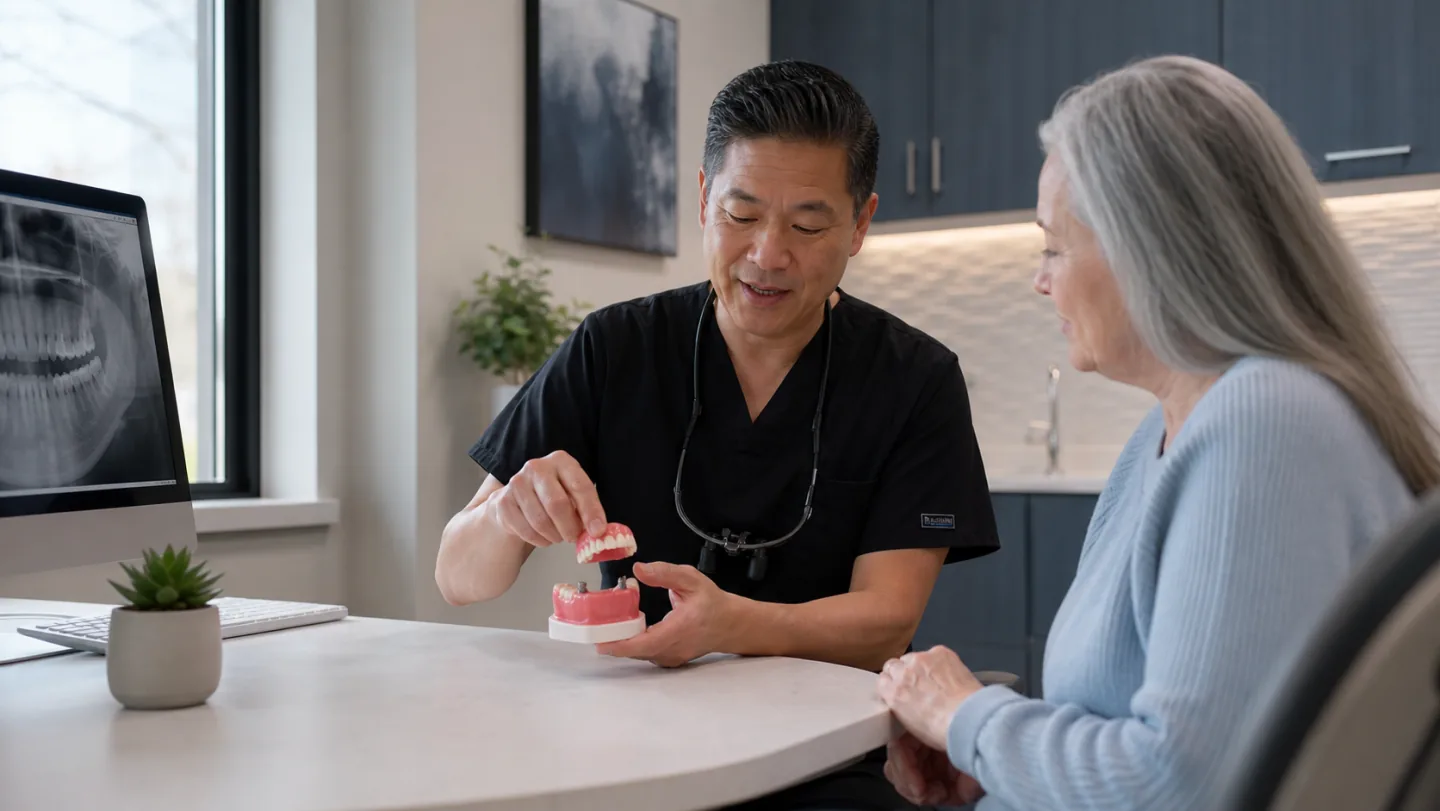
A dentist demonstrating how a snap-in denture connects to implant attachments
How the snap actually works

Snap-in Dentures for Aurora Residents

If you like knowing how something works before you trust it, this page is for you. Aurora residents who want the details explained in person are seen at our clinic on McPhillips Street in Winnipeg.

Let's find a time

Request an appointment

We’ll call to confirm your appointment. For urgent care, please call us directly.

The mechanics

What Holds a Denture in Place, and What the Snap Adds

A conventional denture rests on your oral tissues. What keeps it there is a combination of your anatomy, its fit, saliva and the control of the surrounding muscles. With so many variables, movement can become quite noticeable, and that is often more true of the lower arch.

A snap-in denture brings in a mechanical connection. Implants in the jaw act as planned anchor points, while attachments link them to replaceable retention elements inside the denture. That linkage adds resistance to lifting and sliding, though you can still unclip the whole thing and take it out.

Explore snap-in dentures
Winnipeg North Dental waiting area with a low bench and two blue abstract prints
A striped window shade behind two small tables with potted plants.

Anchors in the jaw

Implants offer fixed points to connect to, but only once they have had time to heal.

A replaceable link

Retention elements sit inside the denture and are made to be maintained or changed.

Shared support

Your oral tissues go on contributing some of the support even after the connection is made.

Part by part

Follow the load from tooth to jaw.

Three components do different jobs here. Seeing what each one contributes also explains why this treatment takes several stages and needs ongoing care.

What each part does

No single component does all the work, and each has a defined role in the system.

  • Implants provide the anchor points, sitting in the jaw.
  • Implant components carry one half of the attachment.
  • Retention elements inside the denture carry the other half.
  • The denture itself holds your teeth and rests on your tissues.

What the design does not change

It helps to be clear about the limits of this mechanism, as well as its benefits.

  • It remains an appliance that you remove yourself.
  • Bone, anatomy and bite still shape what can be done.
  • Chewing still depends on support and your adaptation.
  • A fixed full-arch restoration is a separate design altogether.

Understanding the mechanics does not settle whether it suits you. The dentist makes that call through assessment, using imaging and an examination of your mouth.

The build sequence

Why the parts arrive in this order.

Every stage relies on the one before it, which is why the order stays the same even when the number of implants and the timing differ between plans.

Request your visit
  1. 01

    Survey the foundation

    Anchor points need adequate bone and healthy gums, so these are evaluated first, along with your bite, health history and denture.

  2. 02

    Map the positions

    Attachments must sit where the finished denture can use them, and imaging combined with restorative goals determines those positions.

  3. 03

    Let the anchors settle

    After placement, implants need time to integrate according to the clinical plan. Only then are records taken to make or modify the denture.

  4. 04

    Join and tune

    Retention is set at the connection appointment, and pressure areas are checked. You will then be taught how the release works and how to do it properly.

Bring your curiosity

Technical questions are welcome here.

If you want to know why a part sits where it does, or how a piece gets replaced, ask. A patient who understands the system is often better prepared to look after it.

You can ask to be shown the imaging and have your own implant positions explained, if that would help you follow the plan.

Bring along

  • Your questions about how the components fit together.
  • The denture you have now, if you wear one.
  • An up-to-date record of your medications and conditions.
  • A note of when your current denture moves the most.
Winnipeg North Dental office with a landscape painting and a white desk
Winnipeg North Dental treatment chair in pale blue beside a sink counter

A framed painting of shoreline and sky on a white wall.

Understanding helps

Knowing how it works can make it less daunting.

Surgery and hardware sound imposing when described in the abstract. Having the reason for each part explained to you can make the whole process feel more manageable.

Ask for a walk-through

Having someone show you the sequence with your own plan in mind can clarify a lot.

Ask what can be replaced

It may reassure you to learn which parts are designed to be changed over time.

Ask what happens next

You are entitled to know what each appointment is for before you go ahead.

Parts in service

Moving parts call for maintenance.

Any connection that clips on and off will gradually wear. Retention inserts are made with this in mind, and how often they need attention depends on your use and alignment.

01

The wearing part

A snap that holds less firmly than it did may indicate an insert in need of attention.

02

Force is not the fix

Twisting or forcing around the attachment areas is exactly what the technique avoids.

03

System-wide checks

Regular examinations cover all components, and also your gums and bite.

If a part feels loose or the denture will not release, stop and call the clinic.

Talk with our team
Winnipeg North Dental storefront with grey siding and a white sign above the door

Winnipeg North Dental

Unit-5 2358 Mcphillips Street, Winnipeg, MB R2V 4J6
Get directions (opens in a new tab)
Where the work is done

Aurora Residents Are Seen on McPhillips Street

If you live in Aurora, your care with us takes place at Winnipeg North Dental, Unit 5, 2358 McPhillips Street, in Winnipeg. This section also has a link for directions to the clinic.

The form is simply a request until the clinic has confirmed a time with you. Please phone rather than send it if your concern is urgent.

Questions about coverage?

Talk with our team before your visit or learn about CDCP.

A little clarity before your visit

Your questions, answered.

Helpful details about snap-in dentures in Aurora.

Ask our team
How can Aurora residents get their technical questions answered?

Call (204) 338-3003 or fill out the form on this page, and say what you are curious about. An assessment would be booked at 2358 McPhillips Street in Winnipeg, with the time confirmed by the clinic.

What is actually doing the snapping?

Components on the implants connect with retention elements held inside the denture. Together they form the attachment that clicks into position and adds resistance to lifting and sliding.

Why does the lower denture tend to move around more?

Conventional dentures rely on anatomy, fit, saliva and muscle control. Movement can be more noticeable on the lower arch, which is one reason some people ask about attachments there.

If implants hold it, why does my gum tissue still matter?

A snap-in denture continues to receive some support from the oral tissues. The implants and tissues share the load, so the health of those gums stays important.

Which part is most likely to need replacing?

The retention elements, as they naturally wear with use and are designed for maintenance or replacement. How often this happens varies with your use and alignment.

Ask how it applies

See how the system would be planned for you.

Aurora residents can use this form to request a time, and the clinic will respond about scheduling in Winnipeg.

Patient testimonials

Kind words from our patients

★★★★★ 5.0 from 440+ reviews on Google

Close to home

Areas we serve

Convenient dental care on McPhillips Street for families across northwest Winnipeg and nearby communities.

Explore all service areas

A healthier smile is one visit away

Ready for dental care that feels genuinely comfortable?

✓ New patients welcome ✓ Direct insurance billing ✓ Multilingual team

How can we help?

Our dental team is here for you.

Ready to book or have a question? Choose the option that works best for you.

For urgent dental concerns, please call us directly.

Send us a message

Our team will reply during clinic hours.



