Skip to content
Winnipeg North Dental
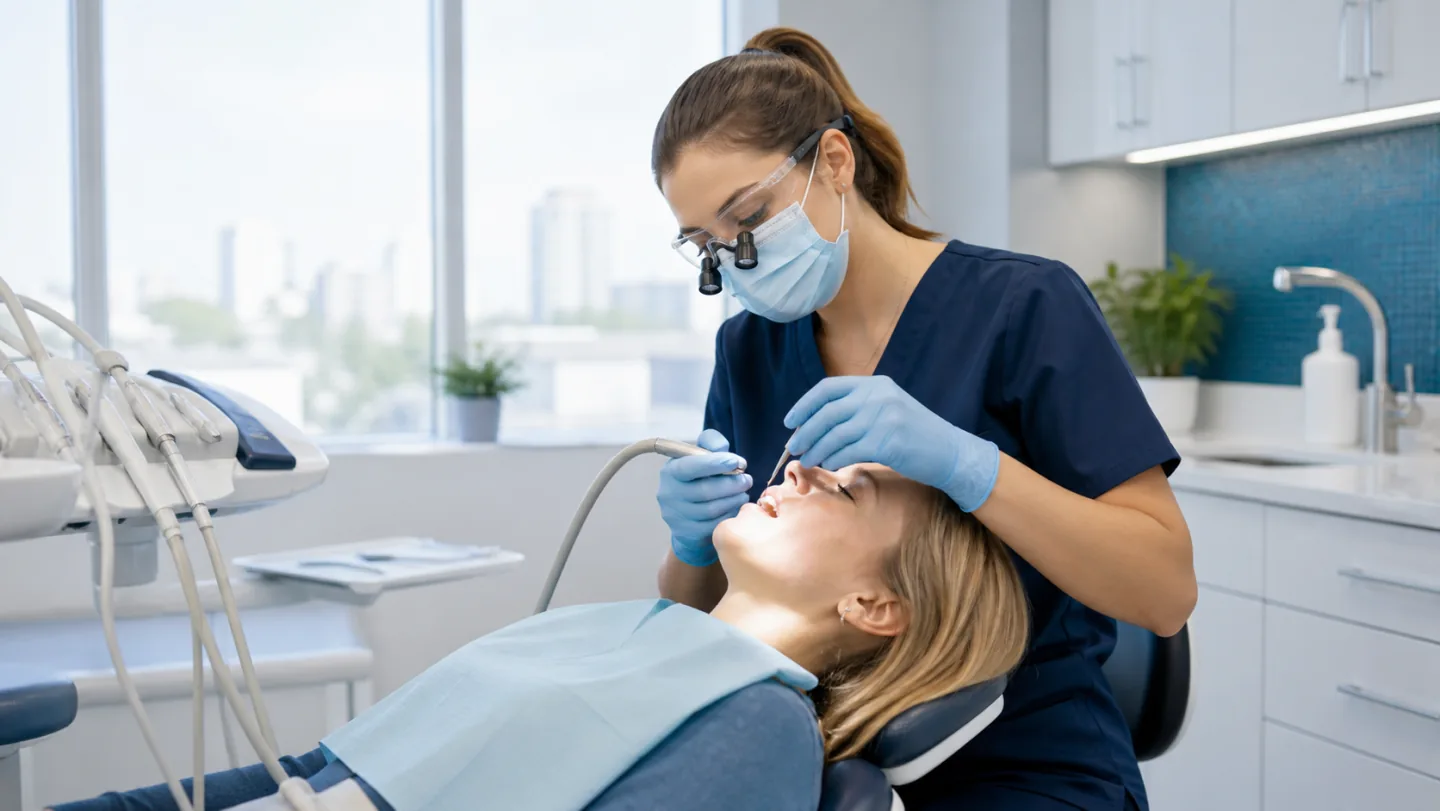
A dental hygienist providing careful deep cleaning below the gumline
After losing a tooth to gum disease

Scaling & Root Planning for Parkview Pointe Residents

When a tooth has had to come out because of its gums, your attention naturally turns to the ones left. That concern makes sense. Here’s how your remaining teeth can be evaluated, and where deep cleaning may fit in.

Let's find a time

Request an appointment

We’ll call to confirm your appointment. For urgent care, please call us directly.

Turning to the teeth you still have

Gum Care After Tooth Loss, for Parkview Pointe Patients

Losing a tooth is unsettling, particularly if it happened because of periodontitis. It’s reasonable to ask whether others are at risk, and the honest answer is that it depends on the findings around each one. An assessment can show which areas are affected, how deep the pockets run, and what the bone looks like on images.

If those findings support it, scaling and root planing is a non-surgical way of cleaning the root surfaces inside affected pockets, with the aim of settling inflammation. Nobody can promise how an individual tooth will do. Still, Parkview Pointe residents can come to our McPhillips Street clinic in Winnipeg to get a clear picture of where things stand.

Explore scaling & root planning
Winnipeg North Dental consultation room with leather chairs and a framed landscape print
Leather chairs and a framed landscape print in a consultation room.

Each tooth is looked at

Readings and images help show the condition of the gum and bone around every remaining tooth.

Stabilizing comes first

Calming active inflammation is often a topic to discuss before deciding how to fill a gap.

Honest about uncertainty

You’ll hear what your findings suggest, with no promises about how any tooth will respond.

What assessment and treatment involve

Learning what’s happening around the others.

Periodontitis can affect several teeth differently. So the first job is to map it out, and the second is to treat whichever areas the mapping shows need it.

Mapping your mouth

Your dentist builds an overall picture of your gums, instead of focusing on where the missing tooth used to be.

  • Depth readings at sites around each remaining tooth.
  • Bleeding during measurement, which signals inflamed tissue.
  • Calculus below the gumline, on root surfaces.
  • Images of bone levels, as clinically appropriate.

Treating affected areas

In diagnosed areas, deep cleaning removes plaque, calculus and bacterial deposits that daily brushing and floss can’t reach.

  • Generally done with local anaesthetic for comfort.
  • Completed in one visit or by section of the mouth.
  • Followed by home-care guidance and a reassessment.

Scaling and root planing can’t restore a tooth that has been lost, and it isn’t a replacement option. Your dentist decides with you whether it suits your situation.

From worry to a plan

How your care may be organized.

Everybody’s mouth is different, particularly after an extraction. Your own visits may vary, but here’s the usual sequence.

Request your visit
  1. 01

    Share what happened

    Explain which tooth came out and why, as far as you know, along with your medications and health history.

  2. 02

    Assess what remains

    Measuring and any needed images show where periodontitis is active, and whether bone has changed around your other teeth.

  3. 03

    Treat the planned roots

    Once you’re frozen, specialized instruments work through the pockets identified in your plan, in one or several sittings.

  4. 04

    Adapt your routine

    A gap changes how you brush and clean around neighbouring teeth, so you’ll want guidance that reflects this new layout.

Pulling your history together

Whatever you remember is a useful start.

You may not know exactly when the tooth came out or what was recorded. That’s all right. Any detail you can recall, or the name of the office that did the extraction, can add context to your assessment.

Cost depends on how many areas need treating, and your plan’s terms decide what’s covered. Ask for an estimate once your findings are known, and ask separately about any replacement options.

Useful to gather

  • When and where the tooth was removed, if you can recall.
  • Contact details for any previous dental office with your records.
  • Your medications, medical conditions and recent health changes.
  • Any insurance or CDCP information you plan to use.
Front counter with an orchid and glass divider at Winnipeg North Dental
White table and dark chairs by a window in a Winnipeg North Dental consultation room

The front counter with an orchid, and a table by a window.

If this feels heavy

It’s fine to feel uneasy about it.

After losing a tooth, an examination can bring on some real dread about what else might be found. You can say that aloud. Let us know how much detail you’d like, and whether you want time with the results before you weigh any decisions.

Set the pace of information

Tell us if you’d prefer an overview first, then the tooth-by-tooth details afterward.

Ask about any loose tooth

Point out any tooth that feels different so that it can be included in the assessment.

Talk through your fears

Being worried about losing more teeth is a fair thing to bring up with your dentist.

Looking after your remaining teeth

Healing, reassessment and what comes after.

After deep cleaning, gums may feel tender, teeth may react to temperature, and light bleeding can occur. The extent varies with how much was treated, and things should generally ease as the tissues start to recover. Tissue then gets time to respond before a follow-up evaluation.

01

Clean around the gap

Follow the method you’ve been given for the teeth next to the space, using the recommended tools.

02

Eat what’s comfortable

If you’re chewing more on one side, softer choices can spare any tender area for a short time.

03

Plan for maintenance

Reassessment shows where gums are stable. Regular maintenance usually follows, to monitor those areas and control new buildup.

Let the clinic know about bleeding that doesn’t stop, swelling that’s getting worse, severe pain, or a concern that doesn’t match your instructions.

Talk with our team
Street-level view of Winnipeg North Dental and its large window panels

Winnipeg North Dental

Unit-5 2358 Mcphillips Street, Winnipeg, MB R2V 4J6
Get directions (opens in a new tab)
If you live in Parkview Pointe

Where Your Remaining Teeth Can Be Assessed

Your other teeth would be checked, and treated if needed, at Winnipeg North Dental, Unit 5, 2358 McPhillips Street, Winnipeg. The directions link gives you a map.

Say that you’ve recently lost a tooth when you fill in the form or call (204) 338-3003. Any time is confirmed by the clinic. For sudden pain, swelling or bleeding, please call instead.

Questions about coverage?

Talk with our team before your visit or learn about CDCP.

A little clarity before your visit

Your questions, answered.

Helpful details about scaling & root planning in Parkview Pointe.

Ask our team
Am I going to lose more teeth?

No one can say from a website, and your dentist can’t promise an outcome either. An assessment gives you real information about each tooth, and that’s what any recommendation rests on.

Should I replace the missing tooth or treat my gums first?

Your findings decide the order, so bring it up at your assessment. Gum health is commonly considered when replacement options are being talked about.

Could the tooth I lost have affected its neighbours?

Neighbouring teeth may be checked closely, as periodontitis can involve more than one tooth. Measurements and images help show how each is doing.

Can a deep cleaning tighten a tooth that feels loose?

Gums can become firmer as inflammation falls, but that doesn’t mean a particular tooth will tighten. Have it examined, and ask your dentist what’s realistic.

Do I need this if my tooth came out for some other reason?

Perhaps not. A tooth can be removed for many reasons, so periodontal findings around your other teeth are what determine whether deep cleaning is needed.

From Parkview Pointe, how do I get my other teeth checked?

Complete the form here, or phone (204) 338-3003, and mention the tooth you’ve lost. Your assessment takes place at our McPhillips Street clinic in Winnipeg, and we’ll follow up to confirm.

Find out where things stand

Get your remaining teeth evaluated.

If you’re in Parkview Pointe, request a gum assessment at our Winnipeg clinic. We’ll reach out to set up a confirmed time.

Patient testimonials

Kind words from our patients

★★★★★ 5.0 from 440+ reviews on Google

Close to home

Areas we serve

Convenient dental care on McPhillips Street for families across northwest Winnipeg and nearby communities.

Explore all service areas

A healthier smile is one visit away

Ready for dental care that feels genuinely comfortable?

✓ New patients welcome ✓ Direct insurance billing ✓ Multilingual team

How can we help?

Our dental team is here for you.

Ready to book or have a question? Choose the option that works best for you.

For urgent dental concerns, please call us directly.

Send us a message

Our team will reply during clinic hours.


