Skip to content
Winnipeg North Dental
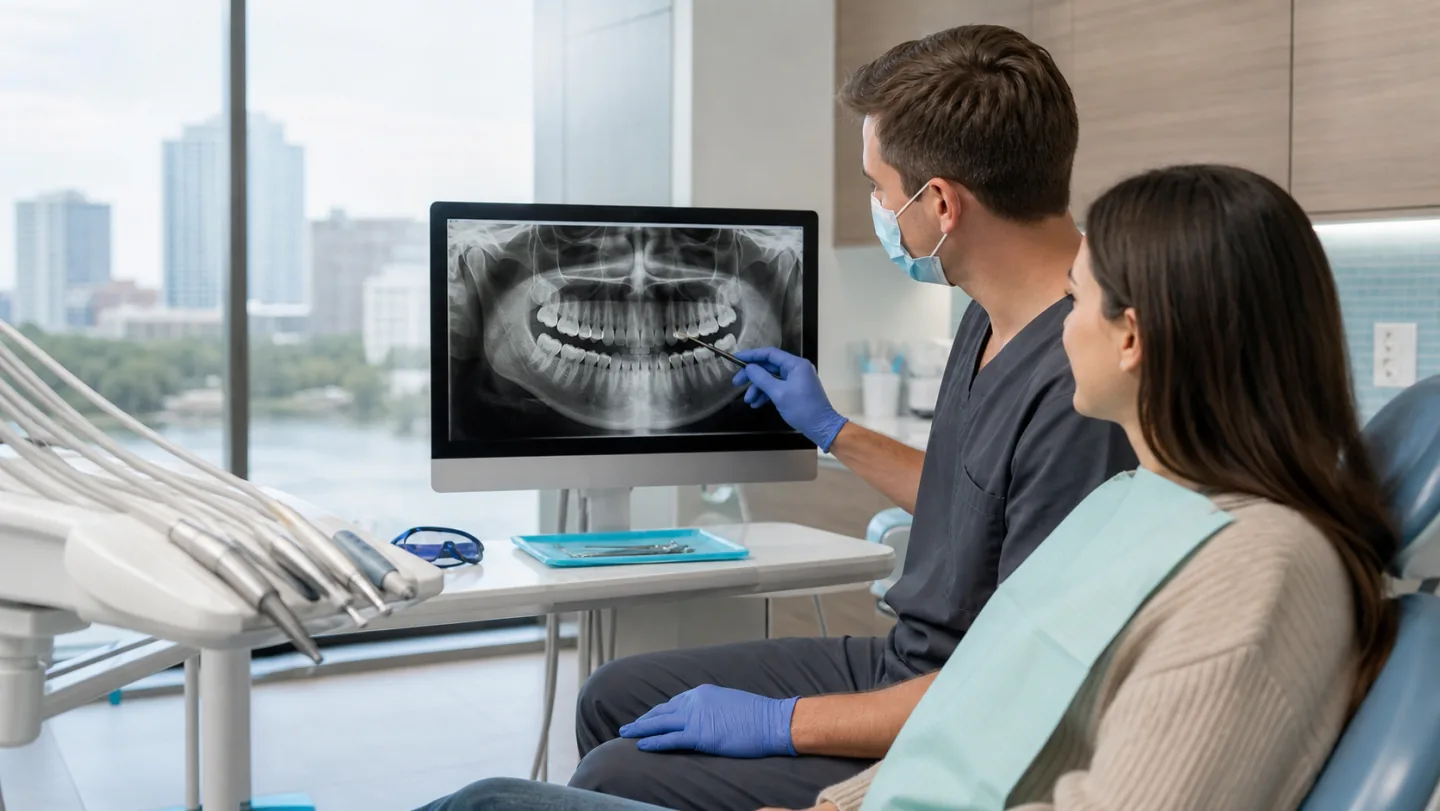
A dentist reviewing a dental X-ray before root canal treatment
This tooth holds up a bridge.

Root Canal Therapy for Stony Mountain Residents

When a sore tooth is also one of the supports for a dental bridge, you have two concerns at once: what’s happening inside it and what could happen to the bridge. An examination is how you get answers to both.

Let's find a time

Request an appointment

We’ll call to confirm your appointment. For urgent care, please call us directly.

More than one tooth depends on it

Root Canal Questions for a Bridge-Supporting Tooth

A dental bridge relies on the anchoring teeth at either end, covered by crowns, to hold the replacement tooth in the gap. Those supporting teeth are still living teeth underneath, so they can develop inner trouble from decay at a margin, a crack or simply the work they’ve been through.

If you live in Stony Mountain, you’d come into Winnipeg to have it examined at our McPhillips Street clinic, as Stony Mountain is outside the city. It’s only after looking at the tooth and appropriate X-rays that the dentist can say whether a root canal is suitable, and whether the bridge is likely to be affected.

Explore root canal therapy
Dental chair and overhead arm in a bright room, with a mixer tap, wood-tone drawers and a wall screen
A dental chair with a mixer tap and wood-tone drawers behind it.

Know which tooth it is

Tell the clinic if the sore spot is under one end of your bridge and not somewhere else.

Don’t assume the bridge is lost

What happens to it depends on what the examination finds, so wait for the findings before planning for the worst.

Share the bridge’s age

When it was placed and how it has behaved are helpful details, even if you only have rough dates.

Two things to consider at once

Treating the anchor, thinking about the bridge.

Treatment is aimed at the affected tissue in that anchor tooth. Planning, though, must also take into account the restoration sitting on top of it, because it’s not independent.

Inside the supporting tooth

After it’s frozen and isolated, the dentist needs a route to the canals. Whether this can be done with the bridge in place is a key question to ask about your case.

  • An opening gives the dentist access to the tissue that has to come out.
  • Canals are cleaned, shaped and disinfected along their narrow paths.
  • Sealing the system lowers the risk of a further infection developing.
  • The number of visits varies with the anatomy and any infection present.

Above the supporting tooth

Any access point has to be closed securely afterward. The dentist also has to judge whether the bridge is still in sound condition or needs replacing.

  • Sometimes the opening can simply be repaired with a filling.
  • Decay or leakage at the edge of a crown may change that advice.
  • A weakened anchor may not be able to support the bridge reliably.
  • Removal and other replacements may come up if it cannot be restored.

It’s impossible to say which of these applies from a description. The dentist needs to evaluate the bridge, the anchor tooth and the bite together.

Sorting out the bridge question

How your assessment may unfold.

Your appointment needs to answer questions about both the tooth and the bridge. Here’s a rough idea of how those may get worked through.

Request your visit
  1. 01

    Describe what you’ve noticed

    Say whether the pain is on biting, whether temperature sets it off, and whether the bridge feels loose or food has started catching beneath it.

  2. 02

    Have the structure examined

    The dentist looks at the bridge’s edges and how it fits, examines the supporting teeth and takes any suitable X-rays to see the area below the crowns.

  3. 03

    Ask what affects the bridge

    Find out whether the proposed treatment could leave it in place, and what the plan would be if it couldn’t. This is the time to raise concerns about appearance.

  4. 04

    Agree on an order of work

    Ask which stage comes first, whether you’d be left with a gap at any point, and what the likely sequence of appointments looks like.

What to look up beforehand

Give your bridge a little background.

A bridge is often years old by the time a problem appears, so details may be hazy. Anything you can gather is useful, even if it’s only an approximate date.

When planning the trip in from Stony Mountain, ask if the first appointment is limited to an assessment, or whether you should plan for anything further.

Try to find out

  • Roughly when the bridge was placed and which clinic placed it.
  • Which teeth it spans, and any earlier repairs to those teeth.
  • Any new looseness, gaps, bad taste or food catching under the span.
  • Questions about how the bridge would be protected during treatment.
Two framed abstract prints above a navy bench along a white wall, with a pale rug on a wood-look floor
Rear view of a high-backed black chair facing a white desk, with a shoreline painting on the wall

A navy bench beneath framed prints, and a high-backed black chair facing a white desk.

When a bigger repair is on your mind

Worries about your smile are valid.

Concern about being left with a gap can weigh on you just as heavily as the toothache itself. You’re free to raise that concern as early as you like.

Ask about appearance

Find out how your bridge might look during treatment if you’re concerned about the visible part of it.

While you’re numb

Local anesthetic is applied first. You can expect sensations such as pressure, but sharp pain should be reported the moment you feel it.

Say what would help

Longer explanations, a quick pause or a look at your X-ray are all reasonable requests to make.

Keeping the bridge in service

Taking care of the span afterward.

Once the tooth has been treated, your bridge still relies on it. It makes sense to ask how to look after this support, and to keep an eye on anything that changes.

01

Initial soreness

Pressure from chewing can feel uncomfortable for a short period. Expect that to fade rather than grow as the days pass.

02

Changes worth phoning about

Contact the clinic about a bridge that feels loose, or about pain or swelling that’s substantial or getting worse.

03

Cleaning under the span

Ask to be shown how to clean under the bridge and around its anchors, since those edges deserve particular care.

Fresh decay, a leak at a margin or a fracture can create new problems later, so regular checkups remain worthwhile for the whole span.

Talk with our team
Winnipeg North Dental’s logo and raised name beside the phone number, over a door with posted notices

Winnipeg North Dental

Unit-5 2358 Mcphillips Street, Winnipeg, MB R2V 4J6
Get directions (opens in a new tab)
Getting the bridge checked

Where Stony Mountain Patients Go

Residents of Stony Mountain come into Winnipeg for this care. The examination and any treatment take place at Winnipeg North Dental, Unit 5, 2358 McPhillips Street.

An online request is exactly that, a request. You’ll have a confirmed time only after hearing back from the clinic.

Questions about coverage?

Talk with our team before your visit or learn about CDCP.

A little clarity before your visit

Your questions, answered.

Helpful details about root canal therapy in Stony Mountain.

Ask our team
How can someone in Stony Mountain have a sore bridge tooth seen?

Phone (204) 338-3003 or send a request through this page, and mention the bridge. Appointments take place at our clinic on McPhillips Street in Winnipeg, once a time has been confirmed with you.

Can a tooth under a bridge have a root canal?

Often, a tooth with a crown over it can still be accessed, but that depends on the tooth and the bridge. An examination and X-rays show whether it’s a workable option.

Will my bridge need to be replaced?

Not always. It depends on how sound the bridge is, how healthy its anchors are, and how much of the tooth remains. Ask the dentist to explain the reasoning for your case.

My bridge feels loose as well as sore. Is that connected?

It could be, although other causes are possible. Please mention this when you contact the clinic, and try to avoid leaving a change like this for a long time.

What if the anchor tooth can’t be saved?

The dentist can talk through removal, and what might replace the span afterward. The right approach depends on your remaining teeth, so options are discussed after an assessment.

Is your bridge sending signals?

Have the tooth beneath it examined.

Request an assessment on McPhillips Street, and clinic staff will reach out. Severe pain or swelling needs a phone call, not the form.

Patient testimonials

Kind words from our patients

★★★★★ 5.0 from 440+ reviews on Google

Close to home

Areas we serve

Convenient dental care on McPhillips Street for families across northwest Winnipeg and nearby communities.

Explore all service areas

A healthier smile is one visit away

Ready for dental care that feels genuinely comfortable?

✓ New patients welcome ✓ Direct insurance billing ✓ Multilingual team

How can we help?

Our dental team is here for you.

Ready to book or have a question? Choose the option that works best for you.

For urgent dental concerns, please call us directly.

Send us a message

Our team will reply during clinic hours.



