Skip to content
Winnipeg North Dental
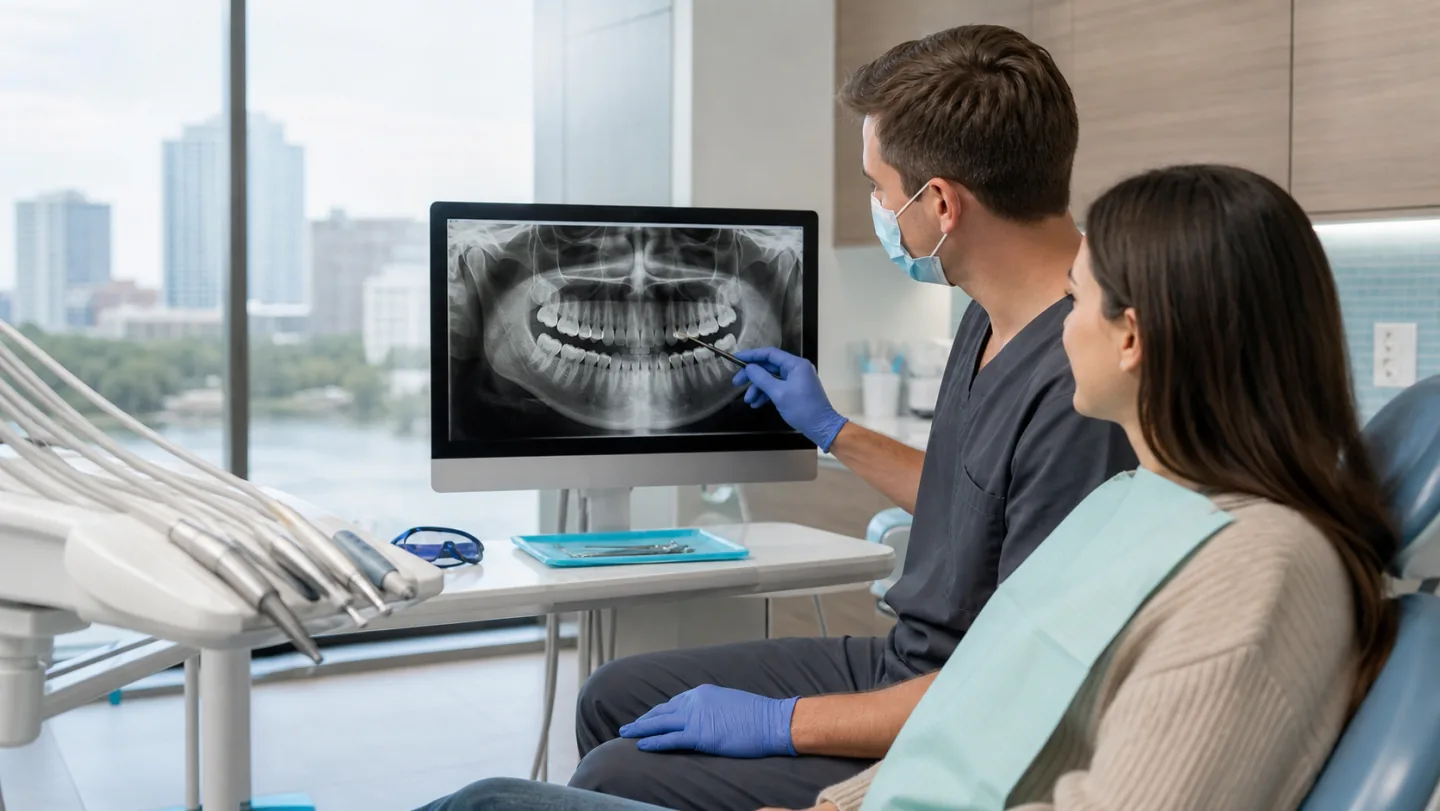
A dentist reviewing a dental X-ray before root canal treatment
A shadow on the X-ray.

Root Canal Therapy for Middlechurch Residents

You came in feeling fine, and now someone has pointed at a dark patch near a root. Here is how to make sense of that finding and what it takes to learn whether it calls for treatment.

Let's find a time

Request an appointment

We’ll call to confirm your appointment. For urgent care, please call us directly.

An image, not yet an answer

What a Dark Area Near a Root May Suggest

On a dental X-ray, dense material shows up as light and less dense areas appear darker. A dark patch around the tip of a root can be a sign that infection from inside the tooth has affected the surrounding bone. That’s one explanation, however, and the picture alone doesn’t settle it.

For a Middlechurch resident, the question usually becomes what to do about a tooth that doesn’t feel like a problem. Middlechurch is outside the City of Winnipeg, so you’d be planning an assessment at our McPhillips Street clinic, where the dentist can consider that image along with the tooth itself.

Explore root canal therapy
Dentist reviewing a dental X-ray and treatment choices with a patient
An X-ray of upper and lower teeth displayed on a monitor between two people.

Feeling fine isn’t the test

Teeth with inner trouble can cause remarkably little discomfort, so the lack of pain doesn’t clear it.

One finding among several

Your history, the examination and the images are weighed together before anyone calls it a diagnosis.

Ask to see it

Having the spot pointed out on your own X-ray often makes the rest of the discussion clearer.

If the shadow points to the pulp

What happens when infection is the answer.

Should the dentist conclude that the source is inside the tooth, root canal therapy tackles it at its origin. The goal is to clear that inner space, close it off and keep the tooth working.

Treating the source

Tissue within the root system can’t be reached from the outside of the tooth, so the work goes in through the crown, with everything numbed beforehand.

  • Isolation keeps the working area clean from saliva and the rest of the mouth.
  • A small opening gives access to the tissue that must be taken out.
  • Instruments and disinfection clean those narrow spaces along their length.
  • Filling the canal system helps to discourage a return of infection.

Closing up the tooth

A tooth with no symptoms is easy to underrate at this stage, but it may still be structurally vulnerable. The restoration is the piece that protects what the canal work has achieved.

  • A filling and frequently a crown are part of the complete plan.
  • Recommendations for front teeth depend on the structure and your bite.
  • A well-made final repair helps guard against leakage over time.
  • Ask how this stage fits in with the rest of your appointments.

Teeth can’t always be kept. If support or structure is lacking, the dentist can explain why extraction might be the more realistic choice.

How that spot gets explained

Sorting out what the image really shows.

This outlines how a finding on an X-ray may become a decision. Sometimes further images or tests are appropriate, and sometimes the answer comes quickly.

Request your visit
  1. 01

    Mention the finding

    When you reach out, say that an X-ray raised a question about a certain tooth. If it was taken at another clinic, mention where and when.

  2. 02

    Recount the tooth’s past

    A knock years ago, a large filling or a brief bout of pain you’d nearly forgotten could all be relevant to what that shadow means.

  3. 03

    Let the dentist test and look

    The dentist examines the tooth and gum and reviews the appropriate images, looking for signs that fit with an infection, or for ones that don’t.

  4. 04

    Talk through the options

    Ask what happens if you treat it now, what happens if you don’t, and how confident the dentist is in the explanation offered.

What you can look up

Memory jogging for a quiet tooth.

When nothing hurts, it’s hard to know what to report. A little thought about that tooth’s past will still give you something useful to share at your appointment.

Ask how long an assessment appointment usually takes, and how treatment visits would work if you decide to go ahead, so your trip in from Middlechurch is easier to plan.

Things to think back on

  • Any past blow to the face or mouth, even one that seemed minor then.
  • Dental work on the tooth, such as a deep filling or an older crown.
  • Short spells of aching, tenderness or a gum pimple that later cleared up.
  • Where the X-ray was taken and whether a copy can be sent along.
Empty treatment room with a blue chair, a counter with a faucet and a small monitor above the headrest
Corner of a white reception desk with a white orchid, small green plants and a soft blue accent wall

A blue chair facing a small monitor, and a reception desk with a white orchid.

When a calm tooth becomes a worry

It’s okay to feel unsettled by this.

A surprise finding on a day you felt well can be unnerving. You’re allowed to take in the information and come back with your questions, as long as you don’t lose track of it.

Ask for it in plain terms

The words used for these findings can sound alarming, so ask what each means for you if any of them is unclear.

Numbing even when calm

A tooth that seems quiet is still frozen for treatment. Report anything sharp you notice while the work is happening.

Take the decision at your pace

Find out from the dentist how much time you have to think, as it’s likely to depend on what’s been found.

Watching that spot over time

How do you know it’s working?

With no pain beforehand, you won’t have the usual relief to tell you treatment helped. That’s why it makes sense to ask how the area will be reviewed afterward.

01

Short-term sensations

Your tooth may feel tender on biting in the first while, even though it was quiet before. That should settle down gradually.

02

Signals not to ignore

Swelling, or pain that’s strong or heading in the wrong direction, is a reason to telephone rather than wait for a routine visit.

03

Future images

Ask whether a later X-ray is recommended to review the area, and when that would make sense for your tooth.

New decay, a fracture or leakage can still affect a treated tooth later on, so keep that tooth in your routine care.

Talk with our team
Dark-framed entrance of Winnipeg North Dental, with a metal railing in front of the doors

Winnipeg North Dental

Unit-5 2358 Mcphillips Street, Winnipeg, MB R2V 4J6
Get directions (opens in a new tab)
Having that X-ray followed up

Where Middlechurch Residents Are Seen

People living in Middlechurch come into Winnipeg for this assessment, at Winnipeg North Dental, Unit 5, 2358 McPhillips Street. Any treatment that follows is provided at the same clinic.

The online form sends a request, and a time isn’t set until staff have replied to you. Do mention the X-ray finding in your message.

Questions about coverage?

Talk with our team before your visit or learn about CDCP.

A little clarity before your visit

Your questions, answered.

Helpful details about root canal therapy in Middlechurch.

Ask our team
How can I get an X-ray finding followed up from Middlechurch?

You can telephone (204) 338-3003 or send the form, and explain what the X-ray showed. Your exam would be at our clinic on McPhillips Street in Winnipeg at a time the clinic confirms.

Does a dark spot always mean an infected tooth?

No. Not every dark area on an X-ray is caused by infection, and the image is only part of the evidence. A diagnosis also relies on examining the tooth and hearing its history.

How can a tooth be infected if it doesn’t hurt?

Some teeth needing a root canal produce few or no symptoms, and in some of these cases the first sign is a finding on an X-ray or a recurring gum bump.

Can we just watch it for a while?

Ask the dentist this directly. The answer depends on what’s been found and how certain the explanation is, so the advice for your tooth may differ from someone else’s.

Will the dark spot disappear after treatment?

Ask what would be expected for your tooth and whether a future X-ray is planned. Results differ from one case to another, so no one can promise a particular result.

Still wondering about that spot?

Have the tooth and its X-ray reviewed.

Ask for an assessment at our Winnipeg clinic using the form, and you’ll hear back. Any pain or swelling that’s severe should be phoned in.

Patient testimonials

Kind words from our patients

★★★★★ 5.0 from 440+ reviews on Google

Close to home

Areas we serve

Convenient dental care on McPhillips Street for families across northwest Winnipeg and nearby communities.

Explore all service areas

A healthier smile is one visit away

Ready for dental care that feels genuinely comfortable?

✓ New patients welcome ✓ Direct insurance billing ✓ Multilingual team

How can we help?

Our dental team is here for you.

Ready to book or have a question? Choose the option that works best for you.

For urgent dental concerns, please call us directly.

Send us a message

Our team will reply during clinic hours.