Skip to content
Winnipeg North Dental
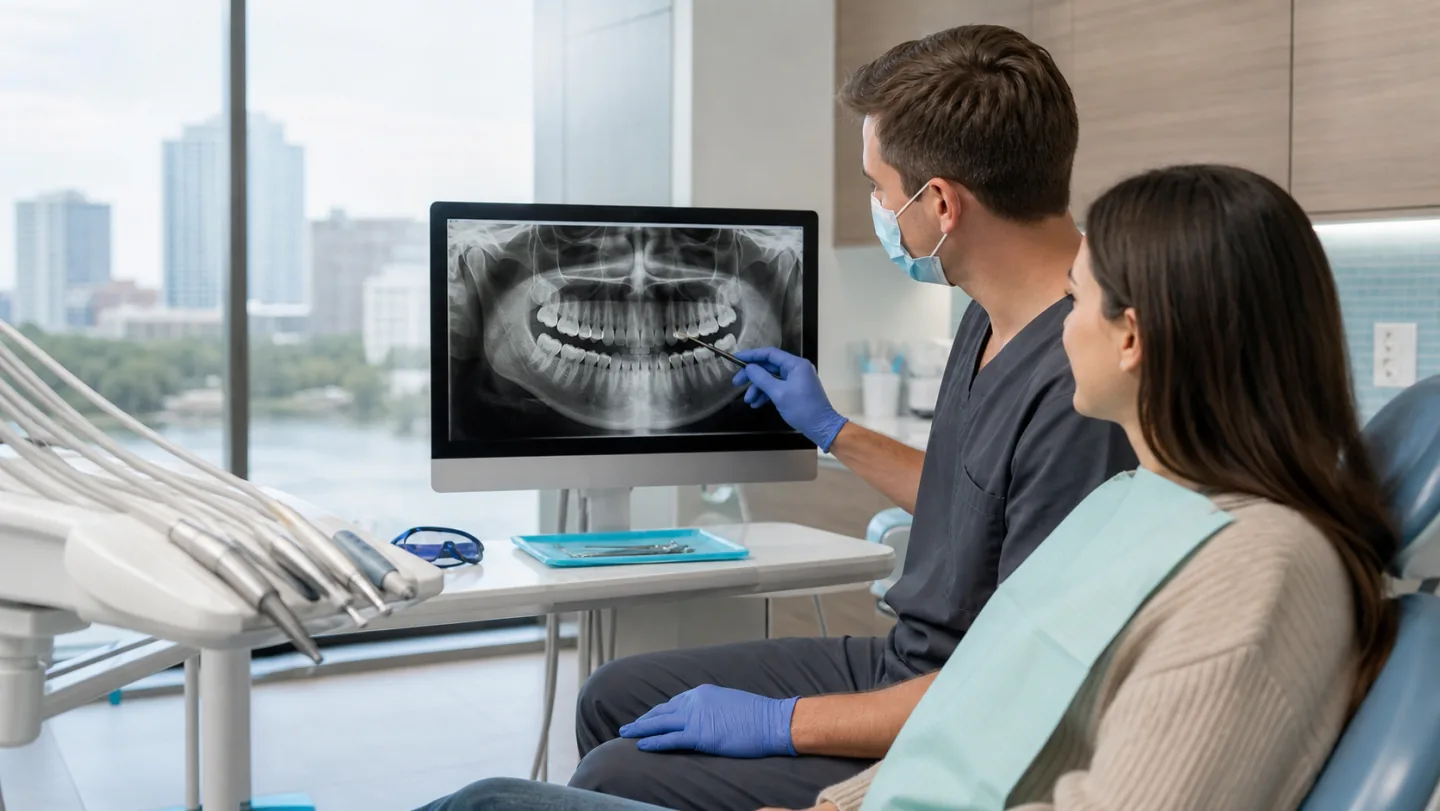
A dentist reviewing a dental X-ray before root canal treatment
I thought it was just a cavity.

Root Canal Therapy for Margaret Park Residents

Decay does not always stop at a depth a simple filling can handle. Here is why a cavity can turn into a bigger conversation, and what that conversation is likely to cover.

Let's find a time

Request an appointment

We’ll call to confirm your appointment. For urgent care, please call us directly.

From surface to centre

When Decay Goes Deeper Than a Filling Can Fix

Decay works its way inward, through enamel and then dentin, toward the pulp at the centre of the tooth. As long as that inner tissue is healthy, repairing the outer layers may be enough. Once it is irreversibly inflamed or infected, patching the outside no longer addresses the source of the problem.

That is often when root canal therapy enters the discussion. For Margaret Park residents, who live in an area of Winnipeg, this assessment takes place at our McPhillips Street clinic. An examination and X-rays help the dentist judge how far decay has travelled and what your tooth now needs.

Explore root canal therapy
Dental professional holding a tooth model while talking with an older man at a table
A dental professional explaining a tooth model to a patient.

Depth drives the decision

How close decay has come to the inner tissue shapes what treatment makes sense.

Pain can mislead

A deeply decayed tooth may cause little discomfort, or quite a lot, before it is examined.

Your tooth is still the goal

When enough sound structure remains, treatment aims to keep your natural tooth working.

Two levels of repair

A filling and a root canal do different jobs.

One rebuilds the outside of a tooth, while the other treats the inside as well. The right one depends on the health of the pulp.

Where a filling fits

A filling replaces tooth structure lost to decay, and it suits teeth whose inner tissue is not the source of trouble.

  • Decayed material gets removed from the affected area.
  • Restorative material then rebuilds the missing part of the tooth.
  • The pulp stays in place when it is judged healthy.
  • Your dentist decides on this after assessing how deep the damage is.

Where a root canal fits

Treatment goes further by removing affected tissue from within the tooth before it is restored.

  • The tooth is numbed and isolated before any work begins.
  • Inflamed or infected tissue comes out through a small opening.
  • Canals are cleaned, shaped, disinfected and then sealed.
  • A filling and often a crown finish the job, since less tooth remains.

A cavity alone does not mean you need a root canal. Only an examination and appropriate X-rays can say what is going on in your tooth.

Finding out how deep it goes

From a suspected cavity to a clear answer.

You should understand what has been found before deciding anything, and appointment numbers vary depending on the tooth and the planned restoration.

Request your visit
  1. 01

    Point out the suspect tooth

    A dark spot, a rough edge, food catching or a twinge when eating are all useful to mention, as is how long you have noticed them.

  2. 02

    Measure the damage

    Examination and X-rays give the dentist a sense of how far decay has progressed and how much of the tooth is sound.

  3. 03

    Discuss what fits

    You hear whether a filling may still be enough, whether the pulp appears affected, and whether the tooth can be predictably restored.

  4. 04

    Treat and rebuild

    If root canal therapy is the agreed path, the canals are treated first with the area numbed, and a suitable restoration follows.

Getting ready to ask

A surprise diagnosis raises fair questions.

Hearing about a root canal when you expected a filling can be jarring. Asking the dentist to show you what they saw on the X-ray is a perfectly reasonable request.

Because the two treatments differ, ask for estimated costs of whichever is recommended, along with any final restoration it requires.

Things to bring up

  • When you first noticed the spot, and any changes since then.
  • Whether hot, cold or sweet food sets off a lingering ache.
  • What medications you take and any updates to your health history.
  • Insurance or CDCP information, if you have it.
Bright waiting area with a navy bench, two white chairs and abstract art
White desk and dark office chairs in a clinic consultation room

The waiting area and consultation room at our clinic.

No lecture here

However the cavity got this far.

Decay does not always announce itself, and life can get in the way of dental visits. Your time here is for understanding the tooth and deciding what to do about it, not for going over what might have been.

See it for yourself

An X-ray can make a hidden problem easier to grasp, so ask to have yours explained.

Numbed before anything starts

Treatment begins with local anesthetic. Please mention right away if you feel anything sharp.

Tell us if you are worried

It is easier to talk through a fear about the procedure before it starts than during it.

Once the deep decay is dealt with

Keeping one cavity from becoming the next.

A repaired tooth still lives alongside the rest of your teeth, and the same risks that affected it may matter elsewhere in your mouth.

01

A tooth with less to spare

Decay and treatment both leave a tooth with less natural structure. Restoring it as advised is how you guard against a fracture later.

02

Decay can still return

The nerve may be gone, but the outside of a treated tooth can still decay. Keep brushing and cleaning around that tooth as you would any other.

03

Catching the next one sooner

Regular check-ups give the dentist a chance to find a developing cavity while the available treatment may be simpler.

Questions after your visit about that tooth? Our clinic is a phone call away.

Talk with our team
Grey-sided storefront of Winnipeg North Dental with frosted windows

Winnipeg North Dental

Unit-5 2358 Mcphillips Street, Winnipeg, MB R2V 4J6
Get directions (opens in a new tab)
Getting that cavity checked

Where Your Tooth Gets Assessed

People from Margaret Park visit Winnipeg North Dental at Unit 5, 2358 McPhillips Street in Winnipeg, where the dentist can review a deep cavity and explain what it may need.

Sending the form asks for an appointment but does not fix one. You will have a set time only after our staff have confirmed it with you.

Questions about coverage?

Talk with our team before your visit or learn about CDCP.

A little clarity before your visit

Your questions, answered.

Helpful details about root canal therapy in Margaret Park.

Ask our team
How can a Margaret Park resident have a deep cavity checked?

Call (204) 338-3003, or use the form on this page and describe the tooth briefly. Your assessment would take place at Unit 5, 2358 McPhillips Street, at a time the clinic confirms.

Why can’t you just put a bigger filling in?

A filling repairs what is missing from the tooth, but it does not treat diseased tissue inside. If the pulp cannot recover, closing over it would leave the actual problem in place.

How do you know decay has reached the nerve?

Your symptoms, the examination and X-rays are considered together. Lingering pain after hot or cold, tenderness on biting or a gum bump can all be clues, though none settles the matter alone.

It barely hurts. Could the decay still be that deep?

It could be, as damage can reach the inner tissue before severe pain begins. Likewise, not every sore tooth needs a root canal, which is why it needs to be examined.

If I wait, could I end up losing the tooth?

Continuing decay can reduce the structure available for a restoration, and a tooth that can no longer be restored may need removal. Ask how much time your own tooth seems to allow.

Wondering how far it has gone?

Have that cavity looked at properly.

Request a visit to our Winnipeg clinic and find out what your tooth needs. Phone us instead if swelling or severe pain has started.

Patient testimonials

Kind words from our patients

★★★★★ 5.0 from 440+ reviews on Google

Close to home

Areas we serve

Convenient dental care on McPhillips Street for families across northwest Winnipeg and nearby communities.

Explore all service areas

A healthier smile is one visit away

Ready for dental care that feels genuinely comfortable?

✓ New patients welcome ✓ Direct insurance billing ✓ Multilingual team

How can we help?

Our dental team is here for you.

Ready to book or have a question? Choose the option that works best for you.

For urgent dental concerns, please call us directly.

Send us a message

Our team will reply during clinic hours.