Skip to content
Winnipeg North Dental
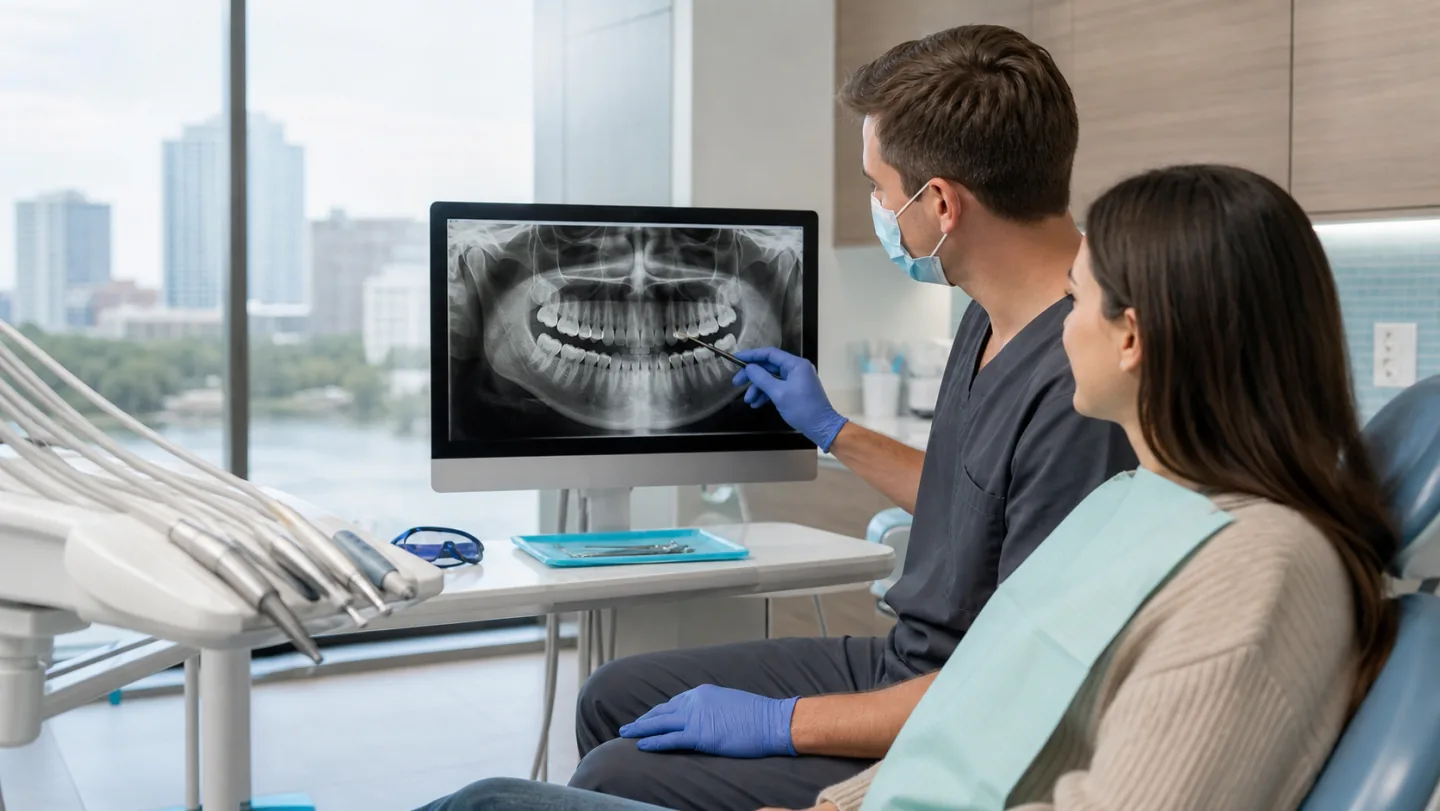
A dentist reviewing a dental X-ray before root canal treatment
What’s actually in there?

Root Canal Therapy for Exchange District Residents

Some people relax once they can picture how a thing works. If that’s you, here’s a short tour through a tooth, layer by layer, ending with what root canal therapy does inside.

Let's find a time

Request an appointment

We’ll call to confirm your appointment. For urgent care, please call us directly.

A tooth from the outside in

Mapping the Territory

A tooth isn’t a solid white block. Enamel forms the hard outer shell, dentin sits underneath, and at the centre is a small chamber of soft tissue that contains nerves and blood vessels. From that chamber, narrow channels run down through the roots.

Once you can picture that layout, root canal therapy makes a lot more sense. This tour is for Exchange District residents, in Winnipeg, who like knowing how things work before deciding anything. Should your tooth need care, it would take place at our McPhillips Street clinic.

Explore root canal therapy
Consultation desk with a keyboard and mouse, black task chairs and a framed landscape
A consultation desk with a keyboard and black task chairs.

Hard outside, soft inside

Enamel and dentin protect the living pulp tissue at the tooth’s core.

Roots have channels

Canals vary in number and shape, which can make each tooth a little different.

The shell can look fine

A tooth may appear intact on the surface while trouble develops within.

Layers, then the repair

How the problem gets in, and gets out.

Trouble tends to travel inward, from the surface toward the centre. Treatment then follows that same path to reach and clean the inner space.

The route damage can take

Each layer offers protection until something manages to breach it.

  • Enamel can be worn away, fractured or broken down by decay.
  • Dentin gives way next, bringing damage closer to the centre.
  • Pulp tissue can become irreversibly inflamed or infected.
  • Infection may then follow the canals down toward the root tips.

How the dentist reverses course

Working through the crown of the tooth, the dentist goes into the inner space.

  • With anesthetic in place, a barrier keeps the area isolated and clean.
  • A small opening through the top provides a way into the chamber.
  • Fine instruments remove tissue and shape the channels for disinfection.
  • A filling material seals the space against reinfection before the top is restored.

Without its pulp, the tooth stays in the jaw, held by the structures around its root.

How anyone can tell

Seeing what’s hidden from view.

No one can peer straight into a tooth, so a diagnosis gets pieced together. Here’s the reasoning a dentist tends to follow.

Request your visit
  1. 01

    Start with what you report

    Lingering reactions to temperature and tenderness when biting are clues, though neither one is proof on its own.

  2. 02

    Look at the surface

    A careful examination checks for decay, cracks, swelling and any gum bump near the tooth in question.

  3. 03

    Add the X-rays

    Images show details that can’t be seen in the mouth directly. Ask to have yours explained, if you’re curious about them.

  4. 04

    Connect it to a plan

    If the inner tissue can’t recover and the tooth can be restored, treatment may be suggested. Visit numbers depend on anatomy and infection.

For the curious patient

Questions you may want to ask.

If understanding the mechanics helps you feel settled, come ready to ask about them. Keep your medical details handy too, as these are needed for planning.

Anything you find confusing on your X-ray is a good question. Asking what you’re looking at is entirely reasonable.

Bring along

  • A question about how many canals this tooth appears to have.
  • A request to be shown where the problem seems to sit.
  • Your list of medicines and a summary of your health history.
  • Insurance information, if your dental care is covered by a plan.
Dental chair and overhead equipment in a treatment room with wood-tone cabinetry
Reception desk seen from the side, with a small cactus, an orchid and a blue accent wall

Equipment around a dental chair, and the reception desk.

Why it feels the way it does

The reasons behind the sensations.

Knowing why something feels the way it does can make it less unsettling. A numb tooth can’t register everything, yet it isn’t cut off from all sensation.

Why pressure gets through

Numbing dulls pain, but you can still notice pushing or vibration from instruments as they work.

Why sharpness is different

It’s a signal the dentist needs to hear about, so don’t wait to report it.

Why a sore tooth complicates it

Tissue that’s already inflamed can influence how comfortable you are, during the procedure and through recovery.

The mechanics of healing

What goes on after the canals are sealed.

Sealing the inside doesn’t finish the story. The outer tooth still has a mechanical job to do, and the surrounding tissues need time to settle.

01

Why it may feel tender

Chewing pressure can be uncomfortable for a short period, which should improve. Worsening pain or swelling warrants a call to the clinic.

02

Why structure matters

With decay and access removing tooth material, the cusps may be left weaker. Cuspal coverage helps guard against fracture in many back teeth.

03

Why new problems remain possible

Leakage, a fracture, complicated anatomy or new decay can all allow trouble back in. A good seal and routine care help guard against this.

Curious how your restoration protects the tooth? Ask to have the design explained at your appointment.

Talk with our team
Dark-framed clinic windows and door beneath a white sign reading Winnipeg North Dental

Winnipeg North Dental

Unit-5 2358 Mcphillips Street, Winnipeg, MB R2V 4J6
Get directions (opens in a new tab)
From theory to your own tooth

See Yours on McPhillips Street

Exchange District residents can have a tooth examined at Winnipeg North Dental, Unit 5, 2358 McPhillips Street, Winnipeg. That is also where any root canal therapy would take place.

The form sends us your request, and a time isn’t held until the clinic follows up with you.

Questions about coverage?

Talk with our team before your visit or learn about CDCP.

A little clarity before your visit

Your questions, answered.

Helpful details about root canal therapy in Exchange District.

Ask our team
How can an Exchange District resident have a tooth looked at?

Phone (204) 338-3003 or send a request from this page. Exams and treatment happen at 2358 McPhillips Street, and clinic staff will contact you to arrange things.

If the nerve is removed, how does the tooth stay alive?

The inner tissue is gone, but the tooth remains anchored by the structures around its root. With suitable restoration, it can continue to function when you chew.

Why do canals need shaping and not just cleaning?

Shaping prepares those narrow spaces so they can be disinfected and sealed. The aim is to get them ready for a filling that reduces the chance of reinfection.

Why can’t this tissue simply heal by itself?

Sometimes it can, if the inflammation is mild enough. When the damage is irreversible, it can’t recover, and that is when removing and sealing may be recommended.

Why are some teeth more complicated to treat?

Root anatomy varies. Curved or complex canals and active infection can add to the work, which is one reason appointment numbers aren’t the same for everyone.

Can I see my own X-ray?

Feel free to ask. Seeing where a problem appears to sit may help it make sense, and the dentist can explain what the image does and doesn’t show.

That’s the general map.

Now learn about your own tooth.

Request an assessment at our Winnipeg clinic and ask whatever you’re wondering about. If pain is severe or swelling has developed, please phone.

Patient testimonials

Kind words from our patients

★★★★★ 5.0 from 440+ reviews on Google

Close to home

Areas we serve

Convenient dental care on McPhillips Street for families across northwest Winnipeg and nearby communities.

Explore all service areas

A healthier smile is one visit away

Ready for dental care that feels genuinely comfortable?

✓ New patients welcome ✓ Direct insurance billing ✓ Multilingual team

How can we help?

Our dental team is here for you.

Ready to book or have a question? Choose the option that works best for you.

For urgent dental concerns, please call us directly.

Send us a message

Our team will reply during clinic hours.



