Skip to content
Winnipeg North Dental
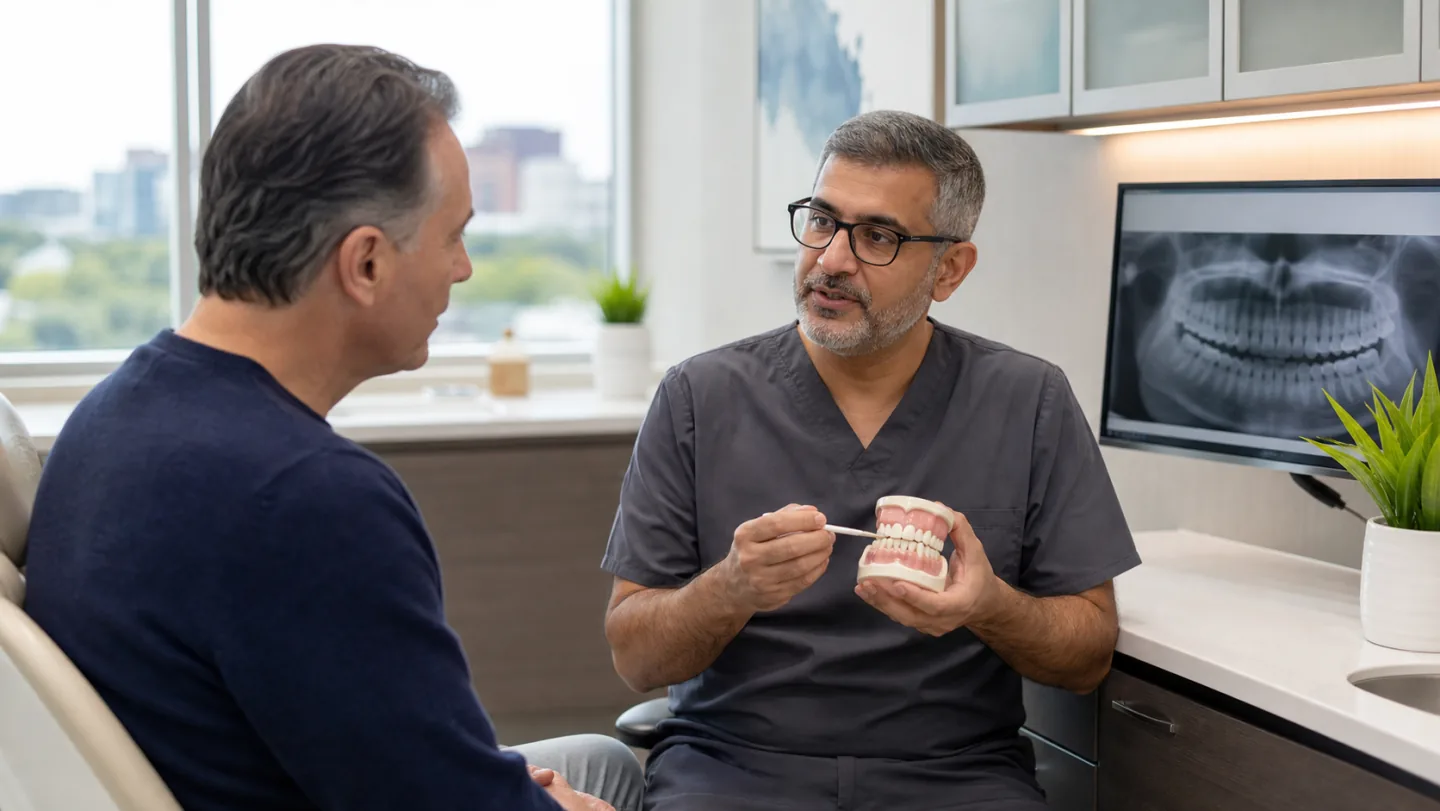
A dental professional explaining periodontal pocket treatment with a dental model
The deep spot is way at the back

Pocket Reduction Surgery for Waterford Green Residents

Molars are awkward to reach with a brush, and awkward for gum treatment too. If you live in Waterford Green and your stubborn readings sit behind your cheek, this page looks at why location in the mouth matters.

Let's find a time

Request an appointment

We’ll call to confirm your appointment. For urgent care, please call us directly.

Teeth you rarely see

Why Back Teeth Can Hold On to Deep Pockets

Back teeth tend to have more than one root, and those roots do not always have tidy, even surfaces. When a pocket forms there, plaque and hardened deposits can settle in contours that a brush, floss or even a non-surgical cleaning may struggle to follow. That is one reason a molar can stay deep while the teeth in front of it settle down.

Pocket reduction surgery opens the gum so those surfaces can be seen and treated directly. Whether it suits your molar is a question for an assessment at our McPhillips Street clinic in Winnipeg, where Waterford Green residents come for this care.

Explore pocket reduction surgery
Pale blue dental chair and wood-look cabinets in a treatment room at Winnipeg North Dental
A reclined blue chair with an overhead arm in a Winnipeg North Dental treatment room.

Root shape plays a part

The form of a molar’s roots and the bone around them influences what treatment can reach.

Reach cuts both ways

A back tooth has to be cleanable after healing as well, so ask how you would get to it.

The tooth’s outlook counts

Looseness, decay and remaining support all feed into whether surgery makes sense for that molar.

Surgery at the rear of the mouth

What gets weighed, and what gets done.

A molar is judged on its own merits before anyone talks about operating. If surgery goes ahead, the sequence is the same one used elsewhere in the mouth, applied to a harder-to-reach place.

Questions about the molar itself

These findings help your dentist decide whether opening the area would leave you with something you can maintain.

  • Did this tooth improve at all after scaling and root planing?
  • Does it still bleed when the pocket is measured?
  • How is the bone shaped around the separate roots?
  • Is any looseness, decay or failing dental work present?

How the procedure unfolds

Work is confined to the planned area, starting only once local anaesthetic has taken effect.

  • Freezing is applied around the molar being treated.
  • A section of gum is eased back so the roots become visible.
  • Deposits and inflamed tissue come away under direct view.
  • Uneven bone may be smoothed if needed before sutures secure the gum.

Not every molar is a good candidate. If predictable upkeep seems unlikely, your dentist can talk through other ways of managing that tooth.

From reading to decision

A careful look at one hard-to-see area.

You will want to understand what is happening in a place you cannot easily look at yourself. Here is a sensible order for that conversation.

Request your visit
  1. 01

    Point out what you have noticed

    Food that keeps catching, tenderness when chewing or bleeding from the same corner are all worth mentioning, along with any health changes.

  2. 02

    Have the back teeth examined

    Your dentist reviews readings, bleeding, bone shape and tooth support, along with any imaging that is clinically needed for that part of the mouth.

  3. 03

    Ask to see where the problem is

    A model or image can make a molar’s roots easier to picture. Ask for one if a verbal description of the area is not enough.

  4. 04

    Settle the plan for that tooth

    Surgery, continued monitoring or another approach may be discussed. Chosen sites are then scheduled, with healing appointments to follow.

Getting ready to talk molars

Note which corner is bothering you.

Back-tooth problems can be surprisingly hard to describe. A quick note about the side, upper or lower, and what you feel there gives the discussion a useful starting point.

Finding it hard to pinpoint a sore spot is common at the rear of the mouth, so an approximate description is perfectly useful.

Helpful details for your visit

  • Which side tends to trap food or feel tender when you chew.
  • Any earlier gum readings or treatment records for those teeth.
  • Crowns, large fillings or root canal work in that part of your mouth.
  • Your medication list, tobacco use and current health conditions.
Reception desk with potted plants and an abstract painting at Winnipeg North Dental
Dental chair with an overhead light arm at Winnipeg North Dental

A reception counter with orchids, and a blue treatment chair, at Winnipeg North Dental.

Staying comfortable at the back

A long reach calls for clear signals.

Having someone work far back in your mouth can feel different from treatment at the front. Saying so early gives you and the team a chance to talk about what would help.

Thorough freezing first

Local anaesthetic is how these procedures are commonly done, and other comfort choices depend on your health history.

If your jaw tires easily

Mention jaw stiffness or a strong gag reflex beforehand, since rear-tooth work can make both more noticeable.

Arrange a way to pause

Decide with your team how you will signal a need for a break while your mouth is open.

Healing behind the cheek

Leave the area alone, then learn to reach it.

Tucked-away sites can tempt you to pull your cheek aside for a look. Resist that, and let the follow-up appointment answer your questions about how the gum is doing.

01

Hands off for the first days

During the initial 24 to 48 hours, rest, take medication only as directed, pick foods that suit you and avoid stretching your cheek to check.

02

Clean as you were told

The operated area is not brushed early on, so rely on the rinse or cleaning directions you were given, and stay away from tobacco.

03

Practise your new angle

After the review visit tells you when to restart, ask which small brush or aid gets to those rear surfaces and how to steer it there.

Worried about how the site is healing? Call the clinic instead of trying to inspect it yourself.

Talk with our team
Front of the Winnipeg North Dental building with its name and phone number above the door

Winnipeg North Dental

Unit-5 2358 Mcphillips Street, Winnipeg, MB R2V 4J6
Get directions (opens in a new tab)
Where the molar gets assessed

Back-Tooth Gum Care on McPhillips Street

If you live in Waterford Green, your molar would be examined, and any surgery carried out, at Winnipeg North Dental, Unit 5, 2358 McPhillips Street, Winnipeg.

Sending the form asks for a time; it does not hold one. Someone from the clinic will reply to confirm, or you can phone (204) 338-3003.

Questions about coverage?

Talk with our team before your visit or learn about CDCP.

A little clarity before your visit

Your questions, answered.

Helpful details about pocket reduction surgery in Waterford Green.

Ask our team
I’m in Waterford Green with a deep molar reading. How do I get it looked at?

Use this page’s form or call (204) 338-3003 to request an assessment at our McPhillips Street clinic, and mention which tooth you were told about if you know.

Why did my front teeth respond to cleaning but not this molar?

Multiple roots and uneven surfaces can make a back tooth harder to treat without seeing it directly. Your dentist can look at how that particular tooth is shaped.

Would it be simpler to remove the tooth?

That depends on the tooth’s support, its restorative condition and whether it could be maintained. Ask about keeping it, treating it differently and removing it, and what each path would involve for you.

Can I chew on that side while it heals?

Your own aftercare sheet comes first here. Ask what to eat and where to chew, because the answer can vary with how much was done and which teeth were involved.

Will a molar be easier to clean once this is done?

Better access is the aim, though the area may have wider spaces or more exposed root than before. Ask for a demonstration of how to clean it after you have healed.

Get that corner checked

Find out what your stubborn molar needs.

Request a gum assessment on McPhillips Street and tell the clinic which side concerns you. A staff member will follow up to arrange a time.

Patient testimonials

Kind words from our patients

★★★★★ 5.0 from 440+ reviews on Google

Close to home

Areas we serve

Convenient dental care on McPhillips Street for families across northwest Winnipeg and nearby communities.

Explore all service areas

A healthier smile is one visit away

Ready for dental care that feels genuinely comfortable?

✓ New patients welcome ✓ Direct insurance billing ✓ Multilingual team

How can we help?

Our dental team is here for you.

Ready to book or have a question? Choose the option that works best for you.

For urgent dental concerns, please call us directly.

Send us a message

Our team will reply during clinic hours.


