Skip to content
Winnipeg North Dental
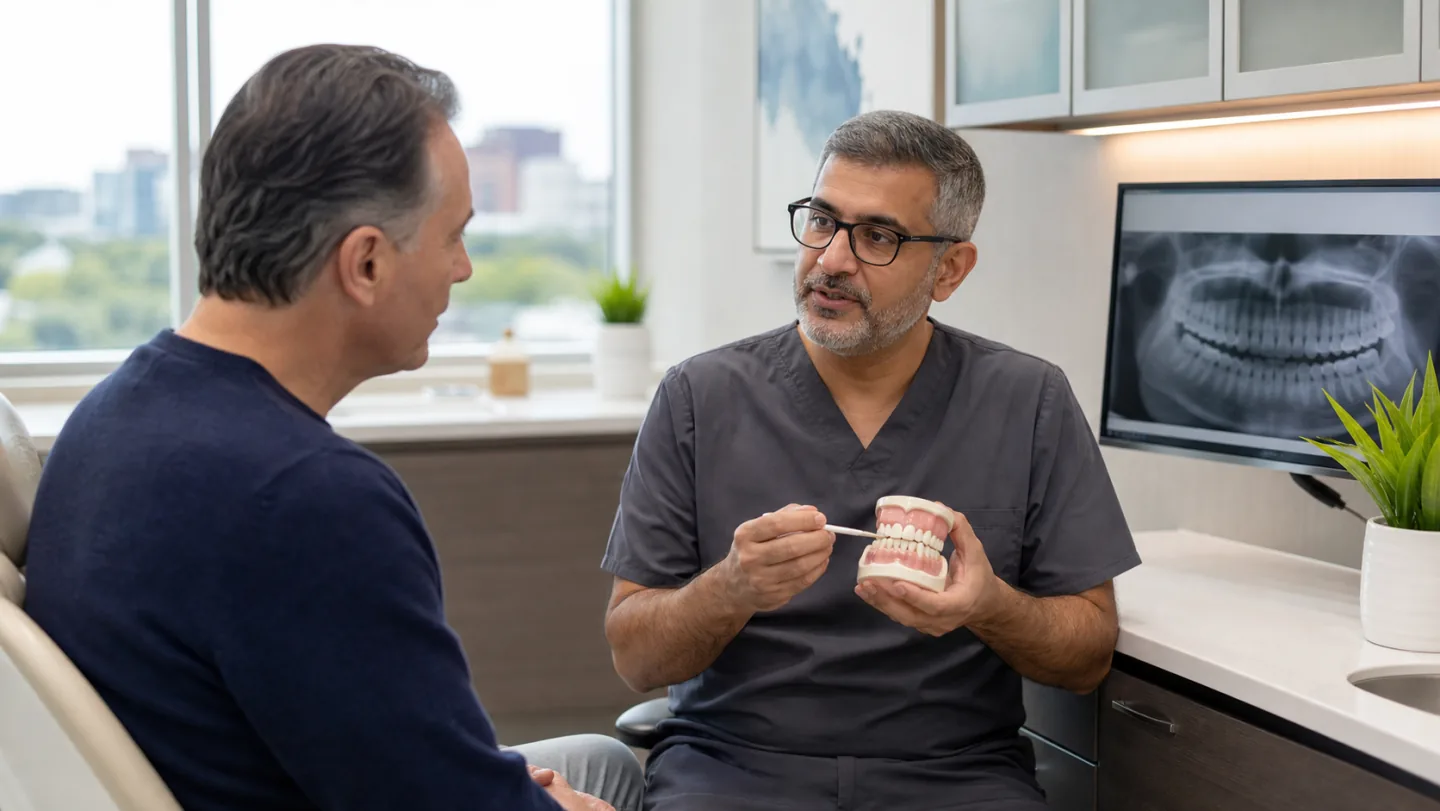
A dental professional explaining periodontal pocket treatment with a dental model
A folder for your gum care

Pocket Reduction Surgery for St. Andrews Residents

Periodontal treatment produces a lot of numbers, dates and instructions. If you live in St. Andrews and come into Winnipeg for care, a tidy personal record makes every stage of pocket reduction easier to follow.

Let's find a time

Request an appointment

We’ll call to confirm your appointment. For urgent care, please call us directly.

Paper trail, plain language

Tracking Gum Surgery From First Reading to Maintenance

Pocket reduction surgery sits in the middle of a longer story. Deep cleaning generally comes first, then a reassessment, and any surgery is followed by healing checks and ongoing maintenance. Details from one stage inform the next, which is why some people like to keep their own notes.

St. Andrews lies outside the City of Winnipeg, and the treatment itself happens at our McPhillips Street clinic. With appointments spread over time, a simple folder holding your questions, dates and aftercare instructions means you are not relying on memory between trips.

Explore pocket reduction surgery
White desk with black padded chairs and a framed coastal painting in a consultation room at Winnipeg North Dental
A white desk, black padded chairs and a coastal painting in a consultation room.

Note the sites

Jot down which teeth were discussed and what was said about each, in words that make sense to you.

Log the dates

Earlier therapy, reassessment, surgery and review dates form a timeline that is handy when questions come up.

Keep the aftercare handy

Store whatever instructions you are given where you can find them quickly once you are back home.

Worth writing down

Two sets of facts to keep track of.

One set explains why a site is being considered for surgery. The other describes what the procedure does. You needn’t master the terminology, but knowing the headings helps your notes make sense.

Why the site was chosen

A pocket measurement is one entry among several. Your dentist weighs a wider group of findings before suggesting an operation.

  • How the area responded to scaling and root planing.
  • Whether it still bleeds, and whether it stayed deep.
  • The shape of the bone and the anatomy of the roots.
  • Mobility, remaining support, decay and any restorations.

What gets done on the day

Should surgery go ahead, the sequence is straightforward to record, and you can ask which parts apply to your own sites.

  • Local anaesthetic thoroughly numbs the planned area.
  • Gum tissue is lifted so roots and bone can be seen.
  • Deposits and inflamed tissue are cleared away with care.
  • Irregular bone may be reshaped, then sutures hold the tissue.

Ask to have anything unfamiliar spelled or explained again. A note that makes sense to you later is worth an extra minute of conversation.

Your timeline

Four entries you will want in your folder.

People’s timelines differ, so treat this as a framework. Fill in the real dates and details as your own care unfolds.

Request your visit
  1. 01

    Entry one: the assessment

    Record the sites reviewed, any readings you were told about and what your dentist thinks of the tooth’s outlook. Bring along any earlier findings you already hold.

  2. 02

    Entry two: the decision

    Capture which options were raised, including monitoring or a different approach, along with the estimate and your remaining questions for the next conversation.

  3. 03

    Entry three: surgery day

    Add the area treated, the medication directions you received and how to clean around it. Your clinician’s instructions outrank anything you read elsewhere, this page included.

  4. 04

    Entry four: the healing review

    Write down whether sutures came out, when you were told to resume cleaning that area and how your periodontal maintenance will be arranged going forward.

Gather these first

Start your folder before the assessment.

You don’t need anything elaborate. A notebook or a phone note will do, as long as everything lives in one place and you can bring it with you.

When you speak with the clinic about booking, a useful question is how many visits to allow for and roughly how long each may take, so your trips can be planned sensibly.

First pages of the folder

  • Current medications and an up-to-date summary of your health history.
  • Where and when your scaling and root planing took place, if you know.
  • Contact details for any dental office that holds your X-rays or charts.
  • Insurance or CDCP information, plus a spare page for estimate questions.
Blue upholstered bench below two abstract paintings in the Winnipeg North Dental waiting area
Pale blue treatment chair beside wood-toned cabinets at Winnipeg North Dental

A blue bench beneath two paintings, and a pale blue treatment chair with wood-toned cabinets.

Notes on comfort too

Comfort details belong in the record as well.

What helped you feel at ease last time is as worth remembering as any measurement. Mention it, and add anything you would like handled differently at your next appointment.

How freezing has gone

If freezing has been slow or patchy for you in the past, say so. Local anaesthetic is what this surgery commonly relies on.

List your worries

A short list can be easier to bring up than a feeling. Hand it over or read from it if talking is difficult.

Ask for a recap

Before leaving, check your notes against what you were told. Clearing up a mix-up in the room beats wondering at home.

Afterward, in your own hand

Keep the record going as you heal.

Recovery has stages, and each comes with its own instructions. Rest comes first, then careful plaque control, then a review, and finally the routine that carries on for years.

01

The first 24–48 hours

Your note for this stage is short: rest, take medication as directed, choose suitable foods, and leave your lip and cheek alone instead of peeking at the site.

02

Before your review

No brushing on the surgical area for now. Follow the rinse or cleaning method you were shown, skip tobacco, and steer clear of activity that could disturb sutures.

03

Maintenance entries

A history of periodontal disease stays relevant after surgery. Add each maintenance date and any changed reading, so a shift at one site stands out.

Anything worrying during healing is a reason to call the clinic, not an item to save for your next visit.

Talk with our team
Clinic storefront with a Winnipeg North Dental sign and phone number above glass doors

Winnipeg North Dental

Unit-5 2358 Mcphillips Street, Winnipeg, MB R2V 4J6
Get directions (opens in a new tab)
Address for the folder

Where St. Andrews Patients Have This Surgery

Assessment, surgery and healing reviews for St. Andrews residents happen in Winnipeg, at Winnipeg North Dental, Unit 5, 2358 McPhillips Street, Winnipeg, MB R2V 4J6.

Sending the form starts a conversation; the clinic replies to settle an actual time. Prefer to talk it through? The number for your notes is (204) 338-3003.

Questions about coverage?

Talk with our team before your visit or learn about CDCP.

A little clarity before your visit

Your questions, answered.

Helpful details about pocket reduction surgery in St. Andrews.

Ask our team
What is the first entry for a St. Andrews resident?

Request an assessment using the form on this page or by phoning (204) 338-3003. Your gums are examined at our McPhillips Street clinic before any surgical decision is reached.

What should I write down at the assessment?

Teeth discussed, what was found at each, which options came up and what you still want to ask. Your own wording is fine, as long as you can understand it afterward.

Can I ask what my pocket numbers mean as they are read out?

Certainly. Bear in mind that depth is only part of the picture, because bleeding, bone shape, tooth support and how well the area can be kept clean also shape the advice.

How would earlier records from another office help?

Previous findings can show how a site has behaved over time. Ask the clinic what would be useful for your appointment and how the transfer can be arranged.

Does a good reading in my notes mean I am finished with care?

No. Pockets can deepen again when plaque builds up or risk factors remain, so home cleaning and periodontal maintenance carry on after a reassuring result.

What should I ask to help plan trips into the city?

Ask how many appointments your sites may involve, how long to allow for each and when a healing review is likely. Answers depend on the extent of the planned treatment.

Open your first page

Book the assessment and begin your record.

Send a request to our McPhillips Street clinic. Someone will respond about a suitable time, and your first set of questions can come along with you.

Patient testimonials

Kind words from our patients

★★★★★ 5.0 from 440+ reviews on Google

Close to home

Areas we serve

Convenient dental care on McPhillips Street for families across northwest Winnipeg and nearby communities.

Explore all service areas

A healthier smile is one visit away

Ready for dental care that feels genuinely comfortable?

✓ New patients welcome ✓ Direct insurance billing ✓ Multilingual team

How can we help?

Our dental team is here for you.

Ready to book or have a question? Choose the option that works best for you.

For urgent dental concerns, please call us directly.

Send us a message

Our team will reply during clinic hours.



