Skip to content
Winnipeg North Dental
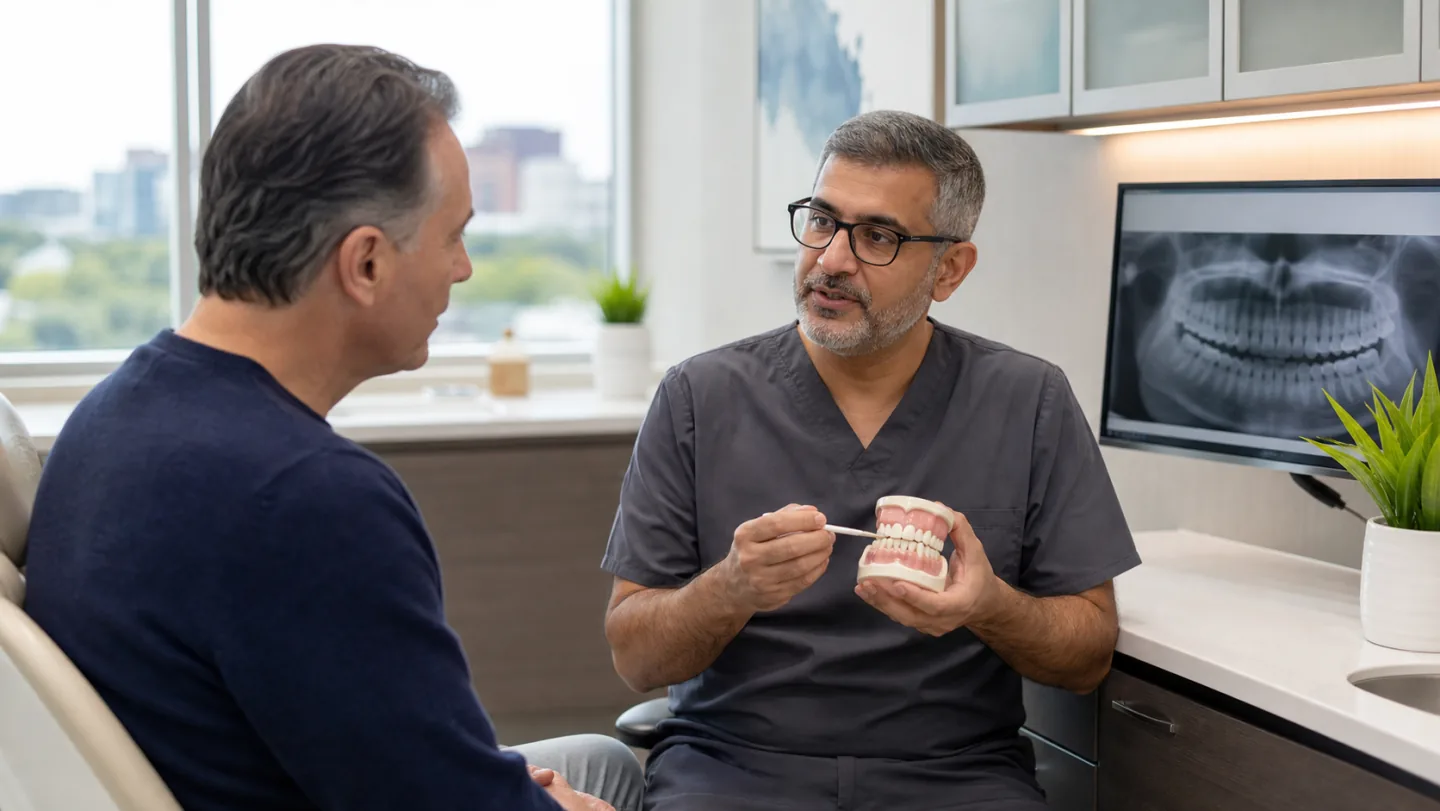
A dental professional explaining periodontal pocket treatment with a dental model
Your share and the dental team’s

Pocket Reduction Surgery for Rivercrest Residents

This surgery works as a partnership. Some of it can only happen in the chair, and much of it happens at your bathroom sink. Here is how that split looks for Rivercrest residents treated in Winnipeg.

Let's find a time

Request an appointment

We’ll call to confirm your appointment. For urgent care, please call us directly.

A two-sided commitment

What the Clinic Handles, and What Stays With You

It is tempting to think of surgery as something done to you, after which the problem belongs to the past. Pocket reduction doesn’t quite work that way. The operation creates better access, and it is regular cleaning and maintenance that make use of that access over the years.

Rivercrest is outside the City of Winnipeg, so residents travel in to our McPhillips Street clinic for the clinical part of this partnership. Most of your own part takes place back home, every day, once the site has healed enough for you to begin.

Explore pocket reduction surgery
Treatment room at Winnipeg North Dental with a pale blue chair, instrument arm and wooden cabinets
A pale blue chair, an instrument arm and wooden cabinets in a treatment room.

Clinic: diagnosis and surgery

Evaluating the site, carrying out the procedure and reviewing your healing are clinical responsibilities.

You: everyday plaque control

Between appointments, what you do at home is what keeps plaque from rebuilding around the treated site.

Together: the long game

Maintenance visits are more useful when you and your team share what is changing and what is hard to reach.

Who does what

Dividing the work, stage by stage.

Your dentist can’t do the daily cleaning, and you can’t reach below the gum. Knowing where each responsibility sits helps you judge whether surgery suits you.

The clinical side

Local anaesthetic comes first. Then the team has direct access to work that you could never do yourself.

  • Gently lifting gum tissue from the root surfaces and bone.
  • Removing stubborn deposits and inflamed tissue.
  • Reshaping uneven bone contours, if appropriate.
  • Resetting the gum at its planned level with sutures.

The side that’s yours

Your dentist will also weigh whether the finished area can realistically be cleaned, because a result you can’t keep up with has limited value.

  • Daily plaque control once you have been cleared to resume.
  • Sharing tobacco use and health changes honestly.
  • Keeping your follow-up and maintenance appointments.
  • Mentioning any area you struggle to reach with your tools.

If you doubt that you can manage the cleaning, tell your dentist. It is relevant information for the recommendation, and nobody will be surprised to hear it.

Shared steps

Where each party comes in along the way.

Your experience may run differently depending on your findings. This outline simply shows how responsibility shifts over the course of care.

Request your visit
  1. 01

    Assessment: mostly the clinic’s job

    Findings on inflammation, bone, roots and tooth outlook come from your dentist. What you contribute is your history, your medications and your honest routine.

  2. 02

    Decision: very much a joint one

    You hear what is advised and which alternatives exist, such as monitoring. Your questions and priorities are then what shape how things go forward.

  3. 03

    Procedure: handled by the clinic

    Your part here is simply to arrive prepared and speak up about comfort. Afterward, the instructions you are given become your responsibility to follow.

  4. 04

    Review: back to both of you

    Healing is examined and any necessary suture removal is done. In exchange, you find out exactly when and how to take over cleaning the area again.

Your side of the groundwork

Before surgery, take stock of your routine.

An honest look at how you clean now gives your dentist something useful to work with. Say what works, what you skip and what your hands find awkward.

Coming in from outside Winnipeg? Your own planning can start with a few questions for the clinic: how many visits, how long each may last and what comes afterward.

Things that fall to you

  • Bringing a current medication list and an accurate health history.
  • Being straightforward about tobacco use and flossing habits.
  • Sorting out suitable foods and time to rest ahead of your date.
  • Having insurance or CDCP details ready when an estimate is discussed.
Wide reception space with a counter, a bench and a patterned rug at Winnipeg North Dental
White desk with a keyboard and black chairs in a consultation room at Winnipeg North Dental

A reception counter with a patterned rug, and a white desk in a consultation room.

A two-way conversation

Comfort is a responsibility you can share too.

The team can only adjust to what they know about. Your job is telling them what is going on, and theirs is responding with care and explanation.

You speak up

If something feels off during treatment, signal it. Nobody expects you to sit silently through a concern.

They explain

Feel free to ask what each stage involves. An explanation you can follow is a fair thing to expect.

Numbing is on their side

Local anaesthetic is commonly how this is done, and your health history is reviewed along with any comfort options.

When it passes to you

Recovery hands over to you one stage at a time.

You follow your own instructions first of all, since those are written around your own surgery. Here is the general handover, from early healing into the long term.

01

You guard the site

Rest for the first 24–48 hours, take medication as directed and eat suitable foods. Your job includes not pulling back your lip or cheek for a look.

02

You stay off it for now

Brushing the area is not yet part of your job. Use the rinse or cleaning approach you were shown, and avoid tobacco and activity that could disturb sutures.

03

You both keep watch

Your cleaning and the team’s periodontal maintenance work together, because disease history stays with you. A changing reading matters most when it is caught and discussed.

If you are unsure whether something you notice is a problem, it is fair to pass that question to the clinic by phone.

Talk with our team
Front of the Winnipeg North Dental clinic with a sign, phone number and glass doors

Winnipeg North Dental

Unit-5 2358 Mcphillips Street, Winnipeg, MB R2V 4J6
Get directions (opens in a new tab)
The clinical part happens here

Rivercrest Patients and Our Winnipeg Clinic

For Rivercrest residents, the clinical stages take place at Winnipeg North Dental, Unit 5, 2358 McPhillips Street, Winnipeg, MB R2V 4J6.

Sending the online form asks for a time; the clinic’s reply is what actually arranges one. Call (204) 338-3003 if you would like to discuss it first.

Questions about coverage?

Talk with our team before your visit or learn about CDCP.

A little clarity before your visit

Your questions, answered.

Helpful details about pocket reduction surgery in Rivercrest.

Ask our team
From Rivercrest, what is my first step in this partnership?

Start with the request form or by calling (204) 338-3003. Your visit takes place at our McPhillips Street clinic, and any surgical discussion follows from the examination.

Is the outcome mostly up to the surgeon or to me?

Both matter. Clinical work provides access and a more manageable shape, while your cleaning and maintenance visits help keep that area stable as time passes.

What if I’m not good at flossing?

Say so plainly. Your team can look at what is difficult and show you what might suit the area, and it also informs whether surgery would serve you well.

Who decides whether I go ahead?

You do, after hearing what your dentist advises and why. Your dentist’s job is to explain the findings, alternatives and likely changes so you can make that choice.

How will I know when to take over cleaning the area?

You will be told at your healing review. Until then, follow the rinse or cleaning instructions from your surgery and keep the brush away from the treated site.

What is the clinic’s role once I have healed?

Ongoing periodontal maintenance and monitoring. Ask how visits would be scheduled in your case, since that is a long-term arrangement rather than a final appointment.

Your part starts now

Send a request, and we’ll start with the assessment.

Ask for an appointment at our McPhillips Street clinic, and let the staff know what you hope to discuss. They will respond about possible times.

Patient testimonials

Kind words from our patients

★★★★★ 5.0 from 440+ reviews on Google

Close to home

Areas we serve

Convenient dental care on McPhillips Street for families across northwest Winnipeg and nearby communities.

Explore all service areas

A healthier smile is one visit away

Ready for dental care that feels genuinely comfortable?

✓ New patients welcome ✓ Direct insurance billing ✓ Multilingual team

How can we help?

Our dental team is here for you.

Ready to book or have a question? Choose the option that works best for you.

For urgent dental concerns, please call us directly.

Send us a message

Our team will reply during clinic hours.



