Skip to content
Winnipeg North Dental
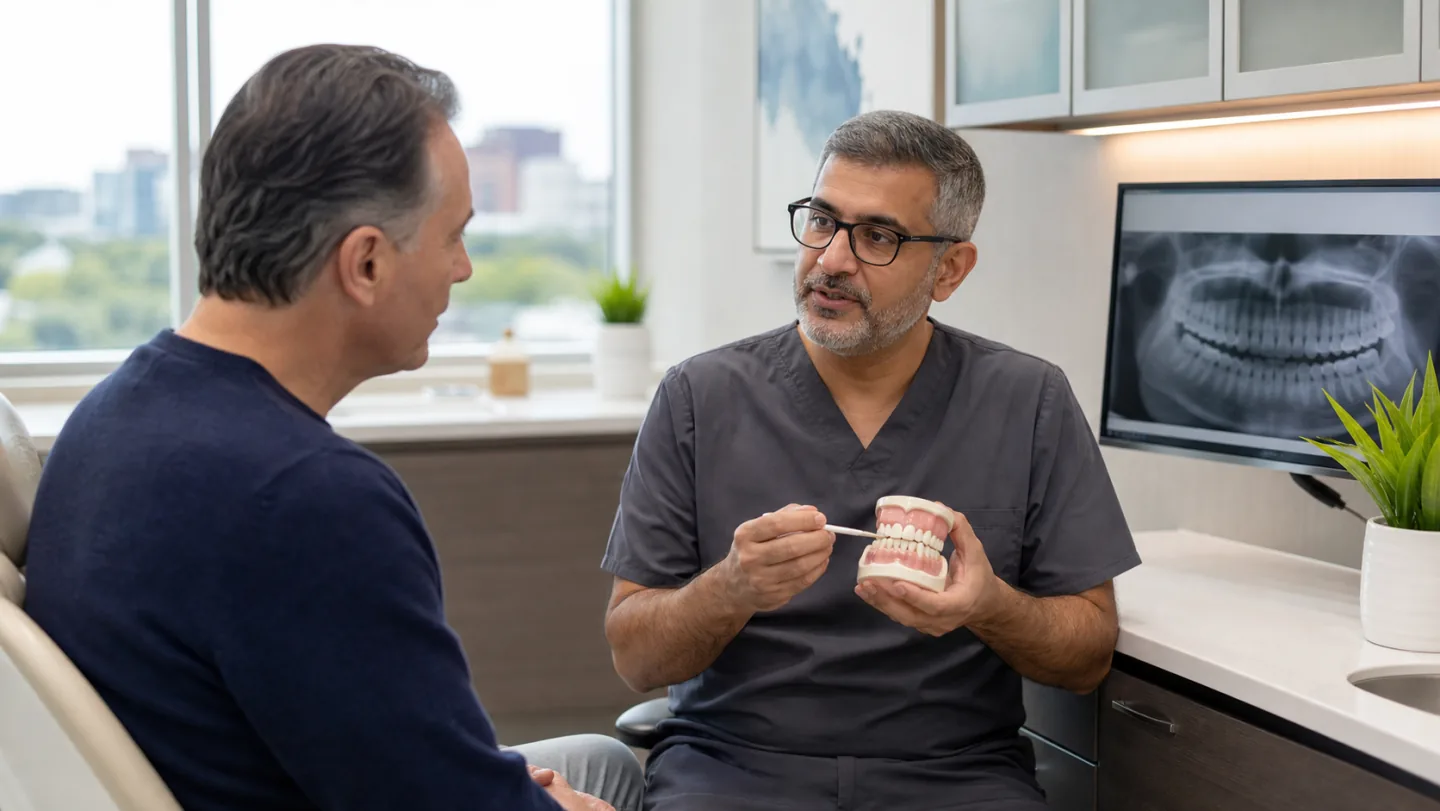
A dental professional explaining periodontal pocket treatment with a dental model
Feeling ashamed of your gums?

Pocket Reduction Surgery for River Trail Residents

Many people quietly assume their gum problems are a personal failing, and that feeling can keep them out of the chair. River Trail readers, this one is about getting past the embarrassment and on to useful information.

Let's find a time

Request an appointment

We’ll call to confirm your appointment. For urgent care, please call us directly.

Set the blame aside

Getting Past the Embarrassment of Gum Disease

Gum disease is an inflammatory condition, and it can be influenced by more than your brushing. Deep pockets can shelter deposits that no toothbrush reaches, so a person doing their honest daily work can still end up with sites that need professional attention. Nobody needs to confess anything to deserve good care.

What helps most is a clear account of where things stand today. Care for River Trail residents takes place at our clinic on McPhillips Street in Winnipeg, and an assessment there can show whether surgery should be considered at all, or whether another step comes first.

Explore pocket reduction surgery
Quiet waiting area with light-coloured chairs by a shaded window at Winnipeg North Dental
Two white chairs and small plants beside a shaded window at Winnipeg North Dental.

Facts over feelings of fault

Your dentist needs accurate information about your mouth and habits, not an apology for them.

Start from where you are

Recommendations follow the current findings, so the past is useful only as background.

Share at your own pace

Tell the team what you feel able to say at first, then add details whenever you are ready.

Clear information, no lecture

What your gums are telling the dental team.

A clinical description can feel gentler than the story you may be telling yourself. Here is what gets looked at, and what surgery would involve if it were suggested.

The findings that count

Each of these is a description of tissue and bone, and none of them is a verdict on you as a person.

  • How deep the spaces around particular teeth are.
  • Whether those places bleed or look inflamed.
  • How the teeth are supported and how the bone is shaped.
  • How each area has responded to any previous gum care.

If surgery is recommended

Scaling and root planing usually comes first, followed by surgery at sites that remain a concern after reassessment.

  • The chosen area is made numb before any other step starts.
  • Gum is lifted so the root surfaces can be cleaned directly.
  • Inflamed tissue is removed, and bone may be reshaped if suitable.
  • Stitches then hold the tissue at the level planned for it.

Keep in mind that surgery supports your home care and cannot replace it. Your dentist will want an honest idea of what you can realistically maintain.

Walking in the door

A first visit does not have to be a confession.

If you are dreading a reaction from staff, it may help to know what you can control. You choose how you begin, and you can take this one step at a time.

Request your visit
  1. 01

    Open with one honest line

    Something like “I’m embarrassed about my gums” gives everyone a helpful starting point, and it saves you from having to explain everything in one breath.

  2. 02

    Give the facts you can

    Your health background, medications, tobacco use and the time since your last cleaning are all useful details, and you may ask why each one matters.

  3. 03

    Let the examination speak

    Your dentist reviews pocket readings, bleeding and support, then explains what they suggest for each area in straightforward language.

  4. 04

    Pick one next step

    You need not solve everything at once. Agree on what comes next, whether that is non-surgical care, monitoring, or planning surgery for selected sites.

Small steps beforehand

You do not need to clean up for the appointment.

Some people postpone a visit until they have tidied up their routine. Your usual care is enough, and seeing your gums as they really are is the point of going.

If a phone call feels easier than filling in a form, or the other way round, choose whichever way gets you started.

Keep these handy

  • Names of your medicines and anything new with your general health.
  • A rough idea of when you last had dental care.
  • Whatever you remember about earlier gum treatment, even if it is vague.
  • One or two questions you would really like answered.
Front desk with a white counter and blue accent wall at Winnipeg North Dental
Consultation room with a desk beside a shaded window at Winnipeg North Dental

A white front desk and a window-side consultation room at Winnipeg North Dental.

Comfort is more than numbness

Feeling respected is part of the visit.

Discomfort can be emotional as well as physical. If a comment or a question lands badly, you are entitled to say so and to ask for things to be explained differently.

Tell us what you dread

A lecture, a mirror held up, a long list of numbers: naming what you fear helps your team understand.

Numbing for the procedure

Local anaesthetic is usual for this surgery, and any further comfort options depend on your health history.

Ask for a breather

You may want a moment during a difficult conversation or a procedure, so ask how to signal for one.

Moving forward

A fresh routine, with no scorekeeping.

Healing gives you a practical reason to learn new habits. Think of follow-up visits as a chance for coaching rather than a test you might fail.

01

Short-term rules

Rest at first, leave the treated gum unbrushed, follow your rinse directions and avoid tobacco. Your sheet of instructions is the document to go by.

02

Coaching at your review

Sutures may come out at this visit if they need to, and you will be told how to restart cleaning. Ask for help if a technique feels unfamiliar.

03

Honest maintenance visits

Disease history does not vanish after surgery, so continued professional care matters. Be upfront when a routine slips; that information helps your hygienist.

If you miss a step or fall behind, please phone the clinic instead of staying away out of embarrassment.

Talk with our team
Winnipeg North Dental storefront with shaded windows and a raised logo on the sign

Winnipeg North Dental

Unit-5 2358 Mcphillips Street, Winnipeg, MB R2V 4J6
Get directions (opens in a new tab)
When you feel ready

A Judgment-Free Conversation on McPhillips Street

River Trail residents have this assessment and any related treatment at Winnipeg North Dental, Unit 5, 2358 McPhillips Street.

Your form submission is not a booked appointment, as the clinic still needs to confirm with you. If you would like to hear a voice first, call (204) 338-3003.

Questions about coverage?

Talk with our team before your visit or learn about CDCP.

A little clarity before your visit

Your questions, answered.

Helpful details about pocket reduction surgery in River Trail.

Ask our team
I live in River Trail and I’m embarrassed about my gums. What should I say when I call?

Saying that you would like your gums assessed is plenty. Phone (204) 338-3003 or use the form to ask for a visit at our McPhillips Street clinic, and add more only if you wish to.

Will I be told off for neglecting my teeth?

You should expect a discussion of findings and next steps, not a scolding. If anything you hear feels unhelpful, say so, since it is reasonable to ask for a different approach.

Is gum disease my fault?

Plaque control matters, yet other risk factors exist too, and deep sites can be beyond what daily cleaning reaches. Knowing what is driving your own condition is more useful than assigning blame.

Are my teeth too far gone for anyone to help?

That is impossible to judge without an examination. Each tooth’s support and outlook are assessed on their own, and there may be several ways of managing what is found.

Do I have to tell the team how rarely I floss?

It helps if you do. Your dentist uses this to judge whether a treated site could realistically be maintained, and to suggest a routine that you might actually keep.

No apology required

Come as you are, gums and all.

Ask for a visit to our McPhillips Street clinic with whatever words feel comfortable. Staff will reach out to work out the timing with you.

Patient testimonials

Kind words from our patients

★★★★★ 5.0 from 440+ reviews on Google

Close to home

Areas we serve

Convenient dental care on McPhillips Street for families across northwest Winnipeg and nearby communities.

Explore all service areas

A healthier smile is one visit away

Ready for dental care that feels genuinely comfortable?

✓ New patients welcome ✓ Direct insurance billing ✓ Multilingual team

How can we help?

Our dental team is here for you.

Ready to book or have a question? Choose the option that works best for you.

For urgent dental concerns, please call us directly.

Send us a message

Our team will reply during clinic hours.



