Skip to content
Winnipeg North Dental
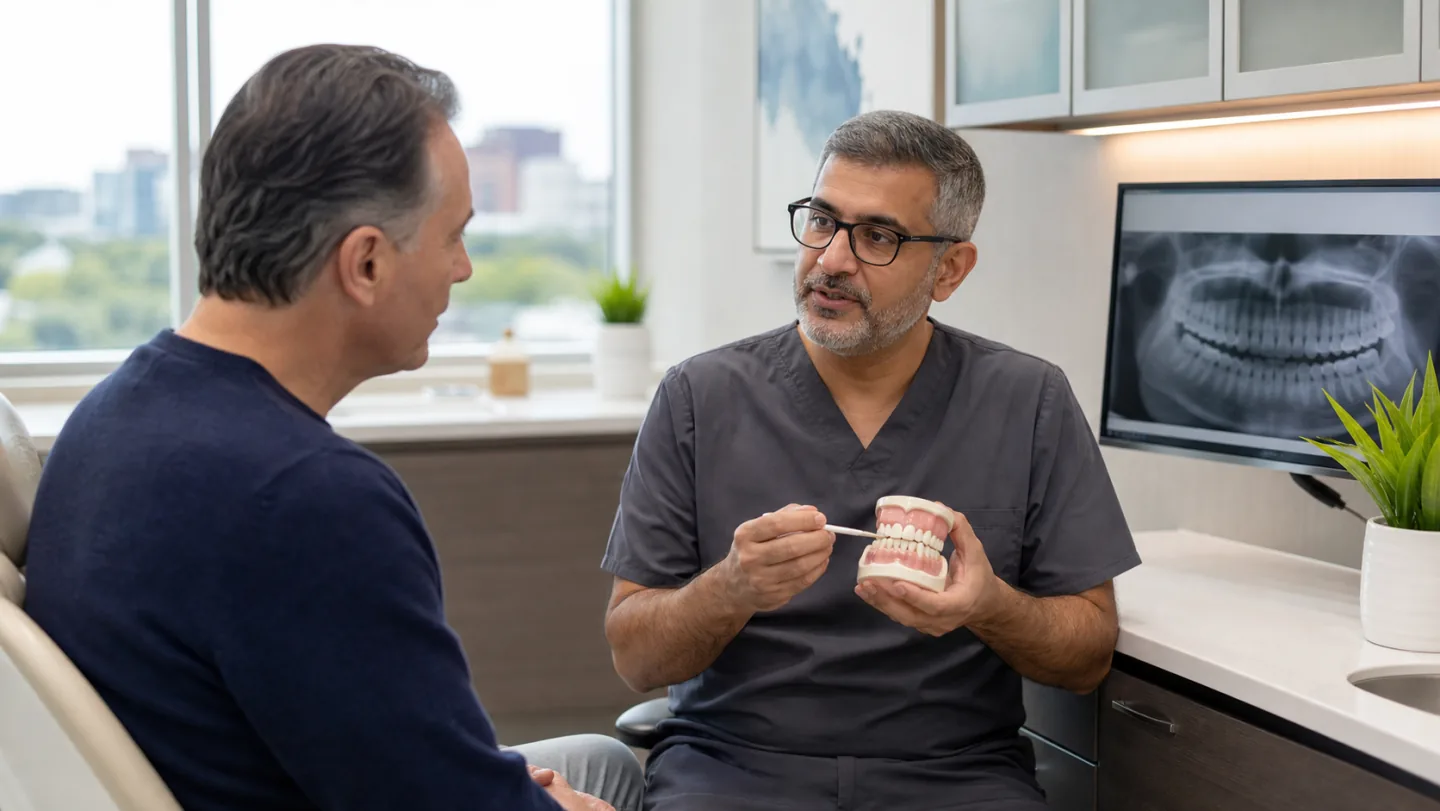
A dental professional explaining periodontal pocket treatment with a dental model
Keeping your regular dentist informed

Pocket Reduction Surgery for East St. Paul Residents

You may already have a dentist you know and trust when gum surgery comes up. This page helps East St. Paul residents think through records, communication and who looks after what if care happens in Winnipeg.

Let's find a time

Request an appointment

We’ll call to confirm your appointment. For urgent care, please call us directly.

More than one set of records

Coordinating Gum Surgery With Your Regular Dentist

East St. Paul lies outside the City of Winnipeg, and residents who come into Winnipeg for care may keep a dental home elsewhere. That can work well when everyone has the same information. Earlier readings, X-rays and the results of past treatment all help show how a site has behaved over time.

Any assessment and surgery with us takes place at our McPhillips Street clinic in Winnipeg. As you plan, ask how information would pass between offices and who you would see for cleanings and maintenance afterward, so that nothing falls between two sets of appointments.

Explore pocket reduction surgery
Reception desk with a clear divider and a glass door beyond it at Winnipeg North Dental
The front desk with a clear divider, and a frosted glass door, at Winnipeg North Dental.

History travels with you

Past readings and images can show whether a pocket has been changing, so ask how to obtain them.

Clarify who does what

Agree early on where healing checks and long-term periodontal maintenance would take place.

One clear point of contact

Find out whom to phone about the surgical site, particularly while you are healing.

Information and treatment

What each record adds, and what surgery does.

A previous office may hold useful clues about your gums. These notes explain how such information can feed into a decision, and what happens if surgery follows.

Records that may help

Your dentist will still examine you directly, but earlier details can make the trend at a site easier to see.

  • Periodontal charts from previous appointments.
  • Existing X-rays, where they remain useful for diagnosis.
  • Dates of any scaling and root planing or earlier surgery.
  • Details of crowns, bridges or other work near the deep site.

The surgery itself

If the findings point this way, treatment concentrates on specific sites and starts with thorough numbing.

  • Anaesthetic is placed at the area chosen for treatment.
  • With the gum eased aside, roots and supporting bone can be reached.
  • Any deposits and inflamed tissue remaining there are cleared.
  • Bone may be reshaped selectively, then sutures position the gum as planned.

Records add context but cannot replace a current examination. Your present findings and your dentist’s judgment shape any recommendation.

Bringing two offices together

A sequence that keeps everybody up to date.

Coordination is largely a matter of asking at the right moments. This outline shows where those questions tend to fit.

Request your visit
  1. 01

    Ask about records early

    When you request your assessment, find out what would be useful to have, and how a transfer from your present dental office could be arranged.

  2. 02

    Have your gums assessed

    Current measurements, bleeding, bone shape and tooth support are examined and can be compared with earlier information that is available.

  3. 03

    Sort out responsibilities

    Discuss where your follow-ups and maintenance might take place, and what information your regular dentist would need if you continue seeing them.

  4. 04

    Proceed with the plan

    Selected sites are then treated on your agreed date. Your review appointment covers healing and tells you when to resume cleaning there.

Before your assessment

Pull your dental history together.

You need not have everything, but a little information goes a long way. Even an office name and an approximate date can tell the team where to begin looking.

Your present dental office can tell you what it holds, and it is reasonable to ask how to have copies sent.

What to gather

  • Contact details for the office that normally looks after your teeth.
  • Approximate dates of your last cleaning and gum treatment.
  • Current medications and health conditions, including any changes.
  • Insurance or CDCP information, if an estimate is part of the discussion.
Consultation desk with a keyboard, shaded window and framed seascape at Winnipeg North Dental
Small white chairs and plants along a shaded window in a waiting area at Winnipeg North Dental

A framed seascape over a desk, and window chairs in the waiting area, at Winnipeg North Dental.

In an unfamiliar office

Tell new people what you already know works.

Visiting a clinic for the first time can feel strange when you are used to your own dental team. Passing on what has helped you before gives everyone a head start.

What has helped you before

If your own dentist has a way of keeping you settled, describe it so you can talk about it here.

The numbing plan

Treatment commonly uses local anaesthetic, and comfort options are discussed after your health history has been reviewed.

Getting to know the room

Ask to have instruments and steps explained if it would help to know what to expect in a new setting.

Afterward, on both sides

Who looks after you once surgery is done?

Healing instructions come from the treating clinic and should be followed closely. Longer-term care may involve your usual office, so it is worth discussing how that would work.

01

Instructions come first

Your aftercare sheet covers rest, medication, tobacco, food and how to clean without brushing the site. If you hear conflicting advice, call and check.

02

The review appointment

Tissue closure and hygiene are checked, and sutures come out where required. Ask if a summary of what was done can be shared with your regular dentist.

03

Maintenance afterward

Your gum disease history remains, so regular periodontal maintenance is essential. Settle where it will happen so that no appointment gets overlooked.

For a concern about your surgical site, phone the clinic that performed the treatment.

Talk with our team
Winnipeg North Dental front entrance with a railing and small garden bed

Winnipeg North Dental

Unit-5 2358 Mcphillips Street, Winnipeg, MB R2V 4J6
Get directions (opens in a new tab)
Where treatment takes place

East St. Paul Patients and the McPhillips Street Clinic

People from East St. Paul come into Winnipeg for this treatment, which is provided at Winnipeg North Dental, Unit 5, 2358 McPhillips Street.

An online request gets things moving but sets no appointment on its own; staff will follow up. You can also telephone (204) 338-3003 about records.

Questions about coverage?

Talk with our team before your visit or learn about CDCP.

A little clarity before your visit

Your questions, answered.

Helpful details about pocket reduction surgery in East St. Paul.

Ask our team
I live in East St. Paul and have my own dentist. Can I still ask about surgery?

Yes. You may request an assessment at our McPhillips Street clinic by form or at (204) 338-3003, and mention your regular dental office when you get in touch.

How do I get my X-rays and charts to you?

Call the clinic and ask what would help and how a transfer would be handled. Your current office can tell you about the records it holds.

Will old X-rays mean I can skip new ones?

Perhaps, depending on their quality and how recent they are. Imaging is decided on clinical need, so your dentist will let you know whether anything further is required.

Could I return to my usual office for cleanings afterward?

Ask about this during planning. The important thing is that long-term periodontal maintenance actually happens, and that whoever provides it knows what has been done.

Who do I call if I have a problem while healing?

Contact the clinic where your surgery was done, since it holds the details of your procedure and your aftercare instructions. Urgent concerns should be phoned in, not sent by form.

What should I ask about the plan for trips into Winnipeg?

Ask how many appointments are likely, what each one is for and how long you should allow. Your answers will depend on the extent of the planned treatment.

Connect the dots

Bring your history and your questions.

Request an assessment at our McPhillips Street clinic and tell us who your regular dentist is. Someone will contact you about the next steps.

Patient testimonials

Kind words from our patients

★★★★★ 5.0 from 440+ reviews on Google

Close to home

Areas we serve

Convenient dental care on McPhillips Street for families across northwest Winnipeg and nearby communities.

Explore all service areas

A healthier smile is one visit away

Ready for dental care that feels genuinely comfortable?

✓ New patients welcome ✓ Direct insurance billing ✓ Multilingual team

How can we help?

Our dental team is here for you.

Ready to book or have a question? Choose the option that works best for you.

For urgent dental concerns, please call us directly.

Send us a message

Our team will reply during clinic hours.



