Skip to content
Winnipeg North Dental
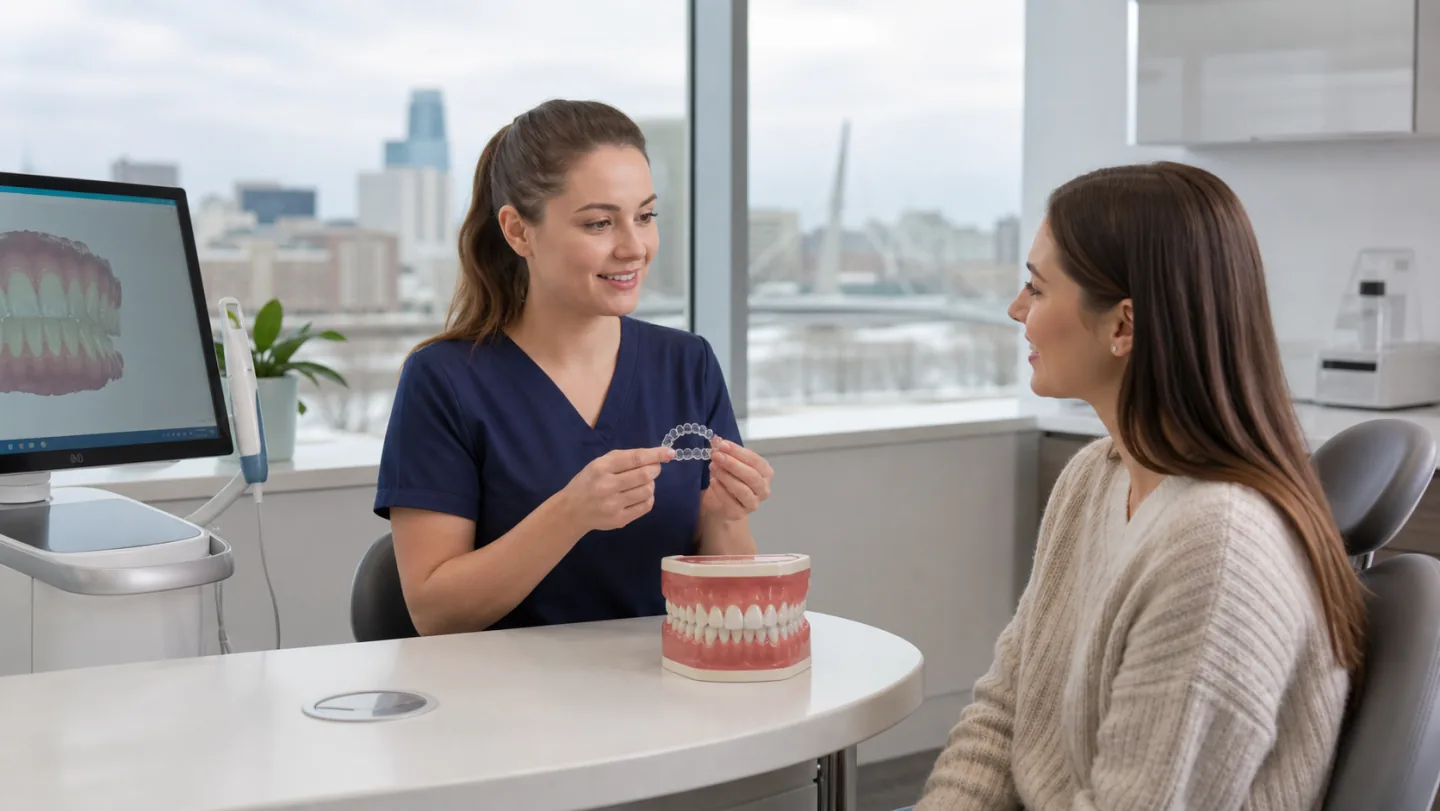
A dentist showing a clear aligner to a patient during a consultation
Align first, polish later?

Invisalign for Weston Residents

Chipped edges, uneven shapes and crowding often show up together. If you’re in Weston and picturing a bigger smile change, it’s worth thinking about what should happen in which order.

Let's find a time

Request an appointment

We’ll call to confirm your appointment. For urgent care, please call us directly.

Position, then shape

Where Aligners Fit in a Larger Smile Plan

Position and shape are two separate things. Aligners change where a tooth sits, while options such as bonding, tooth reshaping or veneers concern its form, surface or colour. If your goals involve both, the sequence of treatment is something to discuss before you commit to any of them.

Sometimes moving teeth first can simplify what comes afterward, and other times aligners aren’t needed at all. Weston residents can have this looked at together during an assessment at our McPhillips Street clinic in Winnipeg, where your teeth, gums and bite are all considered.

Explore invisalign
Treatment room showing a teal chair, a sink with a curved faucet and glass-front cabinets
A teal chair and curved faucet in a treatment room at Winnipeg North Dental.

Separate questions

Where a tooth sits and what it looks like are different issues, and they may call for different treatments.

Sequence deserves thought

Ask how one stage could affect the next before starting anything that alters a tooth’s surface.

Finishing is optional

Reshaping or bonding after alignment is a possibility for some patients, not a required final step.

Two kinds of change

What aligners do, and what they leave alone.

Moving teeth is the whole purpose of aligners. They don’t change a tooth’s surface, chips or colour, which is where other treatments might come in.

What movement may address

If the underlying problem is one of position, trays may offer a way to address it while leaving the tooth’s own structure largely as it is.

  • Crowded or rotated teeth can be aligned in suitable cases.
  • Selected gaps can be closed with controlled movement.
  • Certain bite relationships may be improved along the way.
  • Limited enamel reduction might be planned to create room.

What may come after

Once your teeth are where they’re meant to be, you might find that you want to refine a few remaining details, or that nothing further is needed.

  • Tooth reshaping can refine selected edges and contours.
  • Bonding may refine selected shapes when appropriate.
  • Veneers involve planning for shape, surface and colour.
  • Your dentist decides what suits your teeth at that point.

No need to commit to everything at once. Your dentist can explain which of these would be sensible to consider, and in what sequence, based on your own assessment.

One step at a time

The aligner stage of a longer plan.

Even if cosmetic work is on your mind, the aligner stage has its own structure. These are the steps it follows, with room to raise your wider goals.

Request your visit
  1. 01

    Describe the whole goal

    Tell your dentist everything you’d like to change, as your teeth, gums, bite and jaw relationships are examined and photographs and X-rays are reviewed.

  2. 02

    Sort out the order

    Where aligners make sense, the design covers each tooth’s path, sources of space and any added control. Ask how this fits with your later goals.

  3. 03

    Begin movement

    Trays are fitted and attachments placed where they’re planned. You’ll also be shown how to put in, remove and look after your aligners.

  4. 04

    Review the result

    Tracking visits compare movement with the sequence. As you near the end, you can revisit whether any finishing work still seems worthwhile.

Picturing the end point

Separate your wish list into parts.

Going through your concerns one at a time makes for a far clearer conversation. It also shows which ones might be solved by moving teeth, and which might not.

Photos of smiles you admire may be fine for discussion, as long as you take them as a talking point. Your own teeth and bite determine what’s possible.

Sort your concerns by

  • Teeth that sit out of line or overlap.
  • Edges that are chipped, worn or uneven in shape.
  • Colour or surface concerns you’d also like to discuss.
  • Existing dental work, medications and relevant health details.
White front desk with greenery and a framed blue painting on the wall to its left
Consultation desk seen from a high-backed chair, with a painting of a shoreline on the wall

A framed blue painting beside the front desk and a shoreline painting, Winnipeg North Dental.

Step back if you like

You don’t have to do it all.

A long list of possibilities can feel overwhelming. It’s completely fine to focus on one concern, or decide partway along that you’re happy with how things look.

Attachments in the meantime

If attachments are part of your plan, ask how noticeable they might be during treatment, before any later work.

Is it really needed?

It’s perfectly fine to ask whether something is really necessary, or whether straightening alone may meet your goals.

Change your mind

Goals can shift once your teeth have moved. You can raise that with your dentist whenever it comes up.

Holding the new position

Finishing work doesn’t replace retainers.

Bonding or a veneer won’t stop teeth from moving. Retainers must be worn as prescribed after alignment, whether or not you go on to have any further cosmetic care.

01

If teeth fall short

Refinement aligners based on new records can be used to complete planned movements, and it’s worth doing this before thinking about finishing touches.

02

Retention comes along

Ask how your retainer would work with any cosmetic plans you’re considering, so that the two don’t get decided separately.

03

Teeth keep changing

Shifting can continue throughout life. Let the clinic know if a retainer stops seating properly or gets lost.

Before you agree to any cosmetic change after alignment, ask how it would affect your retention plan.

Talk with our team
Winnipeg North Dental building front with a white sign panel across grey siding

Winnipeg North Dental

Unit-5 2358 Mcphillips Street, Winnipeg, MB R2V 4J6
Get directions (opens in a new tab)
Weston, one plan at a time

Where the Bigger Picture Gets Discussed

Weston is in Winnipeg. Residents come to Winnipeg North Dental, Unit 5, 2358 McPhillips Street, for Invisalign and the conversation about how it might relate to other cosmetic options.

This form asks for a visit rather than booking one, and the clinic replies to settle on a time. Please call if your concern is urgent.

Questions about coverage?

Talk with our team before your visit or learn about CDCP.

A little clarity before your visit

Your questions, answered.

Helpful details about invisalign in Weston.

Ask our team
Can veneers fix crooked teeth without aligners?

Veneers concern shape, surface and colour, so it depends on your teeth. Your dentist can explain whether moving teeth first would be a better choice.

Should I straighten my teeth before getting bonding done?

Ask about the order at your assessment. Bonding may be used to refine selected shapes after alignment, when appropriate, although not everyone needs it.

Will aligners change the colour of my teeth?

Their purpose is to move teeth, not to change colour. If shade matters to you too, mention it so that it’s part of the discussion.

Do existing veneers or bonding complicate treatment with trays?

Point out any existing cosmetic work during your assessment. Your dentist can look at how this might affect attachments and the movements you need.

Would I need finishing work once my trays are done?

Not necessarily. Some people are satisfied with alignment alone, while others like to refine edges or contours. You can consider this later on.

Can aligners make my teeth look more even without reshaping?

Changing position can make a visible difference, but a tooth’s form stays the same. A worn edge may still show once it’s been aligned.

How would a Weston resident talk through a combined plan?

Request an assessment using this page or call (204) 338-3003. Discussions take place at Unit 5, 2358 McPhillips Street, Winnipeg, MB R2V 4J6.

See the whole sequence

Work out what should come first for your smile.

Request an assessment at our Winnipeg clinic and bring your complete list of goals.

Patient testimonials

Kind words from our patients

★★★★★ 5.0 from 440+ reviews on Google

Close to home

Areas we serve

Convenient dental care on McPhillips Street for families across northwest Winnipeg and nearby communities.

Explore all service areas

A healthier smile is one visit away

Ready for dental care that feels genuinely comfortable?

✓ New patients welcome ✓ Direct insurance billing ✓ Multilingual team

How can we help?

Our dental team is here for you.

Ready to book or have a question? Choose the option that works best for you.

For urgent dental concerns, please call us directly.

Send us a message

Our team will reply during clinic hours.



