Skip to content
Winnipeg North Dental
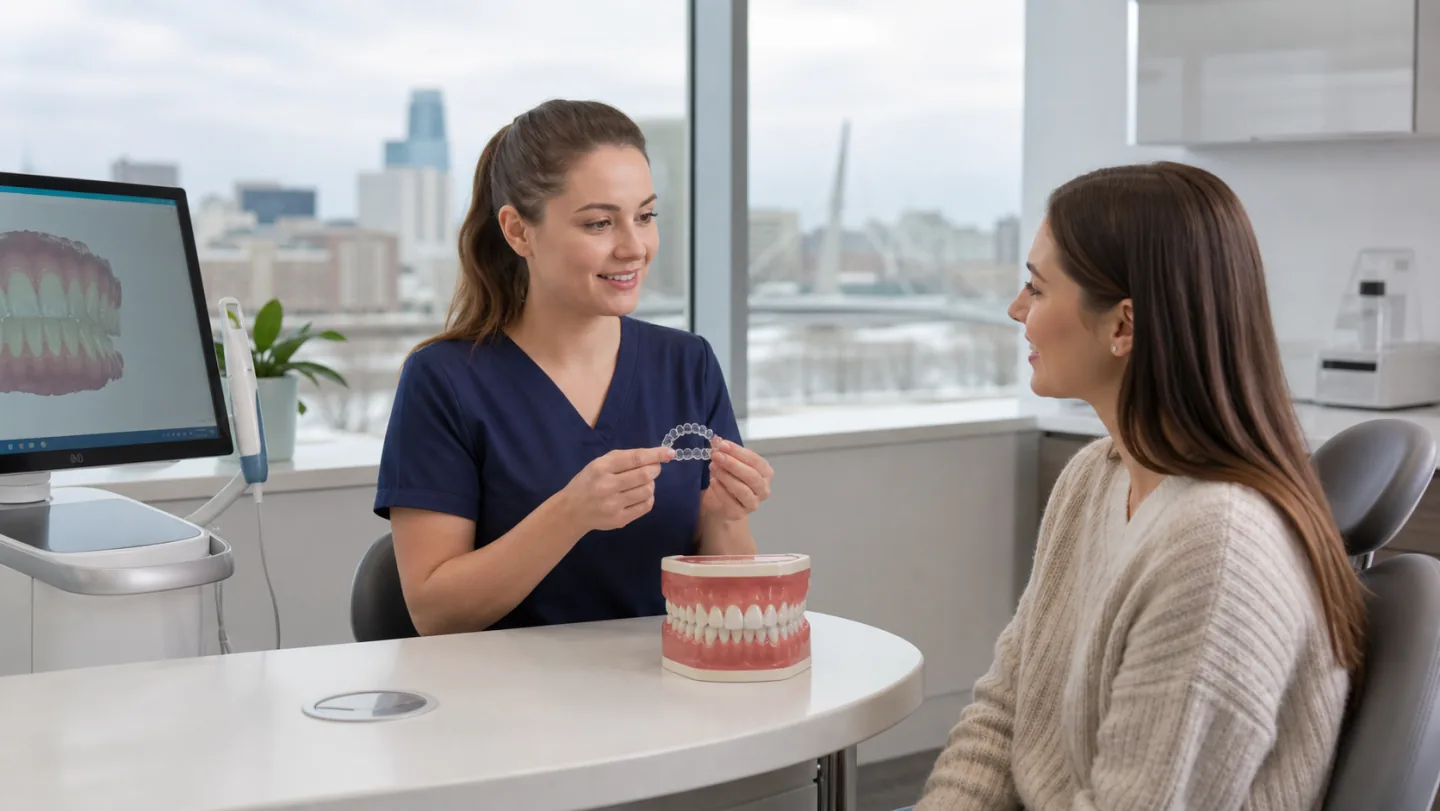
A dentist showing a clear aligner to a patient during a consultation
It’s just this one tooth.

Invisalign for Tyndall Park Residents

Maybe a single tooth has turned or sits out of line, and everything else looks fine to you. People in Tyndall Park with a small concern like that often wonder if aligners are overkill.

Let's find a time

Request an appointment

We’ll call to confirm your appointment. For urgent care, please call us directly.

Small concern, whole mouth

When a Single Turned Tooth Is What Bothers You

You catch it in photographs, or your tongue finds it without trying. A rotated tooth can seem like a tiny problem, and it’s understandable to hope for a tiny solution. Sometimes moving it is the right idea, and sometimes changing its shape might be worth discussing instead.

What looks like one tooth is also part of an arch and a bite, so turning it may require room or adjustments next door. Tyndall Park residents can have this looked at in our McPhillips Street clinic in Winnipeg, where your dentist will explain what a modest change would really involve.

Explore invisalign
Sunlit waiting room with a blue bench, pale rug and a child-sized white chair
Seating and artwork in the Winnipeg North Dental waiting area.

Your concern is valid

A small thing that bothers you every day is a perfectly fine reason to ask a dentist about it.

Neighbours are considered

Surrounding teeth and how you bite both shape what moving a single tooth would mean.

Moving isn’t the only idea

Depending on what’s behind the concern, reshaping or bonding might be something to ask about.

Rotations in practice

Why turning a tooth takes some planning.

A tooth that needs rotating isn’t easy for a smooth tray to grip. Planning has to consider how that movement is controlled and whether the tooth has room to turn.

Getting a grip on the tooth

Rotation is one of the movements for which aligners often use a little help, in the form of a small bonded shape that gives them leverage.

  • Tooth-coloured attachments can add control over rotation and angulation.
  • Their position depends on what the tooth needs to do.
  • A visible front tooth may mean a visible attachment too.
  • Ask how it would look if appearance is your main reason.

Finding room to turn

Straightening a tooth can use up space in the arch, and that space has to come from somewhere when it isn’t already available.

  • Aligners can create and share out space among crowded teeth.
  • Limited enamel reduction between teeth may be appropriate.
  • Your bite is checked, since upper and lower teeth interact.
  • Other teeth may move slightly as part of the planned sequence.

How extensive your plan would be can’t be judged from the mirror. Your examination may show that the change is straightforward, or that a different approach makes more sense.

Scaling to your concern

The same care, whatever the size of the problem.

Even when only one tooth is in your sights, aligner treatment follows the same careful stages. Here’s how each one applies to a limited concern.

Request your visit
  1. 01

    Point it out

    Show your dentist which tooth bothers you and why. Your teeth, gums, bite and jaw relationships are then examined, with photographs and suitable X-rays.

  2. 02

    Hear what it would take

    Planning sets out which teeth would need to move, how room would be made, and whether a turned tooth needs added control.

  3. 03

    Wear the sequence

    Should you go ahead, your aligners are checked for fit and any attachments are placed. You’ll learn how to take care of your trays at this visit.

  4. 04

    Confirm the tooth is turning

    Actual movement is compared against the plan at later visits, which matters because rotations don’t always respond exactly as mapped.

Picture the problem

Show us what catches your eye.

A concern this specific is easier to discuss with a clear example. Think about when you notice this tooth, and what would feel like enough of a change.

It’s fine not to know what you want done. You can simply point to the tooth and ask for an explanation of what’s possible.

Useful to bring or think about

  • A photo or two in which the tooth bothers you.
  • Whether it has changed recently or been that way for years.
  • Any fillings, crowns or chips on that tooth or next to it.
  • Your medications, health updates and any insurance or CDCP details.
Clinic lobby with wood-look flooring, framed art and a white reception counter
Pale blue patient chair with an instrument tray and a sink behind it

The reception area and a treatment room at Winnipeg North Dental.

Nothing too small to ask

You won’t be talked out of caring about it.

You may feel a bit silly about a single tooth, and there’s no need to. The conversation can be as simple as what bothers you, what’s possible and what makes sense.

A proportionate answer

Ask directly whether what you’re considering seems in proportion to what bothers you about this tooth.

Clarity on alternatives

You’re welcome to ask how moving the tooth compares with changing its shape or surface.

No pressure to proceed

Hearing what’s involved doesn’t oblige you to start anything. You can take your time to decide.

Keeping that tooth where it is

Even a small correction has to be held.

A rotated tooth that’s been straightened isn’t automatically settled. Whatever the scale of your treatment, the last stage counts as much as the rest.

01

Judging the finish

Your last planned tray isn’t the final word. If the tooth hasn’t reached its target, more records and refinement aligners could be considered.

02

A retainer for the long run

Tissues around a moved tooth need time to adapt, and teeth can keep shifting all through life. Wearing retainers as prescribed applies to smaller cases too.

03

Finishing the look

Once it’s in position, you may still want to ask about the edge or shape of the tooth. Bonding or reshaping might be options after alignment.

Did that tooth start to look different after treatment? Mention it to the clinic.

Talk with our team
Clinic facade with a large sign, a planter strip and a railing at the entrance

Winnipeg North Dental

Unit-5 2358 Mcphillips Street, Winnipeg, MB R2V 4J6
Get directions (opens in a new tab)
For people in Tyndall Park

Have That Tooth Looked at on McPhillips Street

Tyndall Park lies within Winnipeg. If it’s where you live, you can have your assessment and any treatment at Winnipeg North Dental, Unit 5, 2358 McPhillips Street.

The request form lets the clinic know you’re interested but doesn’t set a time. Expect a reply to arrange one, or telephone if that suits you better.

Questions about coverage?

Talk with our team before your visit or learn about CDCP.

A little clarity before your visit

Your questions, answered.

Helpful details about invisalign in Tyndall Park.

Ask our team
Can aligners turn just one tooth?

They can align rotated teeth, although your dentist will need to examine your mouth to know how much else must move. A plan is built around the whole arch and how you bite.

Why would you need to look at all my teeth for one problem?

A tooth sits within a bite and next to other teeth, and it’s anchored by a root. Each of those affects whether moving it is sensible or even possible.

Would I need an attachment on a turned front tooth?

Possibly, because these bonded shapes help aligners control rotation. Your dentist can tell you where they’d go and how visible they might be.

Is there something simpler than aligners for one crooked tooth?

It depends on what’s bothering you. Changes to shape, such as reshaping or bonding, may be worth raising, although these don’t move a tooth. An examination can make the difference clear.

Do I really need a retainer after moving a single tooth?

Yes. Retainers are part of treatment after aligners because teeth can shift again, and that includes any tooth you’ve had corrected.

How can a Tyndall Park resident have this checked?

Ask through this page or phone (204) 338-3003. Your assessment would happen at Unit 5, 2358 McPhillips Street, Winnipeg, MB R2V 4J6, at a time arranged with the clinic.

Worth asking about

Show us the tooth that’s been bugging you.

Request a visit to our Winnipeg clinic and find out what correcting it would actually involve, from aligners to other possibilities.

Patient testimonials

Kind words from our patients

★★★★★ 5.0 from 440+ reviews on Google

Close to home

Areas we serve

Convenient dental care on McPhillips Street for families across northwest Winnipeg and nearby communities.

Explore all service areas

A healthier smile is one visit away

Ready for dental care that feels genuinely comfortable?

✓ New patients welcome ✓ Direct insurance billing ✓ Multilingual team

How can we help?

Our dental team is here for you.

Ready to book or have a question? Choose the option that works best for you.

For urgent dental concerns, please call us directly.

Send us a message

Our team will reply during clinic hours.



