Skip to content
Winnipeg North Dental
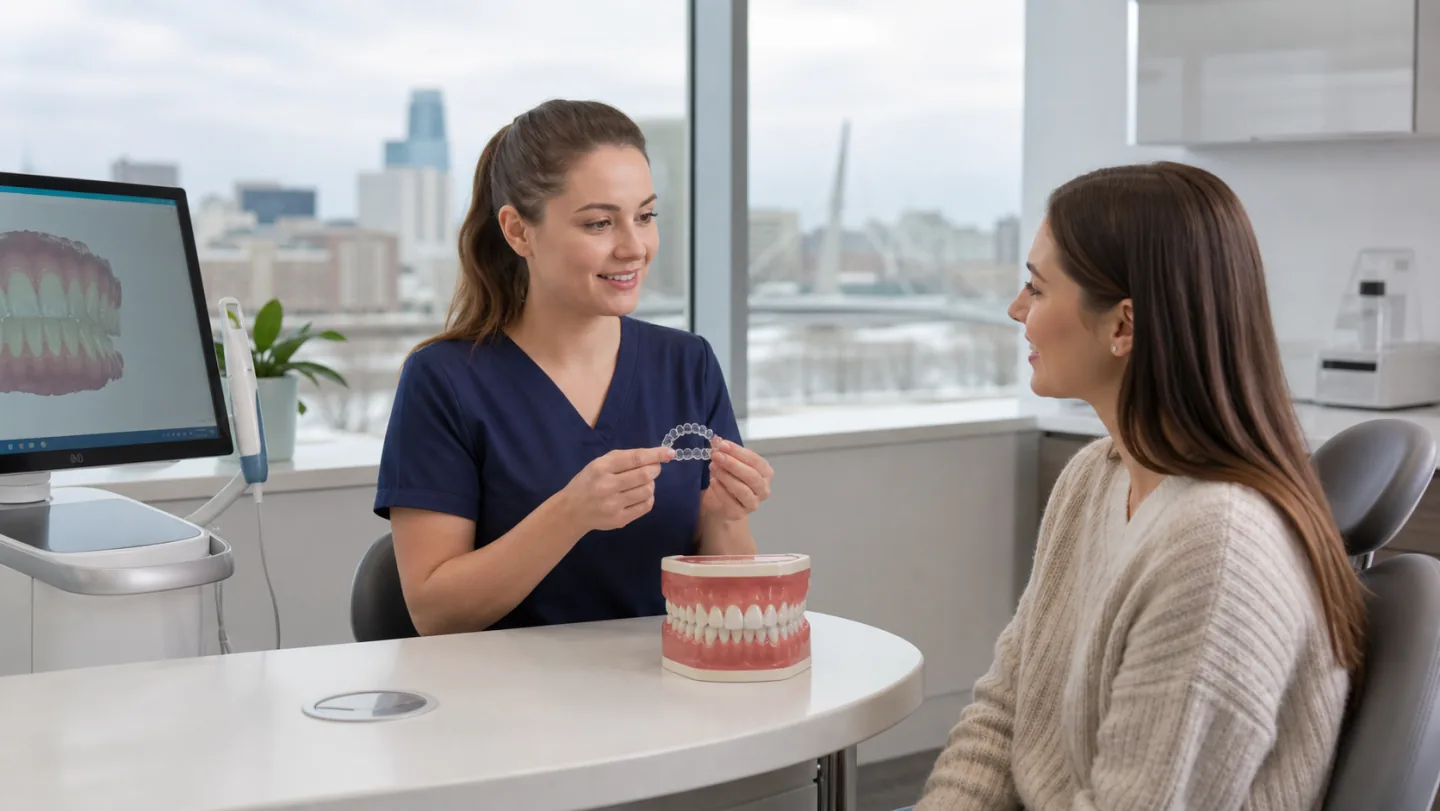
A dentist showing a clear aligner to a patient during a consultation
How does plastic move a tooth?

Invisalign for Shaughnessy Park Residents

It’s a fair thing to wonder when something so thin claims to reposition teeth rooted in bone. If you live in Shaughnessy Park and like to understand how things work, start here.

Let's find a time

Request an appointment

We’ll call to confirm your appointment. For urgent care, please call us directly.

The mechanics

Small Steps, Steady Pressure, Living Tissue

No single tray does anything dramatic. Each is shaped for one stage in a longer series, applying controlled force so that teeth travel a small distance, then hand over to the next. Bone and the tissues holding each root respond over time, which is why this process can’t simply be rushed.

Understanding the theory is one thing, and knowing how it would apply to your own roots and bite is another. That takes an examination, which Shaughnessy Park residents can arrange at our McPhillips Street clinic in Winnipeg.

Explore invisalign
Bright waiting area with framed abstract paintings above a navy upholstered bench
Abstract paintings above a navy bench in the waiting area at Winnipeg North Dental.

Force only while worn

A tray sitting in its case is doing nothing, as pressure on teeth stops the moment it comes out.

Biology sets the pace

Living tissue responds in its own way, so a computer sequence can only ever be a proposal.

Roots matter as well

What you see above the gumline is only part of the picture when a dentist evaluates movement.

Under the hood

What’s happening between tray changes.

Two things make a clear aligner more capable than it looks. One is the carefully staged sequence itself, and the other is a set of small additions that improve its grip.

The staged sequence

Software helps order the movements so that teeth aren’t all asked to do everything at once, and each tray assumes the previous one did its job.

  • Each aligner corresponds to one stage in the plan.
  • Missing wear leaves teeth short of where the next stage expects.
  • Space needs to be accounted for before teeth can align.
  • Actual positions get compared with planned ones at visits.

Grip and leverage

A smooth tray can only push so far on a smooth tooth. For harder movements, your plan might include extras designed to give it something to work with.

  • Bonded shapes help control rotation, angulation and roots.
  • Bands between upper and lower teeth can assist selected bites.
  • Slight enamel reduction or expansion can make room if appropriate.
  • Some movements still remain more predictable with braces.

Your dentist can explain which of these your plan would rely on, and why. It’s a good conversation for anyone who enjoys knowing the reasoning behind things.

From data to trays

How your records turn into a series.

The path from a first look to a working set of aligners has a clear logic. Each stage feeds information into the next.

Request your visit
  1. 01

    Collect the inputs

    An exam of teeth, gums, bite and jaw relationships comes first, supported by records that may include scans, photographs and appropriate X-rays.

  2. 02

    Sequence the movements

    Tooth by tooth, a plan is worked out for direction and order, how space will be created, and where added control is needed.

  3. 03

    Put theory into practice

    Trays are tried for fit, attachments are placed if they’re part of the design, and you’re shown how to handle insertion, removal and care.

  4. 04

    Test against reality

    Follow-up visits treat the plan as a hypothesis, measuring tooth positions against it and responding when a tray is no longer fitting as it should.

For the curious

Come ready to ask how and why.

If you’re the kind of person who reads the manual, your first assessment is a great chance to ask how the general principles apply to your situation.

You don’t need any technical vocabulary. Asking why a dentist would choose one approach over another is a perfectly good place to begin.

Questions for the curious

  • Which of my teeth would have the most work to do?
  • Where would the extra room for movement come from?
  • Which parts of my plan are less predictable than others?
  • What health details and medications should you know about?
Small consultation room with a keyboard on a white desk and a tall plant by the blinds
White reception counter with a clear divider and framed blue artwork on the wall behind

A consultation desk with a keyboard and the white front counter, Winnipeg North Dental.

Explained, not rushed

Understanding it can make it easier.

Knowing why trays feel the way they do can take some of the mystery out of them. You’re welcome to ask about anything you’d like explained in plainer terms.

Why it feels snug

A firm hold reflects the tray’s shape being a little ahead of your teeth. Should it go beyond what you were told to expect, tell the clinic.

Seeing your own records

It can be interesting to ask what your scans and photographs show, and how those findings influence the plan.

No silly questions

Wondering how teeth don’t simply fall out when they move is a common thought. Feel free to ask.

Why teeth don’t just stay

Newly moved teeth need time to settle.

After active movement, the tissues around each root are still adapting. Retainers exist because of that, and because teeth have a tendency to keep shifting through life.

01

Correcting the course

When teeth haven’t quite reached their targets, new records can be used to order refinement aligners as part of a normal plan.

02

Holding the position

A retainer resists further movement while your tissues adapt, and it must be worn in the way it’s been prescribed.

03

When things change

A retainer that has stopped fitting may be telling you something has moved. Check with the clinic about what to do.

The same biology that lets teeth move is also the reason they need holding afterward.

Talk with our team
Winnipeg North Dental street entrance under a large sign showing the clinic’s phone number

Winnipeg North Dental

Unit-5 2358 Mcphillips Street, Winnipeg, MB R2V 4J6
Get directions (opens in a new tab)
For Shaughnessy Park

Where Your Own Case Can Be Examined

Shaughnessy Park is in Winnipeg. People from the area who’d like an Invisalign assessment are seen at Winnipeg North Dental, Unit 5, 2358 McPhillips Street, where records and progress visits also take place.

A form submission isn’t a confirmed booking, and the clinic will respond to organize a time. If something is urgent, phone rather than writing in.

Questions about coverage?

Talk with our team before your visit or learn about CDCP.

A little clarity before your visit

Your questions, answered.

Helpful details about invisalign in Shaughnessy Park.

Ask our team
How can something as thin as a tray move a tooth at all?

Every aligner applies controlled pressure toward a planned position. The tooth and the tissues around its root respond gradually, then the next tray continues the work.

Why does wearing them less slow everything down?

Trays move teeth only while they’re being worn. Reduced wear can leave teeth lagging behind the digital plan, and later stages assume those earlier steps were completed.

Do the roots move too, or only the crowns?

Roots are part of the picture, and attachments can help control root movement. This is one reason your dentist reviews root support and appropriate X-rays.

What decides how many stages I’d need?

The series depends on what each tooth needs to do and how your plan is designed. Ask your dentist to go through this with you once your records are reviewed.

Why are some movements harder for aligners than others?

Trays hold teeth differently from brackets and wires, so not all movements are equally predictable. Attachments can help, and braces may be better for some changes.

Can I ask to see how my movement plan is laid out?

Certainly ask. Scans and software help sequence movement and visualize a proposed outcome, which is a helpful basis for a discussion about your plan.

Where would a Shaughnessy Park resident have their records taken?

Records are taken at Unit 5, 2358 McPhillips Street, Winnipeg, MB R2V 4J6. Use this form to request a visit, or phone (204) 338-3003 and ask what’s needed.

Theory, meet your teeth

Find out how this would work in your own mouth.

Request an assessment at our Winnipeg clinic and ask as many how-and-why questions as you like.

Patient testimonials

Kind words from our patients

★★★★★ 5.0 from 440+ reviews on Google

Close to home

Areas we serve

Convenient dental care on McPhillips Street for families across northwest Winnipeg and nearby communities.

Explore all service areas

A healthier smile is one visit away

Ready for dental care that feels genuinely comfortable?

✓ New patients welcome ✓ Direct insurance billing ✓ Multilingual team

How can we help?

Our dental team is here for you.

Ready to book or have a question? Choose the option that works best for you.

For urgent dental concerns, please call us directly.

Send us a message

Our team will reply during clinic hours.



