Skip to content
Winnipeg North Dental
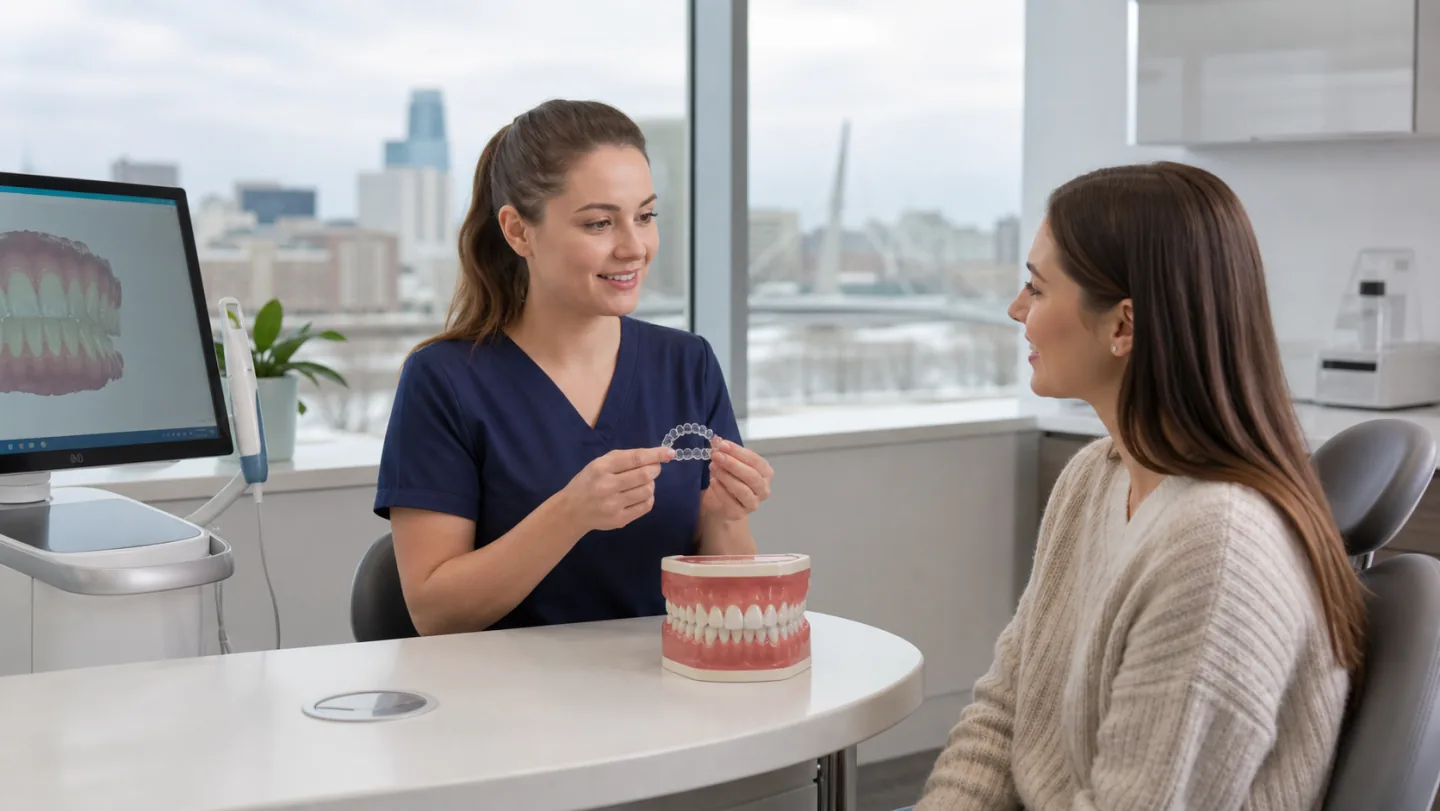
A dentist showing a clear aligner to a patient during a consultation
Why keep coming back in?

Invisalign for River Trail Residents

If trays are made in advance, why do progress visits matter so much? River Trail residents who like to understand the reason for each appointment will find an explanation here.

Let's find a time

Request an appointment

We’ll call to confirm your appointment. For urgent care, please call us directly.

The tracking stage

What Progress Visits Do During Aligner Treatment

It’s easy to assume that a digitally planned series more or less runs itself. It doesn’t, since a sequence on a screen can’t predict precisely how living bone and tissue will respond. Somebody has to compare what was intended with what your teeth have actually done.

That comparison is the job of the tracking stage. It can catch a tooth lagging behind, a tray that no longer sits properly, or a plan that needs changing. These reviews, like the rest of the care for River Trail residents, happen at our McPhillips Street clinic in Winnipeg.

Explore invisalign
Pale blue dental chair under an overhead light, with a sink and cabinets to the side
A pale blue chair beside a sink and cabinets at Winnipeg North Dental.

Teeth versus the plan

A review places the real position of your teeth next to where the sequence expected them to be.

Fit tells a story

A tray that isn’t seating as intended is a useful clue, and the clinic will want to hear about it.

Earlier is simpler

Mentioning a concern at the time it appears lets the dentist respond before you’ve gone further down the series.

On the review list

The things a dentist looks at, and what you report.

A progress check draws on two sources of information. One is what can be observed in your mouth, and the other is what only you know about the weeks since your last visit.

What gets examined

The core question is whether the teeth have gone where the sequence said they should, and whether the current tray still suits them.

  • How closely each tray is seating over your teeth.
  • Whether particular teeth are lagging behind the sequence.
  • The condition of any attachments that were bonded.
  • The state of your teeth and gums while in treatment.

What you can add

Things that happen between visits don’t show up in a tray on their own, so your account fills in the picture. Be frank, because accurate information helps everyone.

  • Days or stretches when wear slipped.
  • A tray that was cracked, lost or damaged.
  • Whether elastics have been worn as directed.
  • Anything that has felt sharp, loose or wrong.

Exactly what’s reviewed varies with your plan. If you’d like to know what was found, ask, and have it explained in words that make sense to you.

Tracking in context

How checks connect to the rest of treatment.

Reviews build on the three stages that come before them, and each earlier stage sets up something a later visit can measure. Here’s how they connect.

Request your visit
  1. 01

    A starting record

    Your initial examination, with photographs and appropriate X-rays, documents your teeth, gums, bite and jaws before any movement has begun.

  2. 02

    A target to measure against

    The digital plan establishes where each tooth is headed. That gives later visits an expected position to compare against, though the plan isn’t a promise.

  3. 03

    A correct fit at the outset

    On delivery day the first trays are checked and attachments placed. You also learn the handling and care that your later progress depends on.

  4. 04

    A repeated comparison

    Each review looks at whether things are on track. When an aligner has stopped fitting as intended, the dentist steps in with a specific correction.

Before each review

Show up with a simple account of recent weeks.

A progress check goes better when you’ve thought about the time since your last visit. It takes a minute, and you won’t need anything elaborate.

Please don’t skip a review because you’ve fallen behind. That’s one of the times when it’s most useful for someone to take a look.

Remember to bring

  • Your current trays, unless you’ve been told otherwise.
  • A note about any days with reduced wear.
  • Any broken or damaged tray, in its case.
  • New medications or changes in your health.
Reception desk with a glass divider, framed abstract art on the wall and a wood-look floor
Consultation desk with a keyboard, a framed painting and a window with striped blinds

A reception desk with a glass divider and a keyboard on a consultation desk, Winnipeg North Dental.

Feeling checked up on?

A review is there to help.

Some people dread these visits, as if a grade were being handed out. They exist to steer treatment, and being open about what happened gives the dentist something to work with.

Fallen behind on wear

Say so directly. Missed time can leave teeth trailing the plan, and the dentist can’t respond to what isn’t known.

Worried it’s not working

Bring that up too. Looking at the actual fit is more reliable than judging by the mirror at home.

Not sure what you’re seeing

Ask for an explanation of anything you’re shown. You’re entitled to understand how your own treatment is going.

When the reviews wind down

The last review isn’t the last check.

As the final tray approaches, the comparison shifts to whether all planned movement has been completed, and what ought to happen next. Retainers come into the picture here.

01

If movement is unfinished

New records could lead to refinement aligners. Treat this as a further round of planning, which doesn’t mean something has failed.

02

When movement is done

Retainers take over, keeping your teeth steady while the supporting tissues adapt to where they’ve ended up.

03

Over the longer term

Since shifting can continue throughout life, ask how your retainer’s fit should be looked at in future.

If a retainer stops fitting at any point, treat it as you would a tray that isn’t seating: call before you assume anything.

Talk with our team
Winnipeg North Dental exterior with dark window frames, signage and a small planting bed at the sidewalk

Winnipeg North Dental

Unit-5 2358 Mcphillips Street, Winnipeg, MB R2V 4J6
Get directions (opens in a new tab)
River Trail check-ins

Where Your Reviews Take Place

For River Trail residents, Invisalign care happens at Winnipeg North Dental, Unit 5, 2358 McPhillips Street, in Winnipeg, including the first assessment and later tracking visits.

You’re welcome to send a request through the form, which doesn’t hold a time. The clinic responds so that one can be arranged. Anything urgent is better handled by phone.

Questions about coverage?

Talk with our team before your visit or learn about CDCP.

A little clarity before your visit

Your questions, answered.

Helpful details about invisalign in River Trail.

Ask our team
Do I really need progress visits if my trays seem fine?

Yes. Tray comfort won’t tell you how far each tooth has actually moved, and only a comparison in the mouth can show whether movement is keeping up.

What does tracking mean?

It describes teeth following the planned sequence. A tooth that isn’t tracking has fallen behind, which may mean the aligner no longer fits as intended.

How would I notice that a tooth isn’t tracking?

You might see a gap between tooth and tray, though it isn’t always obvious. Contact the clinic if your tray doesn’t seem to be seating.

What should I do if I miss a progress visit?

Call to rearrange it, and ask what you should do with your trays in the meantime. Don’t jump ahead in the series on your own.

Can a progress visit change my plan?

It can. Lost wear, damaged trays or lagging teeth may each call for a specific correction, and new records might support extra aligners.

Should I tell you if I haven’t been wearing them?

Please do, since it directly affects how your teeth compare with the plan and what the dentist recommends. You’ll get a more useful answer that way.

Where do River Trail residents go for these reviews?

Reviews happen at Unit 5, 2358 McPhillips Street, Winnipeg, MB R2V 4J6. To reach the clinic about one, call (204) 338-3003.

Want to know how it’s monitored?

Ask how your treatment would be followed.

Request an assessment at our Winnipeg clinic on McPhillips Street, and ask what would be looked at along the way.

Patient testimonials

Kind words from our patients

★★★★★ 5.0 from 440+ reviews on Google

Close to home

Areas we serve

Convenient dental care on McPhillips Street for families across northwest Winnipeg and nearby communities.

Explore all service areas

A healthier smile is one visit away

Ready for dental care that feels genuinely comfortable?

✓ New patients welcome ✓ Direct insurance billing ✓ Multilingual team

How can we help?

Our dental team is here for you.

Ready to book or have a question? Choose the option that works best for you.

For urgent dental concerns, please call us directly.

Send us a message

Our team will reply during clinic hours.



