Skip to content
Winnipeg North Dental
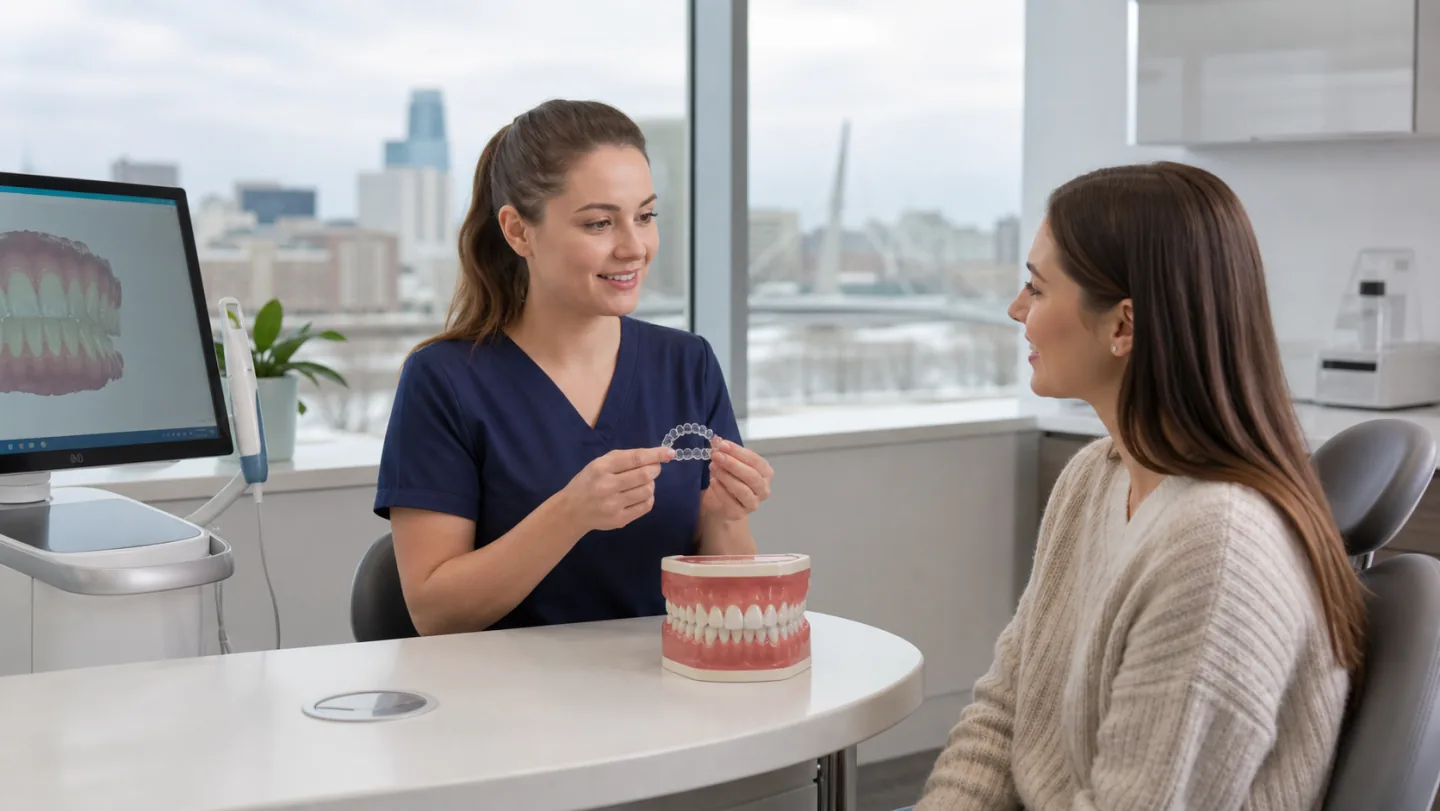
A dentist showing a clear aligner to a patient during a consultation
Bottom teeth starting to overlap?

Invisalign for Parkview Pointe Residents

They used to look fine, you never needed braces, and now the lower front teeth seem to be creeping out of line. Parkview Pointe residents can have this looked at and explained.

Let's find a time

Request an appointment

We’ll call to confirm your appointment. For urgent care, please call us directly.

Change you didn’t expect

When Lower Front Teeth Begin to Drift

Teeth aren’t fixed in place for life, even if they’ve never been treated. They can keep shifting over the years, so a lower row that once seemed straight may gradually start to overlap. It often gets noticed in photographs, or when floss suddenly becomes harder to pass through.

Whether it needs doing anything about is a separate matter, and depends on your own concerns and what’s found. Aligners may be one option where crowding is suitable. Parkview Pointe residents can raise it at our clinic on McPhillips Street in Winnipeg, where their care takes place.

Explore invisalign
Reception area with a tall snake plant, low navy bench and white front counter
A tall snake plant and low navy bench beside the front counter at Winnipeg North Dental.

Shifting can happen

Noticing that your teeth have moved doesn’t mean you did anything wrong. Teeth can shift throughout life.

First, find out what’s changed

An examination looks at more than the overlap, including your gums, bite and the support around your teeth.

Then decide

You can hear what’s possible and still decide to watch it for now. Treatment is a choice you make.

Making room down there

How trays could approach a crowded lower row.

Overlapped teeth can’t simply be swung into line if there’s no space for them. A plan has to work out where the room comes from before anything else can move.

Creating the space

Crowding is usually treated by making and distributing space along the arch. The right way of doing so depends on your teeth and on how much room they need.

  • Limited enamel reduction between selected teeth.
  • Planned expansion, when it’s judged appropriate.
  • Sequencing teeth so each has room before it moves.
  • A digital plan that lays out each of these stages.

Controlling the turn

Lower teeth that have drifted may also have rotated. Trays sometimes need help to get a good grip on them, which is where bonded shapes can come in.

  • Attachments give leverage to control rotation.
  • Their position depends on the teeth that need moving.
  • They may be visible from up close.
  • Some movements may suit a different appliance better.

Your upper and lower teeth work together, so a plan focused on the lower row still has to take into account how the two arches meet.

A first-timer’s sequence

Your first experience of orthodontic treatment.

If you’ve never had braces, all of this will be new to you. The process has four main stages, and you’ll be guided through each if you decide to go ahead.

Request your visit
  1. 01

    Having it examined

    Your dentist reviews teeth, gums, bite and jaw relationships, with photographs and any X-rays that are appropriate. Point out the teeth that caught your attention.

  2. 02

    Seeing a proposed plan

    Software sequences the movements and shows a possible outcome. Treat this as a proposal for discussion, since real teeth don’t always behave as they do on screen.

  3. 03

    Learning the trays

    Trays get checked for fit, any planned attachments are placed, and you practise getting them in and out. Prior experience with appliances isn’t needed.

  4. 04

    Coming in for checks

    Your teeth’s actual movement is compared against the plan at each review, and anything that’s stopped fitting as it should can be dealt with.

Gather your own evidence

Old photos can show what’s changed.

You don’t need dental records to explain what you’ve noticed. Pictures of your smile from a few years back can show the dentist what has caught your attention.

Don’t worry if you can’t say when the change started. Slow drift tends to go unnoticed for a long while, which is common.

Useful to have

  • A few older photos that show your lower teeth.
  • Where flossing or cleaning has become difficult.
  • Prescriptions you’re on, and what’s new with your health.
  • What you’d most like to know about treatment.
Treatment room with a blue dental chair, overhead arm and a screen on the far cabinet
Corner of a waiting area with a white chair, small table and potted plant under a striped blind

A blue dental chair and a white chair beside a striped blind at Winnipeg North Dental.

If this is your first appliance

You’ve never worn anything on your teeth.

A snug tray can feel like a lot if your mouth has never had anything fitted. Expect some adjusting, and contact the clinic if something seems more than ordinary tightness.

Pressure on crowded teeth

Teeth being guided into place will feel the trays. Tell the clinic if what you’re feeling worries you.

Edges around the lower row

Your tongue may seek out new edges behind the lower front teeth. Report anything that feels rough.

Trays out and in

It’s normal for this to take practice with a first appliance. Ask to see it done again if needed.

So it doesn’t creep back

Retainers take on the job drift once did.

If your teeth have already shown they can shift, you’ll understand why retention matters. Once movement is completed, a retainer holds them while the supporting tissues adapt.

01

Last adjustments

Fresh records could lead to refinement aligners if the lower row hasn’t fully reached its intended position.

02

Prescribed retention

Your retainer needs wearing according to your instructions. Skipping it can allow the same teeth to start moving again.

03

Paying attention

You spotted the change once before. If your teeth or retainer begin to feel different, let the clinic know.

First-time patients often ask what retention involves in everyday terms. Feel free to ask before you decide on treatment.

Talk with our team
Grey and white clinic building with a Winnipeg North Dental sign above tall front windows

Winnipeg North Dental

Unit-5 2358 Mcphillips Street, Winnipeg, MB R2V 4J6
Get directions (opens in a new tab)
Parkview Pointe and drifting teeth

Have Drifting Teeth Looked at on McPhillips Street

Parkview Pointe residents receive care at Winnipeg North Dental, Unit 5, 2358 McPhillips Street, in Winnipeg, where the assessment, fitting and later reviews would all take place.

You can ask for a visit using this page’s form, keeping in mind that it won’t reserve anything until the clinic has replied. Phone about any urgent issue.

Questions about coverage?

Talk with our team before your visit or learn about CDCP.

A little clarity before your visit

Your questions, answered.

Helpful details about invisalign in Parkview Pointe.

Ask our team
Why are my lower teeth moving when I’ve never had braces?

Teeth can shift throughout life, whether or not they’ve been treated. An examination can look at what’s going on in your own mouth.

Is it too minor to mention at a visit?

No. Point out what you’ve seen, and the dentist can let you know what has been found. You can then decide if treatment is worth pursuing.

Will my lower teeth keep getting worse?

That’s hard to predict for any individual. Ask what your examination suggests, and what watching the situation over time might involve for you.

Can I straighten only my lower teeth?

That depends on how your arches meet, because moving one row can affect your bite. Ask whether a plan limited to those teeth would be sensible.

Do overlapping teeth make flossing harder?

They can make it harder to reach every surface. Mention it, as your dental team can offer guidance whichever treatment path you take.

Will I be filed down to make room?

Limited enamel reduction is one possibility, used between teeth when appropriate. Expansion may be another route, so ask which your plan would rely on, and why.

How can someone in Parkview Pointe have this checked?

Send the appointment request here or phone (204) 338-3003. The clinic you’d visit is at Unit 5, 2358 McPhillips Street, Winnipeg, MB R2V 4J6.

Noticed something shift?

Learn what’s behind the change in your lower teeth.

Ask for an appointment at our McPhillips Street clinic in Winnipeg, and bring those older photographs along.

Patient testimonials

Kind words from our patients

★★★★★ 5.0 from 440+ reviews on Google

Close to home

Areas we serve

Convenient dental care on McPhillips Street for families across northwest Winnipeg and nearby communities.

Explore all service areas

A healthier smile is one visit away

Ready for dental care that feels genuinely comfortable?

✓ New patients welcome ✓ Direct insurance billing ✓ Multilingual team

How can we help?

Our dental team is here for you.

Ready to book or have a question? Choose the option that works best for you.

For urgent dental concerns, please call us directly.

Send us a message

Our team will reply during clinic hours.



