Skip to content
Winnipeg North Dental
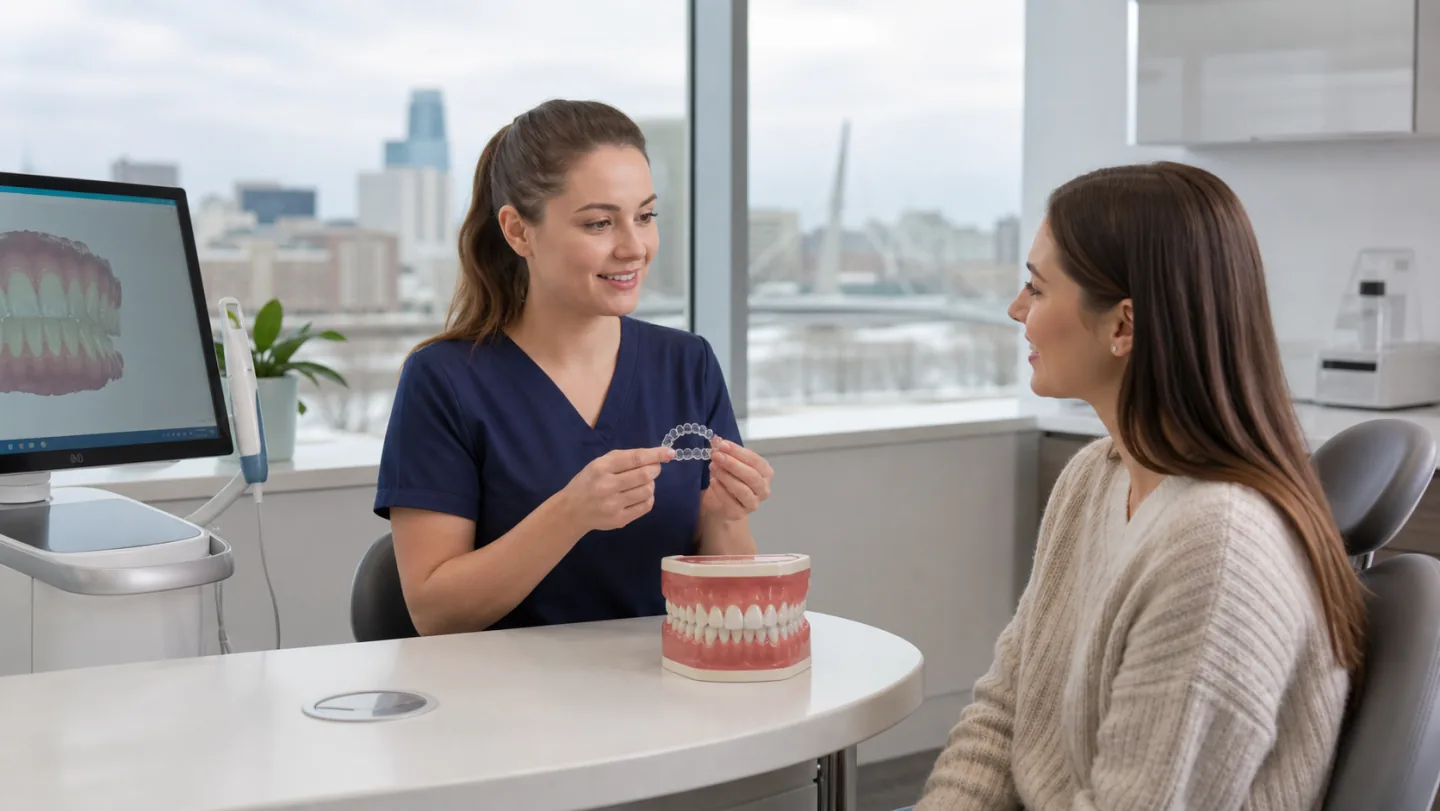
A dentist showing a clear aligner to a patient during a consultation
Who shouldn’t get Invisalign?

Invisalign for Park View Residents

Most pages tell you who aligners are for. Some Park View readers would rather start at the other end, by looking at the reasons they might not be the right choice.

Let's find a time

Request an appointment

We’ll call to confirm your appointment. For urgent care, please call us directly.

Reasons to look elsewhere

When Clear Aligners May Not Be the Right Choice

Clear trays have real advantages, yet they aren’t a universal answer. Two kinds of reason can steer someone away: the teeth may need something aligners do less predictably, or day-to-day life may not support the consistent wear that treatment relies upon.

Neither reason can be settled by reading a web page, and this one isn’t a verdict on you. It simply lists what the dentist will weigh. For Park View residents, the assessment takes place at our clinic on McPhillips Street in Winnipeg.

Explore invisalign
Consultation room seen from behind a high-backed black chair facing a white desk
A high-backed black chair facing a white desk at Winnipeg North Dental.

A no isn’t the end

If aligners aren’t suitable, you’ve still learned something and can discuss what else might work for you.

Your teeth have a say

Root support, jaw relationships and the type of movement required all influence how predictable trays would be.

So does your daily life

An appliance you don’t wear can’t move your teeth, so your honest habits are part of the decision.

The sorting questions

Mouth factors and life factors.

Candidacy has two halves, and either one can change the recommendation. Reading them separately helps you see what can be changed by you, and what can’t.

In your mouth

Certain movements are simply less predictable with trays alone. Braces or a combined approach may then offer the control that’s needed for the tooth to get there.

  • The kind and amount of movement that’s needed.
  • How your roots are supported in the surrounding bone.
  • How your upper and lower jaws relate to one another.
  • Gum or tooth concerns to deal with beforehand.

In your routine

An aligner needs you to wear it, handle it and look after it every single day. People who already know they’d struggle with that are right to say so.

  • Being able to wear trays through the day and night.
  • Removing them whenever you eat or drink anything but water.
  • Cleaning your teeth before each reinsertion.
  • Keeping trays in a case, not on a napkin.

Finding one of these difficult doesn’t automatically rule you out. It’s a reason to talk the matter over and work out what’s realistic.

Where the answer comes from

Suitability gets reviewed more than once.

The first assessment is the main decision point, but the question doesn’t entirely go away. Each stage can bring up new information that affects your treatment.

Request your visit
  1. 01

    First examination

    With your teeth, gums, bite and jaws examined and appropriate X-rays and photographs reviewed, you’ll hear whether aligners seem capable of doing the job.

  2. 02

    Planning

    Designing each tooth’s path shows which movements need added control. Difficult ones may lead to attachments, or to a discussion about other appliances.

  3. 03

    Starting out

    If you go ahead, the fit of your trays is confirmed and you’re taught how to manage them. This is when the daily routine starts to feel real.

  4. 04

    Staying on track

    As progress is compared with the plan, the dentist may step in if teeth lag behind. Sometimes that means a different plan from the original one.

Be blunt with yourself

An honest self-assessment saves time.

Before the visit, consider which of these difficulties you already recognize in your own life. Nobody expects you to promise perfection, just to be candid about your habits.

If you find you’re hoping to hear a particular answer, tell the dentist that as well. Knowing what you want helps frame the conversation.

Consider and note

  • How you’ve coped with retainers or appliances before.
  • Whether you’d prefer something you can’t take out.
  • Any gum or tooth problems you know about.
  • What you take regularly, and how your health has changed.
Window seating with white chairs and small tables, beside a tall potted plant with variegated leaves
Reception desk with an orchid and a frosted glass wall beside a hallway

Window seating with white chairs and a reception desk with an orchid at Winnipeg North Dental.

Hearing a no

A different answer isn’t a judgment.

It can be disappointing to learn that the option you came in for might not suit your teeth. You’re free to ask why, what the alternatives are, and to take time before deciding.

Ask for the reasoning

Find out which specific movement or factor shaped the recommendation, so that you aren’t left guessing.

Ask what would change it

Certain issues, such as a problem to treat first, may affect timing. Others are simply how your teeth are.

Take your time

Nothing has to be decided in the room. You can go home and consider what you’ve heard.

If a yes is the answer

A yes comes with obligations too.

Being a good candidate doesn’t reduce what’s asked of you later on. Everybody finishing active movement moves into retention, and some will need another round of trays first.

01

Possibly more trays

Where teeth have not reached their planned positions, new records could be used to order refinement aligners.

02

Certainly a retainer

Retention isn’t optional after aligners or braces, as your teeth can shift when retainers aren’t worn as prescribed.

03

Continuing dental care

Ordinary check-ups still have their place, so keep your teeth and gums in view well beyond the final tray.

Consider whether long-term retainer wear is something you’re prepared for. That is a suitability question as well.

Talk with our team
Winnipeg North Dental storefront with its name and phone number on a white sign band

Winnipeg North Dental

Unit-5 2358 Mcphillips Street, Winnipeg, MB R2V 4J6
Get directions (opens in a new tab)
Park View, plainly answered

Where You Can Get a Straight Answer

Park View residents have aligner suitability assessed at Winnipeg North Dental, Unit 5, 2358 McPhillips Street, in Winnipeg, and any treatment that follows takes place there as well.

A submitted form doesn’t set an appointment. It lets the clinic know to reach out about a time. Don’t use it for urgent concerns, which call for a phone call.

Questions about coverage?

Talk with our team before your visit or learn about CDCP.

A little clarity before your visit

Your questions, answered.

Helpful details about invisalign in Park View.

Ask our team
What might make me a poor candidate for aligners?

Movements that are less predictable with trays, a concern that needs treating first, or difficulty wearing them consistently could all affect your answer.

Should I be worried if I’m told to get braces?

No. Braces can give direct control over a broad range of movements, and they’re a common recommendation. Ask why they’re being suggested in your case.

Could I still try aligners against advice?

Bring this up with the dentist, who can explain what would and wouldn’t be predictable. You’d want a full understanding of the reasons before deciding anything.

Can tooth or gum problems delay aligners?

They can affect planning, because your teeth and gums are examined as part of the assessment. Ask what would need attention first, and in what order.

I’ve never kept up with a retainer. Is that a warning sign?

It’s worth mentioning, because aligners and retainers both depend on consistent wear. It won’t decide the matter alone, but it does help frame the discussion.

What else is there if aligners aren’t suitable?

Braces and combined approaches are possibilities, while some cosmetic concerns may be handled with other treatments. Your assessment will shape which are worth discussing.

How can someone in Park View learn whether trays would suit them?

Request an assessment using the form, or phone (204) 338-3003. Your visit would happen at Unit 5, 2358 McPhillips Street, Winnipeg, MB R2V 4J6.

Yes, no or maybe

Get an answer based on your own teeth.

Request an assessment on McPhillips Street in Winnipeg, and let the dentist explain which way your case points.

Patient testimonials

Kind words from our patients

★★★★★ 5.0 from 440+ reviews on Google

Close to home

Areas we serve

Convenient dental care on McPhillips Street for families across northwest Winnipeg and nearby communities.

Explore all service areas

A healthier smile is one visit away

Ready for dental care that feels genuinely comfortable?

✓ New patients welcome ✓ Direct insurance billing ✓ Multilingual team

How can we help?

Our dental team is here for you.

Ready to book or have a question? Choose the option that works best for you.

For urgent dental concerns, please call us directly.

Send us a message

Our team will reply during clinic hours.



