Skip to content
Winnipeg North Dental
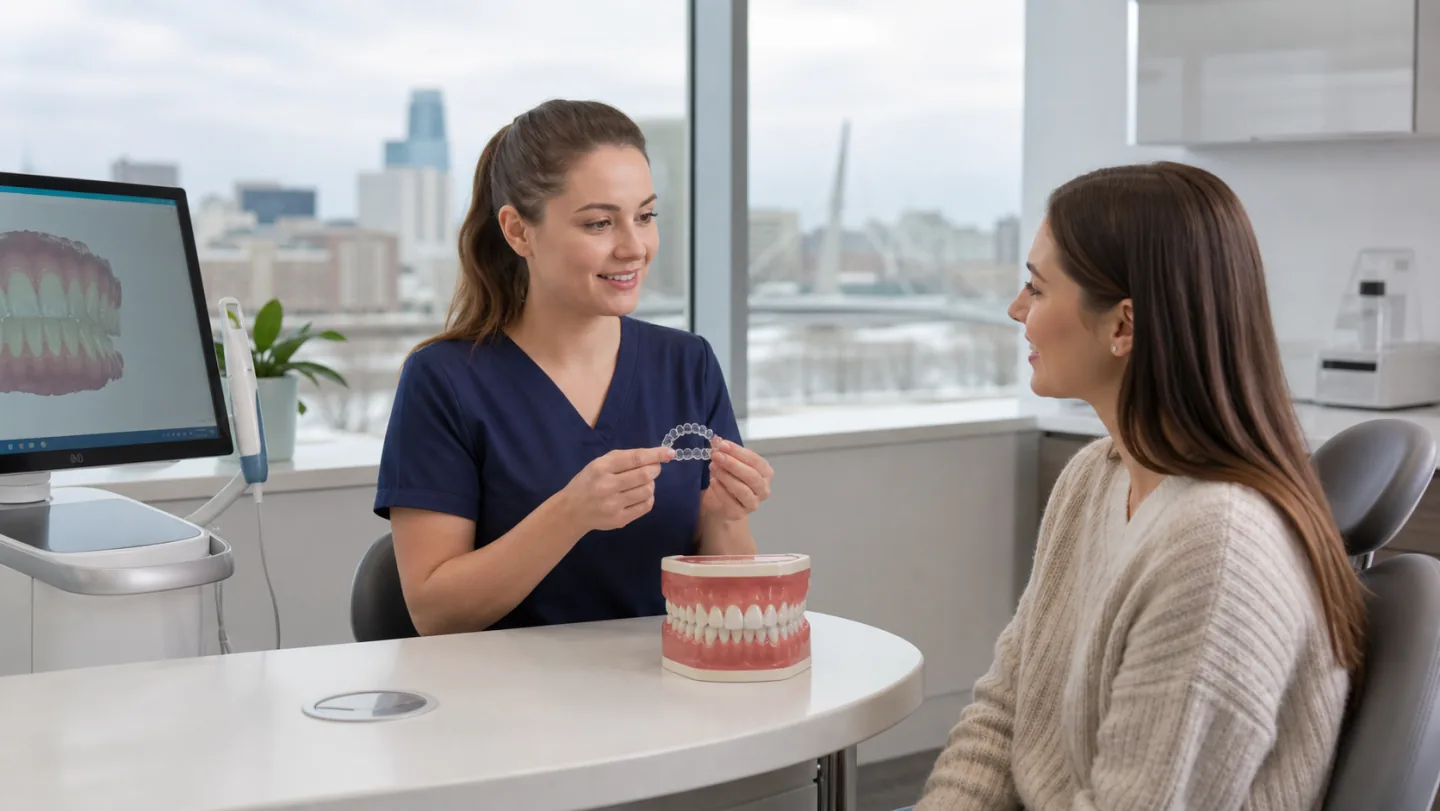
A dentist showing a clear aligner to a patient during a consultation
Front teeth that never touch?

Invisalign for Meadows West Residents

When you close, perhaps a space stays open at the front, or a few upper teeth land behind the lower ones. If you live in Meadows West and that sounds familiar, start here.

Let's find a time

Request an appointment

We’ll call to confirm your appointment. For urgent care, please call us directly.

Open bite and crossbite

Two Bite Patterns Aligners May Be Able to Address

An open bite describes teeth that don’t meet when the jaw closes, most obviously at the front. In a crossbite, some upper teeth sit inside the lower ones rather than outside. Either may be suitable for clear aligners, but that word suitable carries a lot of weight.

Bite correction involves more than the crowns you can see. Root support and the way the jaws relate to each other both feed into whether trays are realistic. Meadows West is in Winnipeg, and residents have these questions examined at our clinic on McPhillips Street.

Explore invisalign
Treatment room with a reclined pale blue dental chair and wood-look cabinets along the wall
A reclined pale blue dental chair beside wood-look cabinets at Winnipeg North Dental.

Roots and jaws count

Your assessment goes past tooth position to look at support below the gumline and how upper and lower jaws line up.

Sometimes more than trays

Elastics, attachments or a different appliance may be part of the discussion, depending on what needs correcting.

Describe how you chew

If biting into food feels awkward or one side does most of the work, mention it. It’s useful information.

Spotting the pattern

What each of these bite problems involves.

You may recognize one of these descriptions in the mirror, though the name matters less than what an examination finds. Here’s how to tell them apart in plain language.

When teeth don’t meet

With an open bite, the back teeth come together while some of the others stay apart. Whether trays can close that space depends on what’s causing it and which movements are needed.

  • A visible space between upper and lower teeth at rest.
  • Biting through food with your front teeth may feel difficult.
  • Attachments can add control for particular movements.
  • Some cases are more predictable with another approach.

When teeth land inside

A crossbite can involve one tooth or a group of them, at the front or the side. Part of the correction may rely on space and on connecting the arches.

  • Upper teeth biting behind their lower neighbours.
  • Removable elastics may link the upper and lower teeth.
  • Planned expansion is sometimes used to create room.
  • Your jaw relationship shapes what is realistic.

These descriptions are for orientation and don’t amount to a diagnosis. Only an examination can identify what your own bite is doing.

Investigating a bite

How the examination becomes a decision.

A bite concern is examined before any plan is drawn up, and then watched closely during treatment if aligners are chosen. Here’s the sequence you’d follow.

Request your visit
  1. 01

    Looking at how you close

    The dentist checks your teeth, gums and jaw relationships, as well as how the arches meet, and reviews photographs alongside appropriate X-rays.

  2. 02

    Deciding what moves where

    The digital plan sets the movement for each tooth and identifies where added control is needed, including whether attachments or elastics belong in your series.

  3. 03

    Fitting and first instructions

    Trays are checked for fit and planned attachments are placed. If elastics are prescribed, ask to have them demonstrated while you’re there.

  4. 04

    Watching the bite respond

    At progress visits, actual movement is held up against the sequence. A tray that has stopped seating as intended gets attention at this stage.

Watch how you bite

A few mirror observations help.

You don’t need to diagnose anything before your assessment. Paying attention to everyday moments gives the dentist a useful description to go along with what’s examined.

There’s no need to test anything special at home. Closing and biting as you normally do will tell you enough.

Things to notice

  • Foods you tend to bite with your side teeth.
  • Which teeth touch first when you gently close.
  • Any past orthodontic treatment you’ve had.
  • Medicines you’re taking, and any new health conditions.
Bright waiting area with white chairs by a window with striped blinds and a large potted plant
Black office chairs around a white desk in a consultation room

White chairs by a blind-covered window and black chairs around a desk at Winnipeg North Dental.

Working with extra parts

Bands and bumps take some getting used to.

Bite corrections may ask more of you than trays alone, given the elastics and bonded shapes sometimes involved. Tell the clinic if any part of this is proving a struggle.

Elastics by hand

Hooking removable bands into place calls for practice. Ask to be shown again whenever you need a refresher.

An unfamiliar closing feel

Trays over your teeth change how the arches come together. Report anything that seems painful or doesn’t fit correctly.

Wearing them as directed

Elastics help only when used as instructed. If yours keep getting left off, say so at your next visit.

Keeping a bite stable

A corrected bite still needs a retainer.

Teeth that have been moved into a new relationship need to be held there. The tissues around them keep adapting well after the movement itself has been completed.

01

Refinement, if needed

New records can be used to order extra aligners if planned bite movements haven’t fully come through by the final tray.

02

Holding the result

Your retainer limits unwanted shifting and has to be worn as your dentist prescribes, for as long as you’re told.

03

Noticing changes

If your teeth begin meeting differently in later years, or the retainer no longer sits properly, let the clinic know.

Ask what your particular retention routine would be before you commit, since it’s part of the treatment as a whole.

Talk with our team
Entrance to Winnipeg North Dental with double glass doors and a sign showing the clinic name

Winnipeg North Dental

Unit-5 2358 Mcphillips Street, Winnipeg, MB R2V 4J6
Get directions (opens in a new tab)
Bite questions in Meadows West

Have an Open Bite or Crossbite Examined

Bite assessments and any aligner care for Meadows West residents happen at Winnipeg North Dental, Unit 5, 2358 McPhillips Street, in Winnipeg.

The form tells the clinic you’d like a visit, and it holds no time until you’ve heard back. For urgent concerns, please phone instead.

Questions about coverage?

Talk with our team before your visit or learn about CDCP.

A little clarity before your visit

Your questions, answered.

Helpful details about invisalign in Meadows West.

Ask our team
How do I know whether I have an open bite?

A space between upper and lower teeth when your back teeth are closed may suggest one. Having it examined is how you’d find out for certain.

Can Invisalign fix a crossbite?

It may help with a suitable crossbite. That depends on the teeth involved and on your jaw relationship, and braces or a combined plan are sometimes more predictable.

Do bite corrections always involve elastics?

No. Removable bands are used only for selected bite relationships, and your plan determines whether you’d need them at all.

Why do you need to examine my jaw for a tooth problem?

Where the teeth meet depends partly on how the jaws relate to each other. That affects which corrections aligners can realistically manage.

What is planned expansion?

It’s one of the ways room can be created so that teeth can be aligned, used when appropriate. Ask whether your assessment points in that direction.

What happens if my bite doesn’t correct as planned?

Progress checks compare your teeth with the sequence, and the plan can be adjusted. New records may support refinement aligners, or other options could be discussed.

How can a Meadows West resident get their bite looked at?

Call (204) 338-3003, or send a request through this page. You’d be assessed at Unit 5, 2358 McPhillips Street, Winnipeg, MB R2V 4J6.

Curious how yours closes?

Ask for a proper look at how your teeth come together.

Request an assessment at our Winnipeg clinic, and find out whether aligners could be part of correcting your bite.

Patient testimonials

Kind words from our patients

★★★★★ 5.0 from 440+ reviews on Google

Close to home

Areas we serve

Convenient dental care on McPhillips Street for families across northwest Winnipeg and nearby communities.

Explore all service areas

A healthier smile is one visit away

Ready for dental care that feels genuinely comfortable?

✓ New patients welcome ✓ Direct insurance billing ✓ Multilingual team

How can we help?

Our dental team is here for you.

Ready to book or have a question? Choose the option that works best for you.

For urgent dental concerns, please call us directly.

Send us a message

Our team will reply during clinic hours.



