Skip to content
Winnipeg North Dental
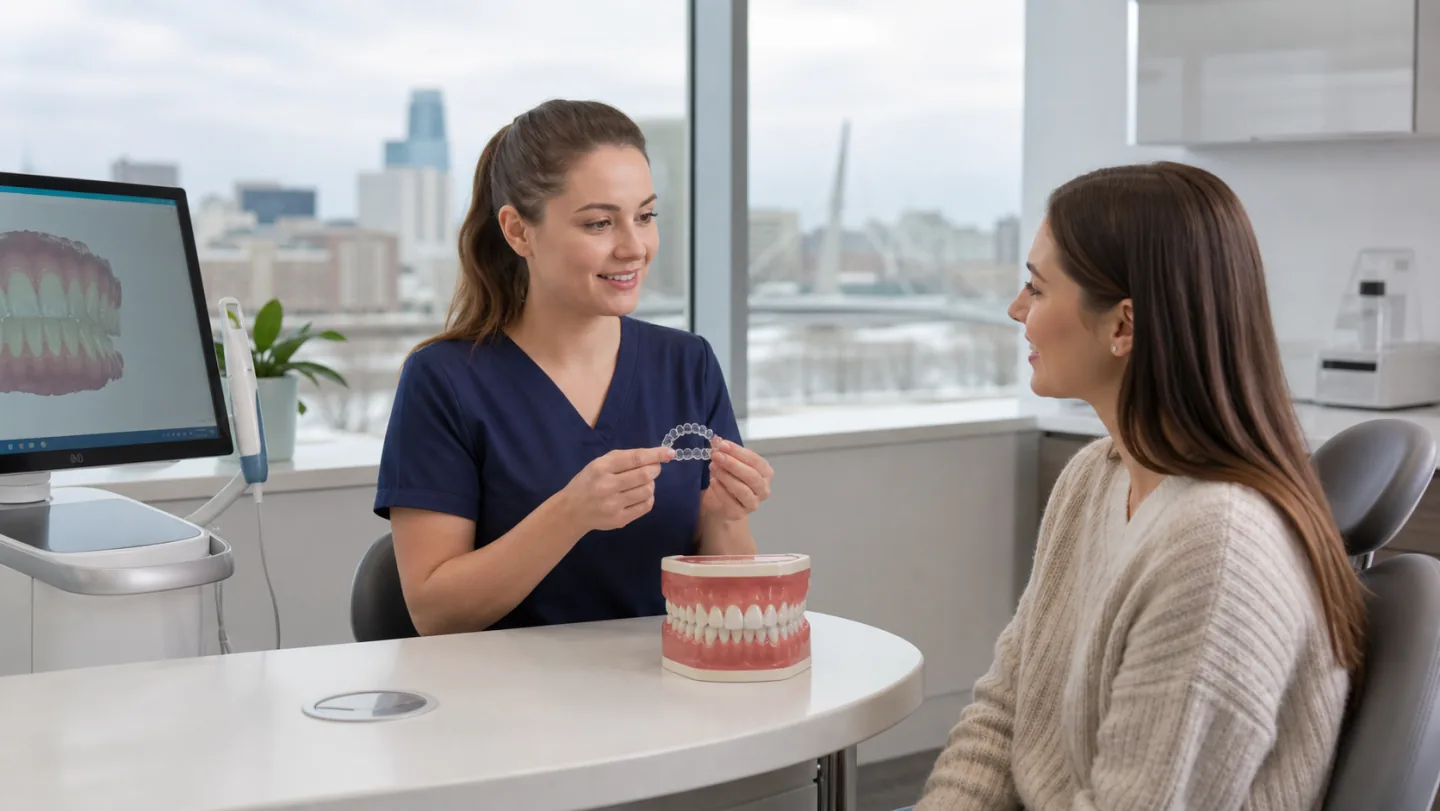
A dentist showing a clear aligner to a patient during a consultation
The short version, please.

Invisalign for Meadow Land Residents

Never looked into aligners before? Here’s the basic picture for Meadow Land residents: what the trays are, what they ask of you, and how you’d find out if they suit you.

Let's find a time

Request an appointment

We’ll call to confirm your appointment. For urgent care, please call us directly.

Invisalign in brief

A Quick Summary of How Aligners Work

Invisalign uses a planned series of clear, removable trays, made for your mouth, to nudge teeth into new positions a little at a time. Trays stay on for most of the day and night. They come off for eating, for drinks other than plain water, and for cleaning.

That’s the summary, and the catch is that they work only while they’re worn. Some movements also suit other appliances better, so an assessment comes first. Meadow Land residents have that assessment, and any care after it, at our clinic on McPhillips Street in Winnipeg.

Explore invisalign
Small consultation room with a white desk, black chairs, a snake plant and striped window blinds
A snake plant, black chairs and a white desk in a room at Winnipeg North Dental.

Removable, not forgettable

You can take trays out, and because you can, it’s on you to put them back in.

Discreet, not invisible

They’re subtle compared with brackets, though the odd person may spot them when you’re speaking up close.

Assessed, not assumed

Whether aligners will work is decided by examining your teeth and talking through your daily routine.

Key terms, quickly

What they treat, and what comes with them.

Two short lists cover most of what newcomers want to know: the problems aligners may help with, and the add-ons sometimes used along the way.

Common reasons people ask

Straight teeth are only part of the plan, as the dentist looks at function as well as appearance. Aligners can manage many concerns, though not all of them.

  • Crowding: overlapping or turned teeth with too little room.
  • Spacing: selected gaps between teeth.
  • Bite: suitable overbite, open bite and crossbite problems.
  • Relapse: teeth that moved after earlier orthodontic work.

Add-ons you may hear about

Trays sometimes need help with difficult movements. Each of these features has a job to do, and may make treatment a bit more visible than the ads show.

  • Attachments: small tooth-coloured shapes bonded to teeth.
  • Elastics: removable bands joining upper and lower teeth.
  • Enamel reduction: limited reshaping between teeth to make room.
  • Expansion: another planned way of creating space.

You’re unlikely to need every item on these lists. Ask which ones, if any, apply to your own teeth.

The four-word process

Diagnose, design, deliver, track.

That’s the entire sequence in four words. Below, each one gets a single quick explanation, so you’ll know what’s being talked about when you visit.

Request your visit
  1. 01

    Diagnose

    An examination of teeth, gums, bite and jaws, supported by photographs and whichever X-rays are appropriate, shows what could be treated and how.

  2. 02

    Design

    Tooth movements are mapped out digitally. The on-screen outcome you see is a proposal, because real teeth respond biologically and may not follow it exactly.

  3. 03

    Deliver

    Your trays arrive and fit is confirmed. Any planned attachments are placed, and you’re taught how to get them in and out and keep them clean.

  4. 04

    Track

    Return visits compare your actual progress with the plan. If a tray has stopped fitting properly, the dentist can intervene and adjust what happens next.

Before an assessment

No research needed, just three questions.

You now know enough to ask useful questions. Decide what bothers you about your teeth, consider whether daily wear seems doable, and note what you’d want explained.

It’s fine to arrive with nothing beyond a vague sense that something could be better. Sorting that out is what the visit is for.

Bring along

  • The one thing you’d most like to change.
  • A list of medications and health updates.
  • Any earlier experience with braces or retainers.
  • Questions about what treatment would cost you.
Dental treatment room with a padded pale blue chair, sink and upper cabinets with frosted fronts
Reception counter beside a tall green plant and a low navy bench

A padded treatment chair and a reception counter with a tall plant at Winnipeg North Dental.

What it feels like

The sensations in a few lines.

Aligners are designed to sit snugly, so a sense of pressure is part of how they do their work. If you’re concerned about what you’re feeling, contact the clinic.

Snug is expected

A tight-feeling tray is usually doing what it was made to do. Poor fit is different, and worth a call.

Sharp is reportable

An edge that irritates your lip or tongue should be mentioned, so the clinic can take a look.

Learning takes a moment

Removing trays may feel fiddly at first. You’re shown how at delivery and can ask to see it again.

After the last tray

Two final words: refinement and retention.

Treatment doesn’t simply stop once you’ve finished the series. These terms describe the two things that may come next, and the second of them applies to everybody.

01

Refinement

Extra aligners, ordered from new records when some planned movement remains incomplete. A normal tool, not a sign that anything went wrong.

02

Retention

Retainers worn as prescribed keep teeth steady as the surrounding tissues adapt, and reduce shifting later on.

03

The long term

Teeth don’t lock into place forever. They can drift throughout life, which is why retention isn’t optional.

If you’ve read this far, you already know the basics. Whatever’s left is specific to your own teeth and goals.

Talk with our team
Street-level view of the Winnipeg North Dental storefront with blinds in its large front windows

Winnipeg North Dental

Unit-5 2358 Mcphillips Street, Winnipeg, MB R2V 4J6
Get directions (opens in a new tab)
Meadow Land, the next step

Where to Ask for the Longer Version

Winnipeg North Dental provides Invisalign care for Meadow Land residents at Unit 5, 2358 McPhillips Street, in Winnipeg, from the first examination through progress reviews.

Fill in the form to tell the clinic you’re interested. It isn’t a booking in itself, so expect a reply to set a time, and call about anything urgent.

Questions about coverage?

Talk with our team before your visit or learn about CDCP.

A little clarity before your visit

Your questions, answered.

Helpful details about invisalign in Meadow Land.

Ask our team
What is Invisalign, in one sentence?

It’s a planned sequence of removable, custom clear trays that applies controlled pressure, so teeth move gradually toward a digitally mapped position.

Can you sum up how often I’d have to wear them?

Generally through most of the day and night, apart from meals, drinks other than water and cleaning. Your prescribed schedule is the one to follow.

Does it work for everyone?

No. Some movements respond more predictably to braces or to a combination of approaches, which is why treatment begins with a full assessment.

Could I have a rough idea of the total cost?

Cost depends on your plan, so an estimate for your own teeth has to follow an assessment. Ask the clinic what any figure you’re given includes.

What’s the single biggest factor in whether it succeeds?

Treatment depends heavily on consistent wear, alongside whether aligners can produce your particular movements. Lost time can extend or alter the plan.

Is there anything else I must commit to afterward?

Yes, retainers. You’ll need them after active treatment, worn according to your prescription, to help maintain what’s been achieved.

How would someone from Meadow Land take the next step?

The form below starts things off, or you can ring (204) 338-3003. Your assessment would happen at Unit 5, 2358 McPhillips Street, Winnipeg, MB R2V 4J6.

Enough reading?

Swap the summary for an answer about your teeth.

Request a visit to our clinic on McPhillips Street in Winnipeg to learn what the basics would mean in your case.

Patient testimonials

Kind words from our patients

★★★★★ 5.0 from 440+ reviews on Google

Close to home

Areas we serve

Convenient dental care on McPhillips Street for families across northwest Winnipeg and nearby communities.

Explore all service areas

A healthier smile is one visit away

Ready for dental care that feels genuinely comfortable?

✓ New patients welcome ✓ Direct insurance billing ✓ Multilingual team

How can we help?

Our dental team is here for you.

Ready to book or have a question? Choose the option that works best for you.

For urgent dental concerns, please call us directly.

Send us a message

Our team will reply during clinic hours.



