Skip to content
Winnipeg North Dental
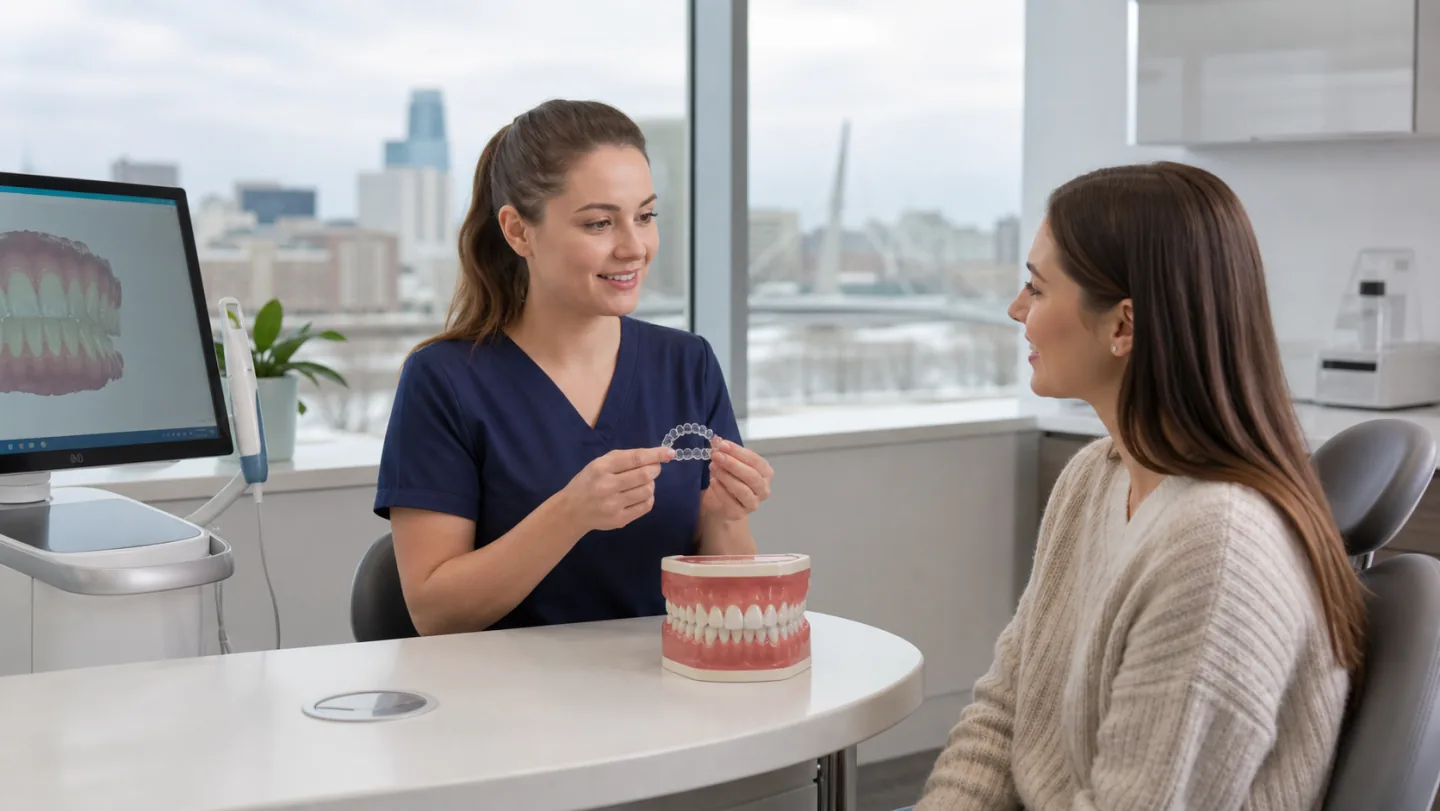
A dentist showing a clear aligner to a patient during a consultation
Stiff fingers, snug trays?

Invisalign for Kildonan Residents

Aligners come out and go back in several times daily, and that takes some fingertip work. If your hands aren’t what they were, Kildonan residents can raise that from the start.

Let's find a time

Request an appointment

We’ll call to confirm your appointment. For urgent care, please call us directly.

Hands matter here

Handling Clear Aligners With Limited Grip or Dexterity

Most descriptions of Invisalign focus on what the trays do to your teeth. Far fewer mention what your hands do to the trays. Removing them for each meal, seating them again and getting them into a case are all small physical jobs, repeated every day for the length of treatment.

Sore joints, tremor, reduced strength or simple clumsiness are all worth saying aloud. Kildonan patients can bring this up at our McPhillips Street clinic in Winnipeg, where insertion and removal are taught when trays are delivered, and where braces can be weighed against aligners if handling looks like a real obstacle.

Explore invisalign
Reception desk with a glass divider, potted plants and wood-look flooring
The reception desk inside Winnipeg North Dental.

Daily handling

Trays leave your mouth for food and non-water drinks, so removal becomes a frequent task.

Fit can feel firm

A snug tray or added attachments may make the first attempts at removal harder.

Practice comes built in

Getting aligners in and out is taught at delivery, and you can say so if it’s difficult.

Beyond the fingers

Your hands are one part of a bigger assessment.

Dexterity alone doesn’t decide anything. Your dentist still has to establish what needs correcting and whether trays can achieve it, then consider how the day-to-day routine would work for you.

The clinical picture

Treatment planning begins with your mouth: how teeth sit, how roots are supported and how upper and lower jaws meet.

  • Overlaps, rotations and gaps are all noted.
  • Bite function is reviewed, not just appearance.
  • Records may include scans, photographs and X-rays.
  • Some movements may be better handled by braces or a mix of both.

The hands-on picture

A short, honest look at what your hands manage easily can head off frustration later, once you’re relying on them several times a day.

  • Mention which small tasks have become difficult, such as buttons or jar lids.
  • Ask how attachments could change the feel of removing a tray.
  • Elastics, when planned, are another small item to handle.
  • Try opening and closing your case while someone is there to help.

Fixed braces don’t have to be taken out for meals. Cleaning around them brings its own demands on the hands, so that’s worth comparing too.

How treatment unfolds

Four stages, with your hands in mind.

Each stage below applies to every aligner patient. Alongside them, we’ve noted the point where your grip or dexterity would be most relevant.

Request your visit
  1. 01

    Examine and record

    Your dentist reviews teeth, gums, jaws and bite along with photographs and suitable X-rays. Bring up any hand concerns at this point, too.

  2. 02

    Sequence the movement

    Each tooth’s intended path is planned, along with the creation of any space and any added control certain movements require.

  3. 03

    Learn on real trays

    Fit gets confirmed, attachments go on where planned, and you try insertion and removal yourself with guidance available.

  4. 04

    Check the tracking

    Return visits measure how far each tooth has really travelled. Handling can come up here too, whether it has grown easier or harder since delivery.

Getting ready to ask

Think through a typical day with your hands.

Nobody expects you to prove anything. A little reflection simply gives you clearer questions and helps your dentist understand what might get in your way.

If you already manage a removable appliance such as a partial denture, say so. Tell your dentist how that goes, whether it’s easy or a struggle.

Say a word about these

  • Any condition affecting your hands, wrists or fingers.
  • Your current medications and recent changes to your health.
  • Dental work you recall, including crowns, bridges or implants.
  • What you’d like to change about your teeth or bite.
Bright room with framed blue abstract art, a bench and a window with blinds
Dental chair in pale blue beside wood cabinets and a wall-mounted screen

Blue artwork and a bench in the waiting area, plus a dental chair.

No embarrassment required

Slow hands are not a problem to hide.

Fumbling with something new in front of a dental professional can feel awkward. It shouldn’t. You’re learning a physical skill, and it’s better to struggle during an appointment than alone at home.

Take another try

Ask to repeat the removal technique as many times as you need before leaving your delivery visit.

Report soreness

If teeth or hands hurt from repeated removal, phone the clinic and describe what’s happening.

Never force a tray

Struggling with one that won’t budge or seat? Stop and call, rather than pushing harder.

Over the months ahead

Handling tends to deserve a second look.

Attachments, new trays and retainers can each change what your fingers have to do. Keep the clinic informed so that handling problems don’t quietly become wear problems.

01

Skipped because it’s hard

If you’re leaving trays out because removing them hurts, or skipping reinsertion, mention it. Missed wear can leave teeth behind schedule.

02

Refinement rounds

Additional aligners could follow if some movement remains incomplete. That means more trays to handle, though it doesn’t by itself signal failure.

03

Retainers afterward

These need wearing as prescribed, since teeth can shift throughout life. Ask how yours would be taken in and out before they’re made.

A tray stuck or won’t sit down fully? Call the clinic about it.

Talk with our team
Clinic storefront with glass doors, frosted windows and a large logo sign overhead

Winnipeg North Dental

Unit-5 2358 Mcphillips Street, Winnipeg, MB R2V 4J6
Get directions (opens in a new tab)
For people living in Kildonan

Learning to Handle Trays at Our Clinic

Kildonan belongs to the City of Winnipeg, and aligner assessments, tray fittings and reviews for its residents take place at Winnipeg North Dental, Unit 5, 2358 McPhillips Street.

Typing into the form lets the clinic know you’d like a visit, though no time is set yet. Expect a reply to settle one, or start things off by phone.

Questions about coverage?

Talk with our team before your visit or learn about CDCP.

A little clarity before your visit

Your questions, answered.

Helpful details about invisalign in Kildonan.

Ask our team
I have arthritis in my hands. Can I still ask about Invisalign?

Yes. Describe which movements are hard for you, and ask your dentist how that might affect treatment. Handling is one practical factor among several in deciding what suits you.

Are trays hard to take out?

Often they’re snug, especially when new or when attachments give them more to hold onto. You’ll be shown a technique when they’re delivered, and you can ask for extra practice.

Is there a tool that helps with removal?

That’s a good question for your delivery visit. Your dentist can tell you what is appropriate for your trays, so please check before trying anything of your own.

Could someone at home help me with my aligners?

It’s worth raising if you’re considering it. Keep in mind that trays come out several times a day, so a helper would have to be available at each of those moments.

Would I manage elastics?

Not every plan uses them. When they’re part of treatment, you’d need to place small removable bands yourself, so ask about that before you agree to a plan.

Do braces make more sense if my hands are unreliable?

Possibly, as they aren’t removed by you. Yet they do require careful cleaning around brackets and wires. Your dentist can weigh those demands against what your teeth require.

How would a Kildonan resident set up an assessment?

Phone (204) 338-3003 or complete the form on this page if typing is easier. Your assessment would be at Unit 5, 2358 McPhillips Street, Winnipeg, MB R2V 4J6, on a date the clinic confirms.

Your teeth, your hands

See how aligners would work in your hands.

Ask for an aligner assessment at the Winnipeg clinic, and say beforehand if handling small objects has become tricky.

Patient testimonials

Kind words from our patients

★★★★★ 5.0 from 440+ reviews on Google

Close to home

Areas we serve

Convenient dental care on McPhillips Street for families across northwest Winnipeg and nearby communities.

Explore all service areas

A healthier smile is one visit away

Ready for dental care that feels genuinely comfortable?

✓ New patients welcome ✓ Direct insurance billing ✓ Multilingual team

How can we help?

Our dental team is here for you.

Ready to book or have a question? Choose the option that works best for you.

For urgent dental concerns, please call us directly.

Send us a message

Our team will reply during clinic hours.



