Skip to content
Winnipeg North Dental
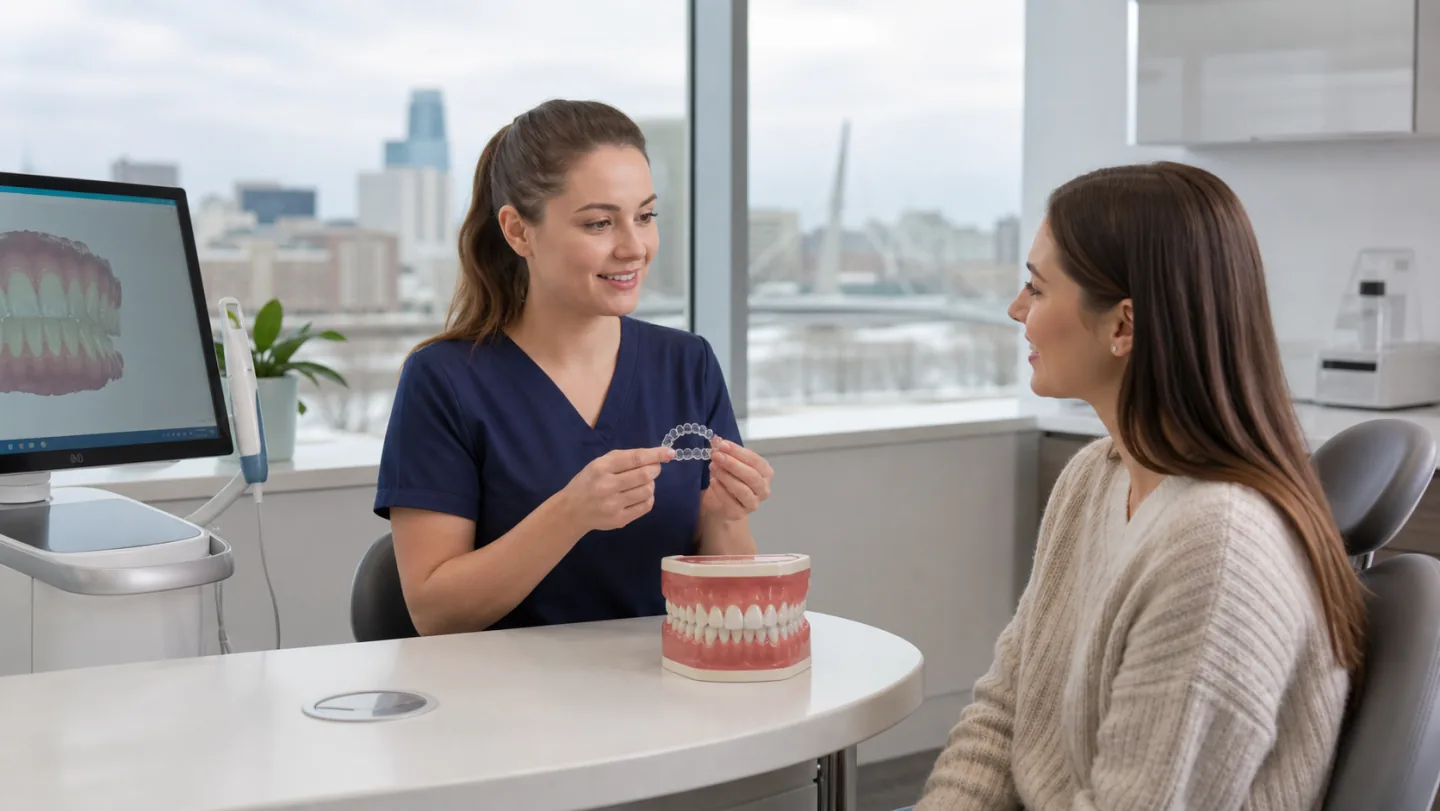
A dentist showing a clear aligner to a patient during a consultation
Told braces were your one option?

Invisalign for Highland Pointe Residents

Maybe that was years ago, and you’ve wondered ever since whether the answer would be different today. Highland Pointe residents can ask, without assuming what the answer will be.

Let's find a time

Request an appointment

We’ll call to confirm your appointment. For urgent care, please call us directly.

An old answer, a new look

Revisiting the Braces Advice You Were Given

Advice about straightening teeth reflects the mouth examined at that moment. Your teeth and bite may have stayed the same since, or they may have changed. A previous recommendation is useful background, but nobody can say what fits you now without looking again.

Some movements really are more predictable with brackets and wires, and a fresh examination could confirm the earlier advice. It could also point to aligners or a combined approach. Highland Pointe is in Winnipeg, and this assessment takes place at our McPhillips Street clinic.

Explore invisalign
White reception desk with a clear divider, potted plants and a blue accent wall
A white reception desk with potted plants beside a blue wall at Winnipeg North Dental.

Looked at afresh

Your teeth, gums, bite and jaw relationships are examined as they are today, rather than as they were described.

Either answer is useful

Hearing that braces still suit you better is a real result, and so is learning that aligners could do the job.

Share what you remember

Whatever you recall about the earlier reasoning gives the dentist a helpful starting point for discussion.

How the appliance gets chosen

The movement decides, along with your daily habits.

Two questions sit underneath this choice: can the appliance produce the movement your teeth need, and can you give it the daily cooperation it requires?

When trays are a reasonable fit

Aligners can manage many selected concerns, using planned force from one tray to the next. A decent match also depends on keeping them in for the prescribed time.

  • Crowded or overlapping teeth needing distributed space.
  • Selected gaps, with angulation kept under control.
  • Suitable overbite, open bite or crossbite problems.
  • Teeth that have shifted after earlier orthodontic work.

When brackets may still win

Fixed appliances stay on throughout active treatment and act directly on the teeth. For certain movements that remains the more predictable approach.

  • A broad range of movements is under direct control.
  • There’s nothing to remember to put back in.
  • Your cleaning routine has to adapt around the wires.
  • Combined plans sometimes draw on both appliances.

Fixed or removable, the choice rests on your assessment. A clear explanation of why one is recommended is a fair thing to ask for.

If aligners stay in the running

What would follow a yes.

Should your examination support aligners, treatment proceeds through a sequence of planned stages. Even a yes keeps being tested by how the teeth actually respond.

Request your visit
  1. 01

    Records and diagnosis

    Beyond the examination itself, photographs and suitable X-rays are reviewed, and this is when you can compare the old advice with what’s found now.

  2. 02

    Sequencing the movements

    Each tooth’s path is worked out digitally, including how to create room. Ask which movements in your case are expected to be the most demanding.

  3. 03

    Starting to wear them

    Fit gets confirmed at delivery. Any bonded attachments go on, and you’re shown how to put trays in, take them out and keep them clean.

  4. 04

    Comparing plan to reality

    Progress visits look at how teeth are really moving. If trays stop fitting as intended, the dentist can step in and adjust course.

What you were told, roughly

Dig up whatever you remember about that advice.

You don’t need the old paperwork or the exact wording. A loose memory of what was said, and roughly when, is enough to open the discussion.

If you’d like copies of earlier X-rays or records from another office, you could ask that office what they’re able to share.

Helpful to bring

  • What you recall of the reason braces were advised.
  • Roughly how long ago that advice was given.
  • A list of what you take, and news about your health.
  • Your feelings about fixed versus removable appliances.
Consultation room with a white desk, keyboard and framed coastal painting on the wall
Dental chair in pale blue upholstery with a tray arm and cabinets behind it

A framed coastal painting in a consultation room and a pale blue chair in a treatment room, Winnipeg North Dental.

What put you off braces

Tell the dentist why you held back.

Plenty of people put treatment aside for a reason, whether it was appearance, cleaning, cost or plain reluctance. Knowing yours makes the discussion more useful.

The look of the wires

If visible brackets were the main objection, ask how noticeable aligners and any attachments would be in your case.

Cleaning around them

Brackets change how you brush. Trays come out for it, but they also ask you to clean before each reinsertion.

Sensations along the way

Trays feel snug by design. Anything sharp or a poor fit is something to phone about, whichever option you choose.

Whichever way it goes

Both roads end at a retainer.

Choosing trays over brackets doesn’t change what follows active movement. After either appliance, teeth need holding while tissues adapt around their new positions.

01

Same need, either way

Retention is required with clear aligners just as it is with braces, so don’t let it sway your choice between them.

02

Extra trays are possible

When teeth haven’t finished moving, new records may support additional aligners. Planning for them is normal practice.

03

Lifelong drift

Without retainers worn as prescribed, teeth can shift again. This is true at any age and after any type of appliance.

Unsure what the retainer stage would ask of you? Bring it up before you decide on anything.

Talk with our team
Winnipeg North Dental storefront with grey siding, large windows and the phone number on its sign

Winnipeg North Dental

Unit-5 2358 Mcphillips Street, Winnipeg, MB R2V 4J6
Get directions (opens in a new tab)
Highland Pointe, taking another look

Where the Question Can Be Reopened

Highland Pointe residents can have braces advice re-examined at Winnipeg North Dental, Unit 5, 2358 McPhillips Street, in Winnipeg, where aligner care would also take place.

The online form is a request, not a booked slot. Once it reaches the clinic, someone replies to arrange a time. Please call about urgent problems.

Questions about coverage?

Talk with our team before your visit or learn about CDCP.

A little clarity before your visit

Your questions, answered.

Helpful details about invisalign in Highland Pointe.

Ask our team
Can aligners do what I was told only braces could?

Possibly, or possibly not. It depends on the movement your teeth need today, so an up-to-date examination is the way to answer that question.

Might you end up agreeing that I need braces?

Yes, that could happen. Certain movements are more predictable with brackets and wires, or with an approach that combines both appliances.

Do I need the records from when I was first told?

They aren’t essential for asking the question. New photographs, X-rays and scans may be taken as appropriate, and you’re welcome to mention what you remember.

What’s a combined approach?

It’s a plan drawing on more than one type of appliance, because no single option covers every movement. Ask whether it applies to your teeth.

Do aligners need less commitment than braces?

A different kind. Brackets stay put with nothing to remember, whereas trays rely heavily on you wearing them consistently through the day and night.

What should I do if I can’t remember why braces were advised?

Simply say so at your assessment. The dentist bases recommendations on what’s examined now, so a hazy memory doesn’t stand in your way.

How can someone in Highland Pointe ask for a fresh assessment?

Phone (204) 338-3003 or use the form. Your visit would be at Unit 5, 2358 McPhillips Street, Winnipeg, MB R2V 4J6.

Still wondering?

Get a current answer instead of an old one.

Ask our Winnipeg clinic to look at your teeth as they are now, and explain which appliance may suit them.

Patient testimonials

Kind words from our patients

★★★★★ 5.0 from 440+ reviews on Google

Close to home

Areas we serve

Convenient dental care on McPhillips Street for families across northwest Winnipeg and nearby communities.

Explore all service areas

A healthier smile is one visit away

Ready for dental care that feels genuinely comfortable?

✓ New patients welcome ✓ Direct insurance billing ✓ Multilingual team

How can we help?

Our dental team is here for you.

Ready to book or have a question? Choose the option that works best for you.

For urgent dental concerns, please call us directly.

Send us a message

Our team will reply during clinic hours.



