Skip to content
Winnipeg North Dental
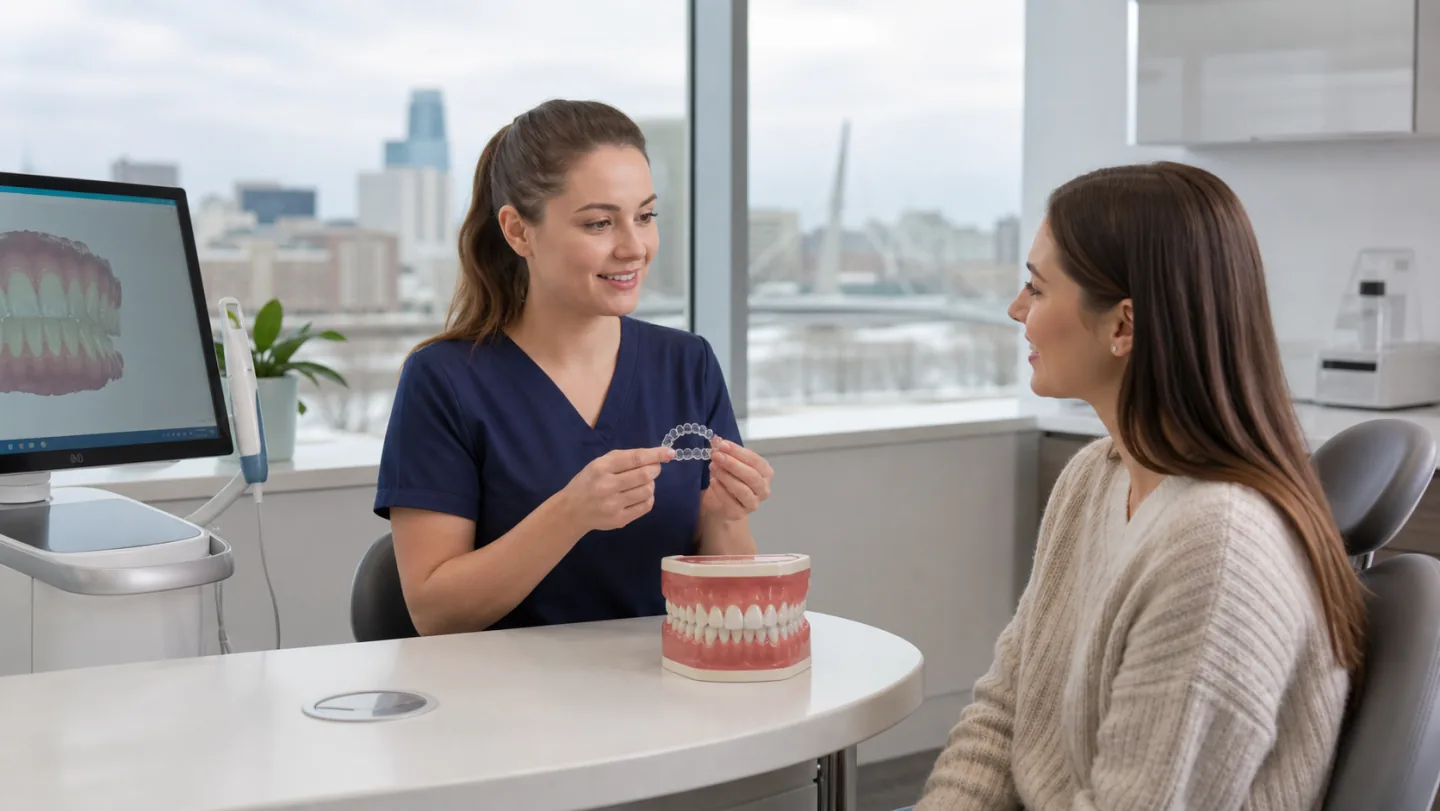
A dentist showing a clear aligner to a patient during a consultation
Why X-rays just to straighten?

Invisalign for Crescentwood Residents

You came to talk about crooked teeth and found yourself asked about photos, scans and films. Crescentwood residents wondering why can read what those records reveal that a mirror never will.

Let's find a time

Request an appointment

We’ll call to confirm your appointment. For urgent care, please call us directly.

Beneath the visible crown

Teeth Move With Their Roots Attached

When an aligner pushes on a tooth, the whole tooth shifts, root included, through the bone that holds it. What you can see in a smile is only the top part of that system. Planning safe movement means knowing what’s going on underneath and how the jaws relate.

That’s why Invisalign records may include photographs, digital scans, X-rays and a bite assessment. Crescentwood residents have this done at our McPhillips Street clinic in Winnipeg, and it’s reasonable to ask what each record is for as it’s taken.

Explore invisalign
Treatment room with a reclined blue dental chair and a monitor mounted on the wall
An operatory at Winnipeg North Dental, where a screen sits behind the blue chair.

Roots and bone

Appropriate X-rays help show the support each tooth has before it’s moved.

A precise model

Digital scans capture tooth shapes that the aligner design is built on.

How teeth meet

A bite assessment records the jaw relationship that movements must respect.

Records into a plan

From measurements to a sequence of trays.

Once records exist, your dentist can work out where teeth should go and in what order. The software then helps visualize a proposed outcome, which is a plan rather than a promise.

What the records feed into

Each type of record answers a different planning question. Together they guide decisions about whether and how to move teeth.

  • Photographs document your smile and face as a starting reference.
  • Scans provide the tooth shapes the aligners are designed around.
  • X-rays help judge root position and the bone around them.
  • Bite records show how upper and lower teeth come together.

Decisions the plan makes

With that information, the plan sets out movements and any added control. Some features can make the trays more visible.

  • Where crowded teeth gain room, and how much.
  • Whether attachments are needed for rotation or root control.
  • If elastics should help with a suitable bite correction.
  • When limited enamel reduction or expansion is appropriate.

Teeth respond biologically, so a digital preview can’t account for everything. Progress still needs checking in your mouth as treatment goes on.

Where records fit in

Four stages, starting with evidence.

Diagnosis comes first because everything afterward is built on it. Here’s how the rest follows.

Request your visit
  1. 01

    Gather and examine

    Teeth, gums, bite and jaw relationships are looked at directly, then photographs and fitting X-rays are reviewed with them.

  2. 02

    Plan the movement

    Your dentist decides each tooth’s destination, how space is made, and where extra control is required.

  3. 03

    Hand over the aligners

    Tray fit is confirmed, any attachments are bonded on, and you’re shown how to insert, remove and look after them.

  4. 04

    Measure against the plan

    Movement in your mouth is compared with the expected sequence, and a tray that isn’t fitting properly prompts a correction.

Helping the records along

Bring what you already know.

A little background makes the records easier to interpret. Previous treatment and health history give context that images alone can’t.

If you’ve had X-rays elsewhere recently, mention it. Your dentist can tell you which images are needed for aligner planning.

Useful details

  • Any orthodontic treatment you had in the past, and when.
  • Crowns, fillings, implants or bridges already in your mouth.
  • Gum treatment or concerns you’ve been told about.
  • A list of prescriptions, supplements and medical diagnoses.
Consultation room with a white desk, a keyboard, black chairs and a coastal landscape print
White reception counter with glass panels, potted plants and a blue bench to one side

The consultation room desk and the front reception counter at Winnipeg North Dental.

Curiosity encouraged

Ask what each picture is for.

You don’t need to sit quietly through record-taking. Asking why an image is needed, and what it might show, is a reasonable part of understanding your own care.

Explained as you go

Ask your dentist to show you what your scans or X-rays reveal.

Your own pace

If you need a pause during scanning, say so.

Findings shared

If records reveal something besides alignment, ask how that would be handled first.

Records later on

New information as teeth move.

The first set of records isn’t the last word. As treatment progresses, your dentist checks whether teeth are tracking and may gather fresh data.

01

Refinement records

When planned movements remain incomplete, new records can be used to order additional aligners. This is a routine planning step.

02

Trays that don’t seat

If an aligner stops fitting, call the clinic rather than skipping ahead. Missed wear or teeth falling behind may need a specific fix.

03

Holding the outcome

Retainers worn as prescribed help keep teeth in place while tissues adapt, and limit shifting later in life.

Concerned about a tray or a tooth between visits? Contact the clinic.

Talk with our team
Winnipeg North Dental entrance with glass doors under a white sign showing the clinic’s phone number

Winnipeg North Dental

Unit-5 2358 Mcphillips Street, Winnipeg, MB R2V 4J6
Get directions (opens in a new tab)
Crescentwood record-taking

Where Your Records Are Taken

Crescentwood is a Winnipeg neighbourhood. Its residents can have Invisalign records and an assessment at Winnipeg North Dental, Unit 5, 2358 McPhillips Street.

Filling in the form asks for a visit; it doesn’t hold a time. The clinic replies to set things up, or you can call instead.

Questions about coverage?

Talk with our team before your visit or learn about CDCP.

A little clarity before your visit

Your questions, answered.

Helpful details about invisalign in Crescentwood.

Ask our team
Why are X-rays needed before clear aligners?

Teeth move along with their roots. Appropriate X-rays help your dentist judge root position and support before deciding whether movement is suitable.

What do the digital scans get used for?

They capture the shape and position of your teeth so movements can be sequenced and aligners designed. The resulting preview is a plan, not a promised result.

Is the on-screen preview what my teeth will look like?

It shows a proposed outcome. Teeth respond biologically, so progress is checked in the mouth and the plan may be refined along the way.

Why does my bite matter if I only care about the front teeth?

Moving front teeth changes how upper and lower teeth meet. A bite assessment helps make sure the planned positions work together.

Could the records show I’m not suited to aligners?

They might. Some movements are more predictable with braces or a combined approach, and gum or bone findings may need attention first.

Will new records be taken partway through?

Possibly. If movements aren’t complete, fresh records may be used to order refinement aligners.

How does someone from Crescentwood arrange the first records visit?

Submit a request on this page or phone (204) 338-3003, and the clinic will follow up. Photographs, scans and any X-rays you need would be done at Unit 5, 2358 McPhillips Street, Winnipeg, MB R2V 4J6.

See below the surface

Find out what your records say.

Request an Invisalign assessment at our Winnipeg clinic, and ask as many questions about the images as you like.

Patient testimonials

Kind words from our patients

★★★★★ 5.0 from 440+ reviews on Google

Close to home

Areas we serve

Convenient dental care on McPhillips Street for families across northwest Winnipeg and nearby communities.

Explore all service areas

A healthier smile is one visit away

Ready for dental care that feels genuinely comfortable?

✓ New patients welcome ✓ Direct insurance billing ✓ Multilingual team

How can we help?

Our dental team is here for you.

Ready to book or have a question? Choose the option that works best for you.

For urgent dental concerns, please call us directly.

Send us a message

Our team will reply during clinic hours.



