
Keep aligners seated through the day and night as prescribed.
Winnipeg North Dental Family Dentistry
Invisalign
Straighten your smile with a series of clear, removable aligners.
Let's find a time
Request an appointment
Clear aligner treatment
Removable by design. Effective through consistency.
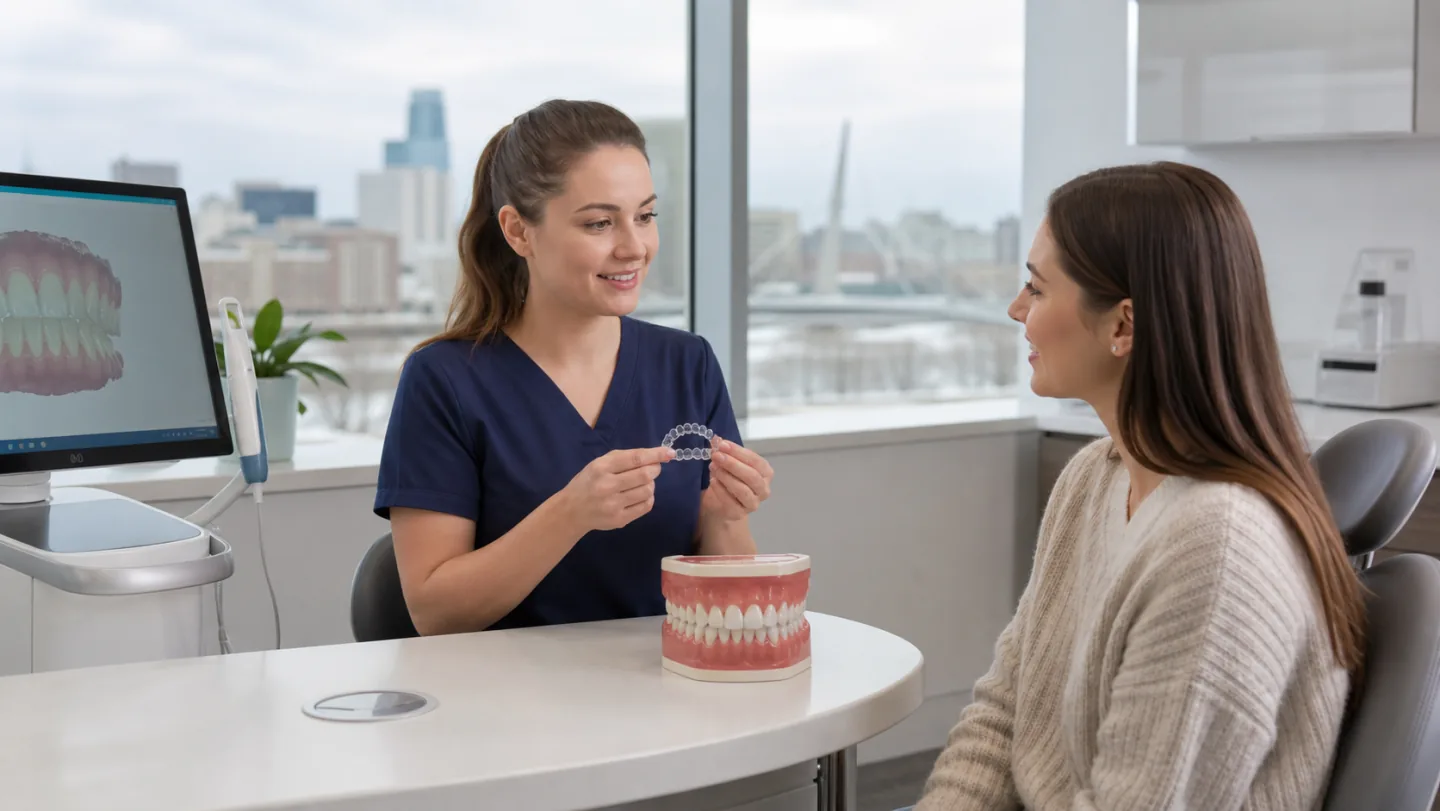
Invisalign treatment uses a planned series of clear aligners to apply controlled pressure and move teeth gradually. The trays can be removed for meals and oral hygiene, making them discreet and flexible—but they only move teeth while they are being worn.
A complete assessment determines whether aligners can achieve the required tooth and bite movements, and whether your daily routine can support the wear schedule.
A day with alignersWear Remove Clean Store
Take them out for meals and drinks other than plain water.
Brush and clean between teeth before reinserting clean trays.
Use the case whenever aligners are out—never a napkin or pocket.
Missed wear time can allow teeth to lag behind the digital plan and may extend or alter treatment.
What clear aligners may address
Straight teeth are only one part of the treatment plan.
We assess tooth position, root support, jaw relationships and bite function. Aligners can manage many concerns, but some movements are more predictable with braces or a combined approach.
Crowding
Create and distribute space to align overlapping or rotated teeth.
Spacing
Close selected gaps while controlling tooth angulation and proportion.
Bite relationships
Address suitable overbite, open bite, crossbite or front-to-back discrepancies.
Relapse
Realign selected teeth that have shifted after previous orthodontic treatment.
Your orthodontic records
The digital preview is a plan—not a promise.
Scans and software help sequence movements and visualize a proposed outcome. Teeth respond biologically, so progress must be checked in the mouth and the plan may need refinement.
Diagnose
Examine teeth, gums, bite and jaw relationships; review photographs and appropriate X-rays.
Design
Plan where each tooth should move, how space will be created and which movements need added control.
Deliver
Confirm aligner fit, place planned attachments and teach insertion, removal and care.
Track
Compare actual movement with the sequence and intervene when an aligner is no longer fitting as intended.
More than clear plastic
Small auxiliaries help the aligners do complex work.
Depending on the movement, treatment may include tooth-coloured attachments, elastics or carefully created space. These features are purposeful and can make aligners more visible than marketing images suggest.
Attachments
Small bonded shapes give the aligner leverage to control rotation, angulation and root movement.
Elastics
Removable bands may connect upper and lower teeth to help correct selected bite relationships.
Space creation
Limited enamel reduction between teeth or planned expansion may create room for alignment when appropriate.
Aligners or braces?
The right appliance is the one that can deliver the planned movement safely and fits the level of daily cooperation you can provide.
- Removable for eating and cleaning
- Less visible, though attachments may show
- Success depends heavily on consistent wear
- Not every movement is equally predictable
- Fixed to teeth throughout active treatment
- Visible brackets and wires require cleaning changes
- No need to remember to insert an appliance
- Can provide direct control for a broad range of movements
Refinement and retention
The last aligner is not the end of treatment.
If planned movements remain incomplete, new records may be used to order refinement aligners. Once active movement is complete, retainers hold teeth while tissues adapt and help limit future shifting.
Refinement
Additional aligners are a normal planning tool, not automatically evidence that treatment failed.
Retention
Retainers must be worn as prescribed because teeth can continue to shift throughout life.
Invisalign FAQs
What clear-aligner treatment asks of you.
How many hours a day do I need to wear aligners?+
Aligners are generally worn through most of the day and night and removed only for eating, drinking anything other than water and oral hygiene. Follow the exact schedule prescribed for you.
Can I eat with Invisalign aligners in?+
No. Remove them for meals and snacks to avoid damage and trapping sugars or acids against the teeth. Plain water is generally acceptable while wearing them.
Are Invisalign aligners completely invisible?+
They are discreet, not invisible. The tray edges, saliva and tooth-coloured attachments can be noticeable at conversational distance.
What if an aligner stops fitting?+
Contact the clinic rather than skipping ahead. Lost wear time, damaged trays or teeth that are not tracking may require a specific correction.
Will I need attachments?+
Many plans use attachments to provide control for particular movements. Their number, shape and position are determined by the treatment goals.
Do I need retainers afterward?+
Yes. Retention is required after clear aligners just as it is after braces. Teeth can shift when retainers are not worn as prescribed.