Skip to content
Winnipeg North Dental
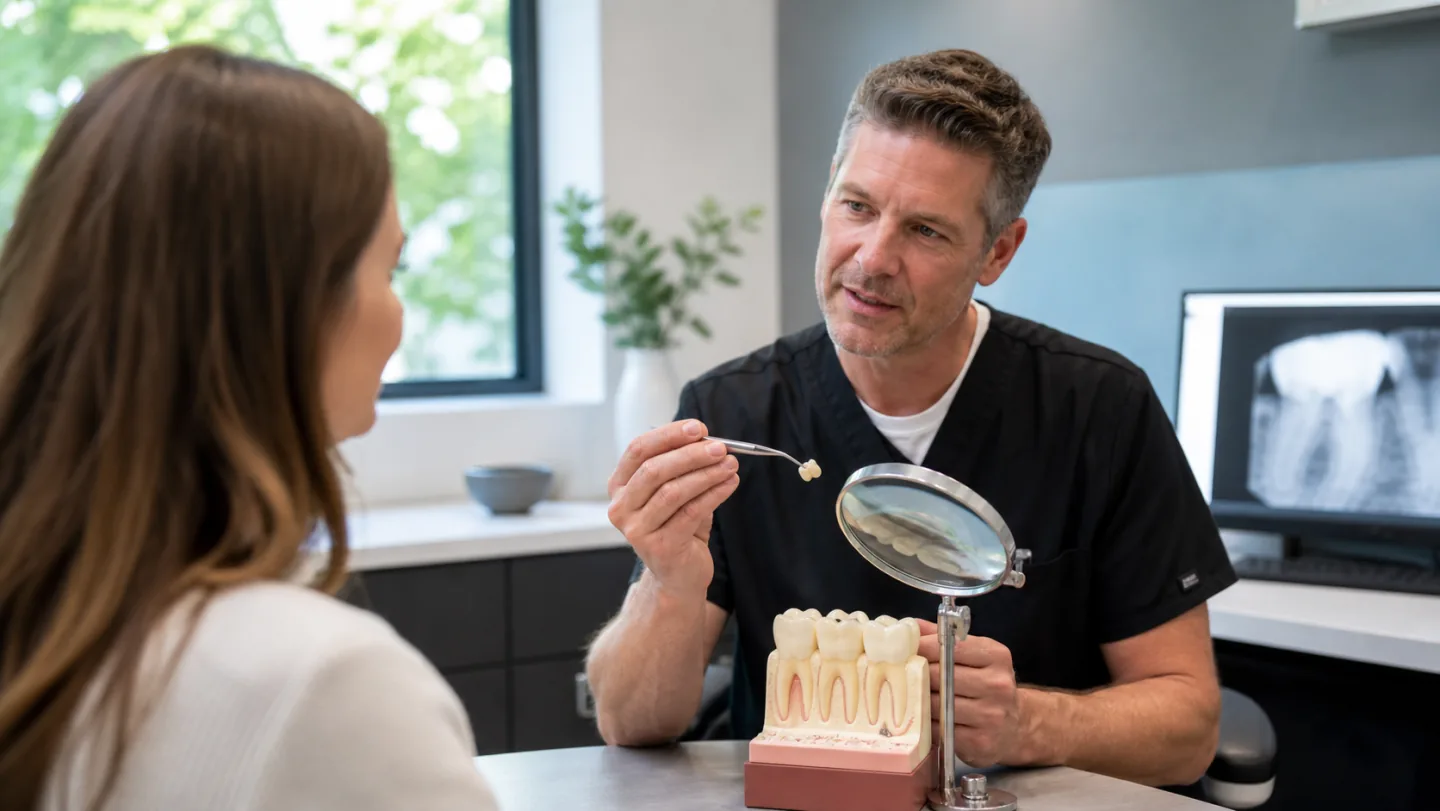
A dentist showing a small ceramic inlay beside a detailed tooth model
North Winnipeg, McPhillips Street

Inlays & Onlays in Winnipeg North

Our clinic sits in Winnipeg North, and this is where inlays and onlays are planned and placed. Here is a plain walk-through of how that custom work gets done.

Let's find a time

Request an appointment

We’ll call to confirm your appointment. For urgent care, please call us directly.

Straight answers first

Inlay and Onlay Treatment in the Northern Part of the City

Let’s begin with the practical part. Unit 5, 2358 McPhillips Street, sits in the city’s north, and that one address is where your treatment would take place.

As for the treatment: an inlay or onlay is a restoration crafted outside your mouth to replace a damaged section of a back tooth. It handles repairs that may be too big for a direct filling, without necessarily covering the tooth as a crown would. Whether it fits your situation is something only an examination can tell.

Explore inlays & onlays
Bright reception desk with potted plants and wood-look flooring
You check in at this front desk for every stage.

A clear address

From assessment to bonding, your appointments are all on McPhillips Street.

Four working stages

Prepare, record, create and bond: each one has a job in making the final piece fit.

Fit checked before bonding

Nothing is secured until the dentist has verified how it seats and how you bite on it.

Inside the process

Why this is not done like a filling.

A filling is placed and shaped directly in the tooth during an appointment. Inlays and onlays take a different path, which explains the extra steps involved.

Designed from a record

The custom piece is based on a scan or impression of your prepared tooth, so it can be built to match that exact space.

  • Records capture the tooth itself and the contacts beside it.
  • Your bite is recorded too, along with a selected shade.
  • Fabrication uses the material planned for your restoration.

Sized to the damage

An inlay stays within the cusps of the tooth. An onlay continues over any that have weakened, while other surfaces remain untouched by the coverage.

  • Moderate decay, fracture or failing dental work are typical reasons.
  • Suitable margins must be achievable when the area is prepared.
  • The planned design has to manage the forces of your bite.

When too little sound tooth remains, or the tooth needs wider protection, your dentist will tell you and explain the alternatives.

Stage by stage

Prepare, record, create, bond.

These are the core stages once your dentist has confirmed that an inlay or onlay is the right fit for the tooth.

Request your visit
  1. 01

    Prepare

    Local anesthetic is usually given first. The dentist then removes the damaged material and forms a clean shape that the restoration can rest on.

  2. 02

    Record

    Next comes the scan or impression, plus notes on your bite and the shade chosen for the piece.

  3. 03

    Create

    The restoration is fabricated in its planned material. When this happens between visits, a temporary may cover the tooth in the meantime.

  4. 04

    Bond

    At the final stage, the dentist confirms fit and bite, fixes the piece in place with adhesive, and polishes it smooth.

Planning your visit

A few details make the first visit easier.

An initial appointment centres on working out what the tooth needs. Knowing your health background and what you have been feeling helps that assessment go smoothly.

When you book, feel free to ask how long the appointment may take and whether an estimate can be prepared for the recommended work.

Have these ready

  • Medications you take now, including any that changed recently.
  • Dental insurance or CDCP details, where they apply.
  • A description of the problem tooth and where it is in your mouth.
  • Any history of cracks, repairs or past dental work on that tooth.
Dental operatory with a reclined blue-green chair beside a wall-mounted monitor
White front desk at the clinic decorated with an orchid and greenery

Our north Winnipeg clinic, from front desk to treatment room.

How it feels

No surprises in the chair.

Knowing the order of events takes much of the uncertainty out of treatment. If you would like the dentist to describe each stage as it happens, just say so at the start.

Numbing the area

Preparation is usually carried out under local anesthetic so the work can proceed comfortably.

Living with a temporary

Temporary materials are not as durable as the final piece, so follow the instructions you receive while wearing one.

Tenderness in the days after

Short-term sensitivity is possible and ought to improve. Should it linger, tell the clinic.

After the last stage

How to look after the finished work.

Bonding completes the restoration, but the tooth around it still counts on your routine and on regular attention.

01

Keep the seam clean

Pay particular care to the line where the restoration meets natural tooth when you brush and floss.

02

Teeth are not tools

Avoid cracking, tearing or prying with that tooth, since it adds force the restoration does not need.

03

Watch for warning signs

A bite that feels high, a rough edge or any sense of movement is a reason to contact us.

Sudden pain or a break should be handled by phone, not through the appointment form. Call (204) 338-3003.

Talk with our team
Front entrance of the clinic with glass doors under a large Winnipeg North Dental sign

Winnipeg North Dental

Unit-5 2358 Mcphillips Street, Winnipeg, MB R2V 4J6
Get directions (opens in a new tab)
Find the clinic

McPhillips Street, in the North of the City

Anyone in Winnipeg North should plan around this address: Unit 5, 2358 McPhillips Street. Tap the link for directions and pick whichever way suits you.

Online requests land with the front desk, and a confirmed time comes only in the reply. Prefer to talk it through? Phone during office hours.

Questions about coverage?

Talk with our team before your visit or learn about CDCP.

A little clarity before your visit

Your questions, answered.

Helpful details about inlays & onlays in Winnipeg North.

Ask our team
Is your clinic really in the north part of Winnipeg?

Yes. We are on McPhillips Street, at Unit 5, 2358 McPhillips Street, Winnipeg, MB R2V 4J6. To ask for a visit, use this page’s form or ring (204) 338-3003, and we will reply to finalize it.

What is actually made for me?

A small custom piece shaped to replace the damaged section of your tooth. It is built from a scan or impression, then bonded into the prepared space.

Do all patients wear a temporary?

Not necessarily. One may be used to protect the tooth if fabrication takes place between appointments, and it needs some care because it is less durable than the finished restoration.

How is an onlay different from a full crown?

Coverage is the key difference. An onlay protects chosen cusps only, whereas a crown generally surrounds the visible tooth around its full circumference.

Which factors decide whether this will work on my tooth?

Your dentist considers cracks, decay, how many walls remain, root health and your bite. A repair also needs margins that can be prepared properly and a design able to handle chewing forces.

Next step

Have the tooth looked at on McPhillips Street.

Patients in Winnipeg North can describe the tooth using the form below. A staff member will contact you, since submitting a request does not reserve an appointment.

Patient testimonials

Kind words from our patients

★★★★★ 5.0 from 440+ reviews on Google

Close to home

Areas we serve

Convenient dental care on McPhillips Street for families across northwest Winnipeg and nearby communities.

Explore all service areas

A healthier smile is one visit away

Ready for dental care that feels genuinely comfortable?

✓ New patients welcome ✓ Direct insurance billing ✓ Multilingual team

How can we help?

Our dental team is here for you.

Ready to book or have a question? Choose the option that works best for you.

For urgent dental concerns, please call us directly.

Send us a message

Our team will reply during clinic hours.


