Skip to content
Winnipeg North Dental
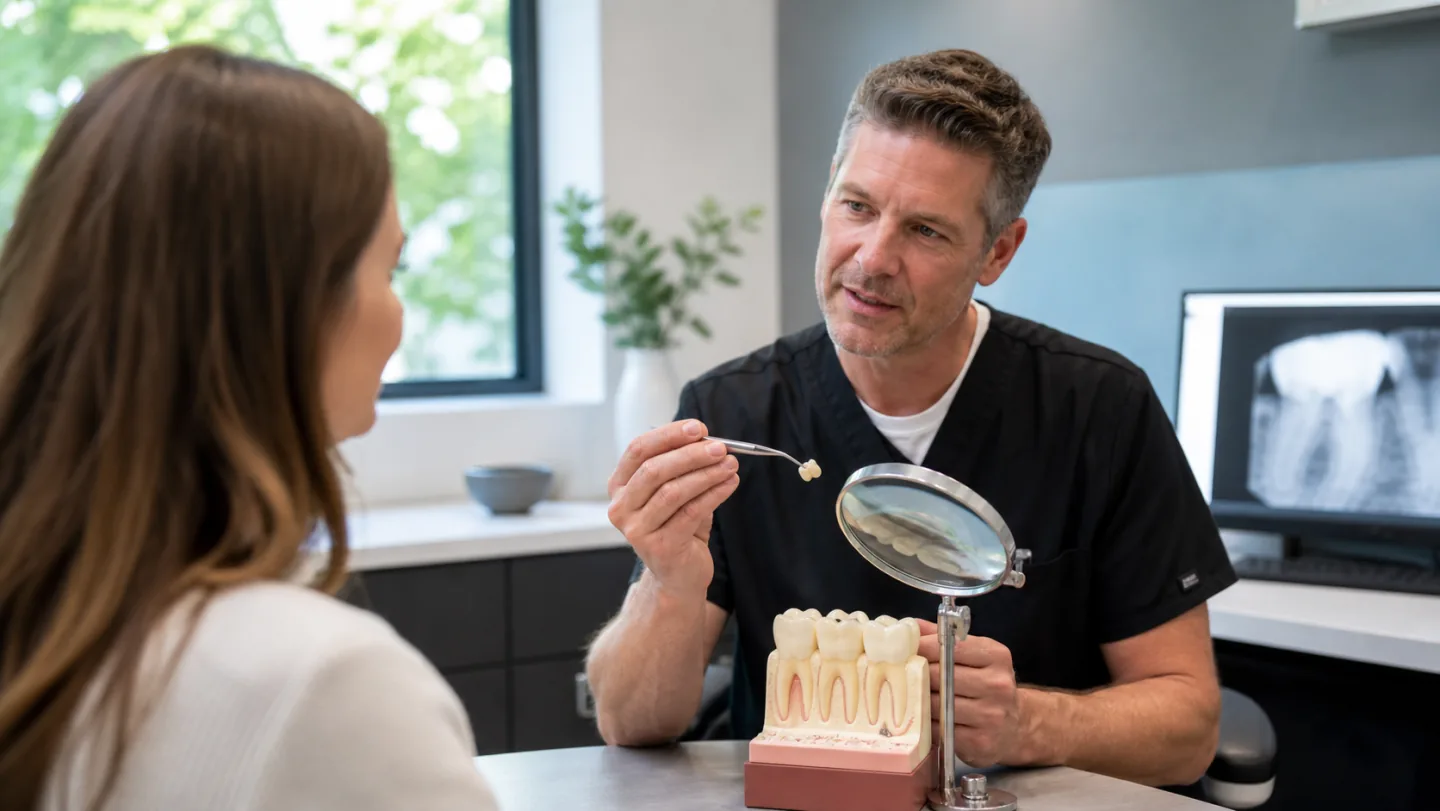
A dentist showing a small ceramic inlay beside a detailed tooth model
Phoning before you come in

Inlays & Onlays for St. Andrews Residents

St. Andrews sits outside the City of Winnipeg, so you may want a conversation before anything goes on the calendar. Here is how to describe a damaged back tooth to our McPhillips Street clinic, and which answers need an examination.

Let's find a time

Request an appointment

We’ll call to confirm your appointment. For urgent care, please call us directly.

A useful first call

Putting a Sore or Broken Molar Into Words

Most of us are not sure how to explain a tooth problem to a receptionist. You do not need any clinical vocabulary. Saying which side it is on, what changed and when, and what sets it off gives the office something real to work with.

A phone call has limits, and it is fair to know them from the outset. Nobody can decide between a filling, an inlay, an onlay or a crown without seeing the tooth. For St. Andrews residents, that examination happens at Winnipeg North Dental on McPhillips Street in Winnipeg.

Explore inlays & onlays
White reception counter with an orchid and small plants, beside a dark blue bench and a tall potted plant
A white reception counter, with a blue bench and potted plant to one side.

Plain words are fine

Upper left, broke on Tuesday and sore with cold is already a helpful description of a tooth.

Timing worth raising

Mention any change in the last few days, because it can affect how the office responds to you.

What waits for the exam

Choosing a type of repair depends on cracks, walls and bite, which have to be looked at directly.

If the word comes up

Two terms you may hear on the phone or in the chair.

Knowing roughly what these restorations are will make the conversation easier to follow. Both are custom pieces for selected back teeth, made outside your mouth rather than built up on the tooth.

Inlay, inside the chewing surface

This piece replaces damage in the central area of a molar or premolar while leaving the raised points uncovered. It comes into the discussion when a direct repair would be large but the surrounding structure looks suitable.

  • No cusp is covered.
  • Sound walls must surround it.
  • It can offer controlled shape and contact.

Onlay, reaching over a cusp

Here the custom piece extends across one or more weakened points of the tooth. Other surfaces stay uncovered, which is where it parts ways with a crown, since a crown generally wraps the visible tooth.

  • Coverage goes where weakness is found.
  • Your bite shapes the design.
  • Healthy surfaces can be left alone.

A description over the phone cannot tell you which of these applies, or whether something else would serve the tooth more suitably. Treat any early suggestion as provisional.

Once you have talked

How the work proceeds after an examination.

If a custom restoration turns out to be suitable, four stages follow the assessment. Ask at booking how they would be divided across your appointments.

Request your visit
  1. 01

    Clearing the damaged area

    With local anesthetic in most cases, the dentist takes away what cannot stay and shapes a clean space with enough support.

  2. 02

    Recording the details

    A digital scan or an impression captures your prepared tooth, its contacts and your bite. A shade gets selected at this point as well.

  3. 03

    Fabricating your piece

    The restoration is made in the material chosen for you. You could wear a temporary in the interval, so ask how it should be treated.

  4. 04

    Fitting it for good

    Fit and bite are confirmed before adhesive secures the piece in place. Polishing is the final touch.

Notes beside the phone

A few details that make the call go smoothly.

Nothing here is a test. Jotting these down first simply means you will not hang up and then remember the one thing you meant to say.

Severe pain, swelling or a tooth that has just broken are reasons to say so straight away at the start of the call.

Jot beside the phone

  • Left or right, top or bottom of your mouth.
  • What triggers it, such as biting or cold.
  • When it started or last changed.
  • Past work on that tooth, if you recall any.
  • Any questions about visits you would like to plan around.
Blue upholstered bench under two abstract paintings, with white chairs and small plants by a window with striped blinds
Pale blue patient chair with a dental light arm, wood-toned cabinets and a wall-mounted monitor

A blue bench below two paintings, and a pale blue patient chair with wood-toned cabinets.

No wrong way to ask

It is fine to call with a half-formed worry.

You may not know yet whether the tooth is even a problem, and that is a perfectly good reason to pick up the phone. Saying that you are unsure gives the office the right place to begin.

Say how you feel about it

If dental visits make you uneasy, that is worth mentioning when you first get in touch.

Freezing for the prep

Preparing the tooth usually takes place under local anesthetic, which you can ask about ahead of time.

Tenderness later on

Some short-lived sensitivity can follow treatment. Expect it to ease rather than linger or build.

Calling again later

The phone stays useful after the piece is bonded.

Your day-to-day part is careful cleaning and sensible chewing. Should something feel different afterward, a short description of the change is a good place to start.

01

Worth describing

Tell the clinic about a bite that sits high, sensitivity that has stalled, movement or a rough edge.

02

Cleaning the margins

The line between tooth and restoration needs steady attention, since new decay can begin along it.

03

Not a bottle opener

Restored teeth should never stand in for scissors or tools, however sturdy the piece may feel.

How well a restoration performs depends on many things, including remaining tooth, bonding, bite, grinding and hygiene, so nobody can give you a fixed lifespan for it.

Talk with our team
Clinic storefront with the Winnipeg North Dental sign and phone number above glass doors

Winnipeg North Dental

Unit-5 2358 Mcphillips Street, Winnipeg, MB R2V 4J6
Get directions (opens in a new tab)
Where the exam happens

From a Phone Call to Our McPhillips Street Clinic

After that first conversation, St. Andrews residents come into Winnipeg to be examined at Winnipeg North Dental, Unit 5, 2358 McPhillips Street. All stages of treatment take place there.

Prefer writing? The form works too, though it does not hold a time, and the office replies to arrange one. For anything urgent, a call is the right choice.

Questions about coverage?

Talk with our team before your visit or learn about CDCP.

A little clarity before your visit

Your questions, answered.

Helpful details about inlays & onlays in St. Andrews.

Ask our team
Can someone tell me over the phone if it is an inlay or an onlay?

No, and an honest office will not try. That choice relies on seeing how much sound tooth remains, along with cracks, decay, bite and root health.

What if I cannot say exactly which tooth it is?

Give the side and the general area and leave it at that. Pinpointing the source is part of what the examination is for.

Should I describe an old filling if I remember one?

Yes, any history you recall could be relevant. Rough memories are welcome, and uncertain details can simply be flagged as uncertain.

What can I ask about the visits while I am on the call?

You might ask what a first appointment covers, how long to set aside for it, and how many further visits a custom restoration commonly involves.

Is it better to call or send the form from St. Andrews?

Either starts a request. Phone (204) 338-3003 if you would like to talk it through or the tooth is painful. Either way, you would be seen at Unit 5, 2358 McPhillips Street, Winnipeg, MB R2V 4J6.

Whenever you are ready

Start with a description of the tooth.

Tell us what you have noticed, by phone or through the form, and the office will follow up about a time at our McPhillips Street clinic. A painful tooth calls for the phone.

Patient testimonials

Kind words from our patients

★★★★★ 5.0 from 440+ reviews on Google

Close to home

Areas we serve

Convenient dental care on McPhillips Street for families across northwest Winnipeg and nearby communities.

Explore all service areas

A healthier smile is one visit away

Ready for dental care that feels genuinely comfortable?

✓ New patients welcome ✓ Direct insurance billing ✓ Multilingual team

How can we help?

Our dental team is here for you.

Ready to book or have a question? Choose the option that works best for you.

For urgent dental concerns, please call us directly.

Send us a message

Our team will reply during clinic hours.



