
An inlay to look after
This piece sits within the cusps and replaces the damaged centre. Its edges meet enamel on all sides.
- Restores the chewing area between cusps.
- Keeps healthy cusps natural.
- Has margins that need daily cleaning.
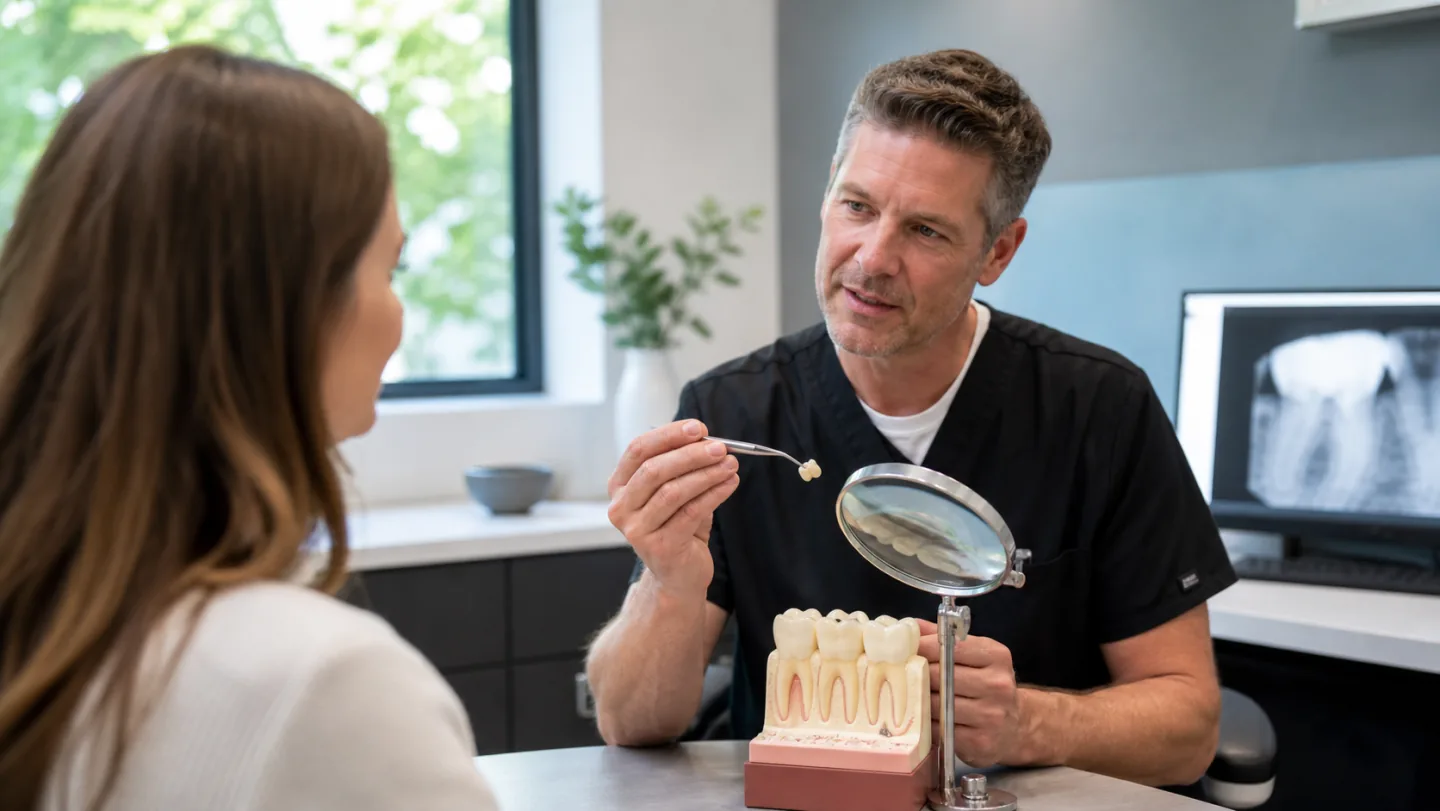
Instructions given while you are still numb are easy to lose. Sage Creek residents having an inlay or onlay at our Winnipeg clinic can use this page to know which points are worth writing down.
Let's find a time
A custom inlay or onlay restores a damaged back tooth while preserving healthy structure. The work in the chair is only part of the story. How you treat a temporary, and later the bonded restoration, also matters.
If you tend to forget spoken advice, it helps to know in advance what you will be told. Sage Creek is an area of Winnipeg, and residents receive their treatment and instructions at Winnipeg North Dental on McPhillips Street.
Explore inlays & onlays
Jot notes on your phone or paper right after each visit while the details are fresh.
Asking for something to be repeated is perfectly fine, especially while you are numb.
A few clear warning signs mean picking up the phone rather than waiting.
An inlay or an onlay is chosen based on how much of the tooth needs rebuilding. Either way, the junction with natural tooth is what needs your attention.
This piece sits within the cusps and replaces the damaged centre. Its edges meet enamel on all sides.
This piece also covers one or more weakened cusps. Because it forms part of your biting surface, notice how your bite feels.
Ask which design you have received, and note it down. It helps when describing the tooth in the future.
Instructions tend to be given after preparation and again after bonding. Here is the general order of treatment.
Request your visitThe dentist reviews cracks, the remaining walls, decay, root health and your bite, and explains the suggested design.
The tooth is numbed, damaged material is removed and the area is shaped. If a temporary is placed, care advice usually follows.
A scan or impression is taken of the prepared tooth, its contacts and your bite, with a shade chosen.
The finished piece is checked for fit and bite, adjusted as needed, bonded and polished. Ask about care before you leave.
A little preparation before each visit means you leave with what you need. Some people find it easier to note a handful of key points than to remember everything.
If the temporary falls off or the tooth becomes painful before your next visit, call the clinic rather than trying to manage it yourself.


A treatment chair and the clinic front desk.
Preparation is normally done with the tooth frozen, and a numb lip and cheek can pull your attention away from what is being said. Asking for the main points again before you head out is completely fine.
As freezing fades, the tooth may feel sensitive for a short time, which should improve.
Temporary materials are less durable than the final piece, so follow the advice you were given.
If you missed something, phoning the clinic to check is better than guessing.
Your ongoing checklist
These few points are worth keeping in your notes. They apply whether you received an inlay or an onlay.
Brush and clean between teeth daily, giving attention to where the restoration meets enamel.
Do not use the restored tooth to open, tear or crack hard items.
A high bite, sensitivity that is not improving, movement or a rough edge are all reasons to call.
No one can say exactly how long a restoration will last. Remaining tooth, preparation, bonding, moisture control, bite, grinding, hygiene and new decay all affect it.
Talk with our team
Winnipeg North Dental
Unit-5 2358 Mcphillips Street, Winnipeg, MB R2V 4J6Get directions (opens in a new tab)Patients from Sage Creek receive treatment, and their care instructions, at Winnipeg North Dental, Unit 5, 2358 McPhillips Street, Winnipeg. Save the directions link by the address alongside your notes.
Sending a request does not set a time. Staff will contact you to arrange one, and if something feels urgent, call.
Questions about coverage?
Talk with our team before your visit or learn about CDCP.
Helpful details about inlays & onlays in Sage Creek.
Ask our teamYou can certainly jot things down before you leave. If you are numb, ask for the key points to be repeated so you catch them.
Call the clinic and ask. It is better to check than to guess, since temporaries are less durable than the final restoration.
A bite that feels high, sensitivity that does not improve, a piece that seems to move or an edge that feels rough.
It helps. Knowing whether you have an inlay or an onlay makes it easier to describe the tooth to any dental professional later.
The basics are similar. Careful cleaning at the edges and avoiding using the tooth as a tool are the main points.
Keep (204) 338-3003 with your notes and phone it with any question. That number reaches Winnipeg North Dental at Unit 5, 2358 McPhillips Street, Winnipeg, MB R2V 4J6, where you were treated.
Read about treatments that help keep restored and natural teeth healthy.
Book dental check-ups and cleanings in Winnipeg for preventive exams, tartar removal, gum monitoring and personalized home-care guidance.
Explore serviceLearn how custom dental crowns in Winnipeg protect cracked, worn or root canal-treated teeth while restoring comfortable function, shape and appearance.
Explore serviceRestore cavities, chips and worn areas with tooth-coloured dental fillings in Winnipeg. Learn when repair is needed and what happens during treatment.
Explore serviceHave an urgent concern? Call (204) 338-3003 to discuss availability.
Ready to begin
Ask for a visit at our Winnipeg clinic, and the office will reach out with timing. If anything urgent comes up, phone instead.
Patient testimonials
Winnipeg North Dental
“Excellent experience at Winnipeg North Dental. Recommended by my friend Gagandeep. The whole staff is professional and attentive. Special thanks to my friend there. Highly recommend!”
Winnipeg North Dental
“Had a great experience at Winnipeg North Dental. My hygienist, Haven, was thorough, professional, and gave really useful recommendations. Watching Netflix during the cleaning was an awesome bonus. Dr. Elzayat was great as well. Overall, a smooth, comfortable visit. Highly recommend!”
Winnipeg North Dental
“I really enjoyed the treatment at this clinic. I had my teeth treated by Dr. Sukhpreet. Everything went great. Thank you so much for your professionalism!”
Winnipeg North Dental
“Dr harpreet and Dr. Sidhu both were very nice during the job , full professional, very knowledgeable and Dr Harpreet was really polite during all time .”
Winnipeg North Dental
“I had a great experience at Dental North in Winnipeg for a teeth cleaning. The staff was friendly and professional, and the hygienist was gentle yet thorough. I left with my teeth feeling amazing and will definitely be returning!”
Winnipeg North Dental
“Very quick, efficient and friendly. Very happy to have found this place.”
Winnipeg North Dental
“I did called them in 2020 October they were not opened at that time. I give them my number, email and name so that when they open they can give me call to book appointment. They might have forgot that. I had a first appointment for dental in Canada. It went really good. They explained every single bit what they gonna do, What is best for me, Doctor was really nice. It was completely satisfying experience. Didnt smell like a clinic. I mean like any walk in doctor clinic. Even they helped me to understand my dental benefits to use them in best possible way. I would definitely recommend to others.”
Winnipeg North Dental
“Excellent experience! The dentist and staff were professional, friendly and were very welcoming!”
Winnipeg North Dental
“I had a great experience at this place, dr Sidhu and all the team was great.”
Winnipeg North Dental
“They are honest and know what they are doing. i came here for my 7 year old dental treatment and Dr sukhpreet guide us very nicely and did perfect job .Its a feeling in safe hands. Reception and staff are polite .”
Winnipeg North Dental
“My recent visit at the Winnipeg North Dental was excellent. The staff was friendly, the cleaning was thorough yet gentle, and the dentist took the time to explain everything clearly. I highly recommend them! Dr Sidhu is awesome:)”
Winnipeg North Dental
“It was really great experience with Dr. Jiwan on my first visit. She treated me very nicely and professionally . Staff were very nice and friendly.”
Winnipeg North Dental
“Excellent clinic with a warm and welcoming atmosphere. Dr. Sidhu handled my tooth issue very gently and in a friendly, professional manner — truly one of the best!”
Winnipeg North Dental
“Friendly staff, clean clinic, and a dentist who really cares. Everything was explained clearly and I felt comfortable the whole time. Highly recommend”
Winnipeg North Dental
“I had great experience at this place all the staff was really helpful and professional.”
Winnipeg North Dental
“I have had nothing but wonderful experiences with Winnipeg North Dental. I have brought my child here for teeth cleaning and she loves how kindly the entire staff treat her. Dr. Sidhu is kind, professional, and extremely thorough. I highly recommend!”
Winnipeg North Dental
“Dr. Sidhu is so kind and caring. Her gentle approach makes going to the dentist a pleasure especially for a child. My daughter and I are so happy we found Winnipeg North Dental. The staff are great too! Highly recommend.”
Winnipeg North Dental
“This place is immaculate, friendly, helpful and the people working there are wonderful! Dr. Sidhu is the BEST!!!! She really cares about you and making your dental experience a positive one! Forever a patient!⭐️⭐️⭐️⭐️⭐️”
Winnipeg North Dental
“Dr. Sidhu exhibits a high level of professionalism and offers exceptional accommodation. She is an outstanding physician who consistently provides assistance with any dental pain or issues that I have encountered. I am grateful for her expertise and support.”
Winnipeg North Dental
“Dr Sidhu is very friendly and kind she takes care of her patients very well. I have my first visit yesterday and she listen and understand my problems and have done a good examination. Also suggested me many things which can improve my teeth situation. The staff is also very good and helpful. I will be visiting there again for sure.”
Winnipeg North Dental
“I had wonderful experience at this place. Thanks to the whole team.”
Winnipeg North Dental
“I have always found Dr. Sidhu to be very patient and comforting as well as gentle and makes for a totally painless visit, when ever I have dental issues. She is a very up beat and positive person which makes for great dental work experience every time.”
Winnipeg North Dental
“I had a wonderful experience! Dr Sidhu and her team are always so friendly. It was also my 1 year old daughters first check up and Dr. Sidhu was so kind and patient with her. I highly recommend Winnipeg North Dental. Kind, passionate, professional and very well managed. So happy I found such a great dentist!”
Winnipeg North Dental
“Recently, i had received two treatments and feeling very good and would like to thank the doctor for explaining in details about the problem and procedure . I would like to thank the staff and doctor for their professionalism for providing the kind service.Thank you.”
Winnipeg North Dental
“My experience here was amazing. Dr. Jiwan Sidhu is very nice and kind! She's overall a great dentist and I recommend others to come here!”
Winnipeg North Dental
“Dr. Sidhu and her Winnipeg North Dental Team are AWESOME!!! They always make their client feel comfortable and explains everything that need to be done in every visit. I also like that she is very caring, always connect with us after our visit to ensure that all is well with our teeth. Very highly recommended.”
Winnipeg North Dental
“Dr Sukhpreet has great and professional knowledge . God bless”
Winnipeg North Dental
“Dr. Sidhu is an amazing doctor who makes her patients feel comfortable and guides through the process. Me and my family had a great experience. I love the way she shares all details about dental health. Thank you”
Winnipeg North Dental
“Amazing place. It is always clean. And Dr.Sidhu takes very good care of her patients. Every time I am there she goes above and beyond to make my stay a pleasant one. Dr.Sidhu truly cares about her patients as do the other staff working with her. They are all very professional. I highly recommend this place and dentist.”
Winnipeg North Dental
“I can't wait to get in the chair with Dr. Sidhu looking down on me with that super powerful freezy needle. Oh yeah, nicest dentist I've ever been to in all of my 79 years. She makes pain fun!”
Winnipeg North Dental
“Dr. Sidhu and her team are amazing. Everyone is very welcoming and know how to make a client comfortable. She explains everything about the procedure and follows up after every session. I am glad I visited her for regular check ups.”
Winnipeg North Dental
“Called first thing in the morning for an emergency and my 4 year old son was taken in within an hour. Dr. Sukhpreet was so nice and gentle and my son just adored her. Just the best dental office for my family..!!!”
Winnipeg North Dental
“My wife and I have been going to Dr.Sidhu and Maribeth for a very long time now. Over 10 years. And when Winnipeg North Dental started we followed them there. The care we get there is the best. From the front desk staff, to the hygienist and dental assistants and the dentists they’re the best group. Thank you guys.”
Winnipeg North Dental
“Knowledgeable staff and easy to get appointments! Thanks”
Winnipeg North Dental
“Just started going to this Clinic and so far my experience are all positive. Staff are friendly. Clinic is super clean. Very organized and always on time. Plenty of parking.Highly recommended”
Winnipeg North Dental
“Dr. Sidhu and her staff are amazing! They don't rush, ask questions, and take the time to answer. I was impressed that Dr. Sidhu spent more than 10 minutes doing my check-up; the last dentist I went to spent 2 minutes and didn't even ask my name! I will definitely be going back.”
Winnipeg North Dental
“I’ve been seeing Dr.Sidhu at Winnipeg North Dental since it opened! Always a 10/10 experience there! She and all her staff exceed my expectations every time! Extremely friendly and will go the extra mile for you to ensure you receive the best dental care possible!”
Winnipeg North Dental
“My experience in Winnipeg North dental was amazing and thankyou to Dr. Sidhu and her team , they also ensure that the patient in their care always feel comfortable. They provide the best quality service to their patients and Dr. Sidhu is amazing , very friendly. Highly recommended.”
Winnipeg North Dental
“Wonderful experience with Winnipeg North Dental Clinic. Dr. Sidhu was a wonderful dentist, and the staff was always helpful and kind. They ensured I had a smooth process and follow-up. I am so glad I chose Winnipeg North Dental clinic and would highly recommend to anyone.”
Winnipeg North Dental
“Had a cleaning that was great! All staff are awesome also had a filling done with Dr Sidhu her bed side manner and pt care is top notch! When she did the freezing needle I could not feel any pain! Absolutely none! If you have any fear of dentists Dr. Sidhu is for you!!”
Close to home
Convenient dental care on McPhillips Street for families across northwest Winnipeg and nearby communities.
Explore all service areasNeighbourhoods & communities
Nearby streets & corridors
A healthier smile is one visit away