Skip to content
Winnipeg North Dental
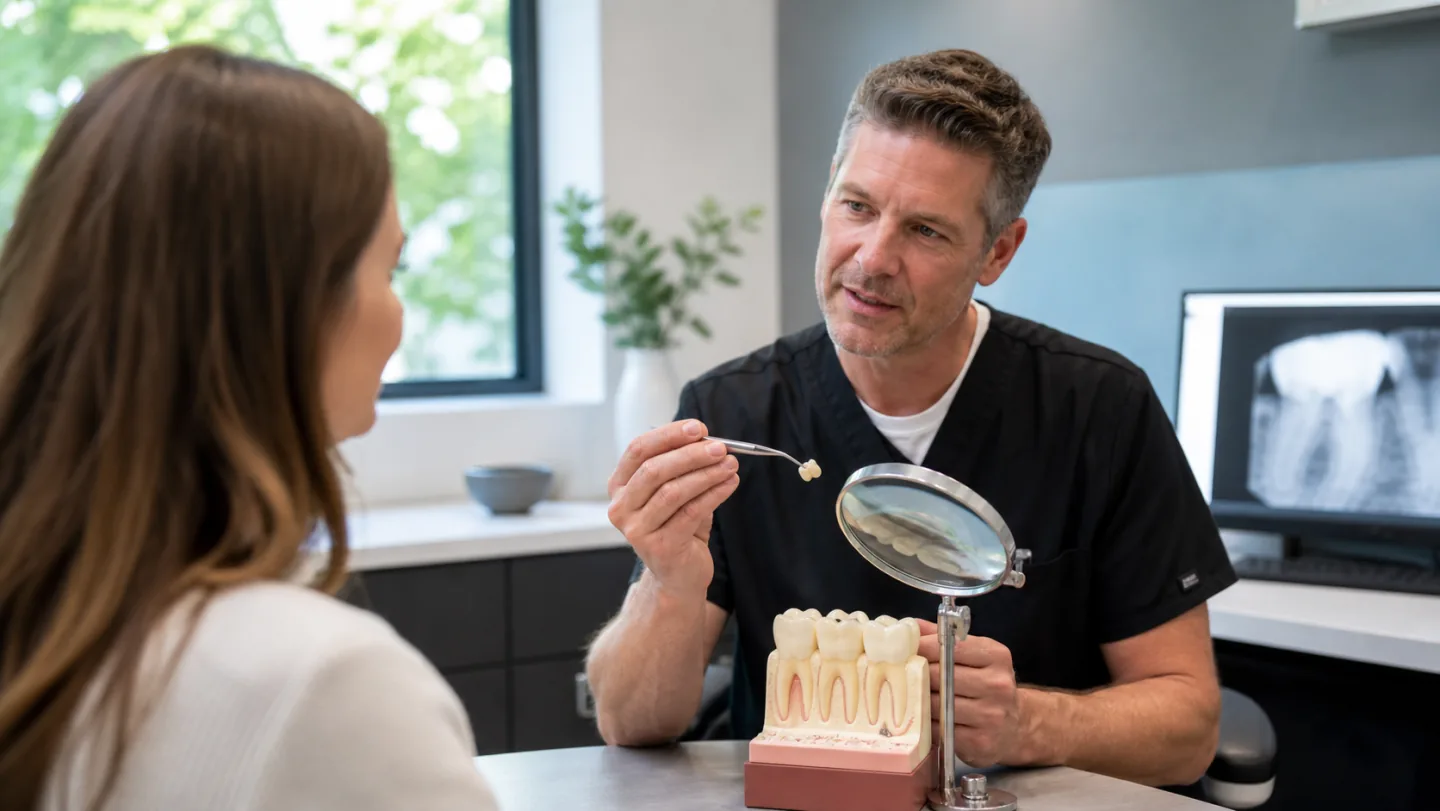
A dentist showing a small ceramic inlay beside a detailed tooth model
Dental terms in plain language

Inlays & Onlays for Margaret Park Residents

Cusps, margins, partial coverage: dental vocabulary can feel like a foreign language. If you are in Margaret Park and have just heard these words for the first time, start here.

Let's find a time

Request an appointment

We’ll call to confirm your appointment. For urgent care, please call us directly.

A short glossary

What Inlay and Onlay Actually Mean

Picture the top of a molar. The raised points are called cusps, and the valley between them does much of the chewing. An inlay is a custom-made insert that sits in that valley. An onlay does the same job but also extends up and over one or more of the points.

Both are crafted outside the mouth to match a prepared space, then bonded in place. Margaret Park is an area in Winnipeg, and if you would like these ideas applied to your own tooth, the dentist at Winnipeg North Dental on McPhillips Street can walk you through them.

Explore inlays & onlays
Bright consultation room with a long white desk, leather chairs and a snake plant
Winnipeg North Dental’s consultation room, where a long white desk faces the blinds.

Cusp

One of the raised points on the chewing surface of a back tooth, the part an onlay can cover.

Margin

The line where a restoration ends and natural tooth begins, which needs thorough cleaning.

Bonding

The adhesive step that secures the finished piece to the prepared tooth at the end.

Telling them apart

Two words, one small but real difference.

The clearest way to tell them apart is by asking where the restoration stops relative to the cusps. Everything else follows from that.

The inlay

Think of it as a precise insert for the central chewing area, kept within the raised points of the tooth.

  • No cusp is covered by the finished piece.
  • The surrounding structure needs to be judged suitable.
  • Your natural cusps go on doing their usual work.

The onlay

This version reaches further, passing over any cusp that has weakened while leaving the stronger surfaces uncovered.

  • One or several cusps may fall under its coverage.
  • It stops short of wrapping around the whole tooth.
  • That boundary separates it from a dental crown.

Between these sits a wider family of repairs: a filling is placed directly for smaller damage, while a crown covers the visible tooth when broad reinforcement is called for.

The process, untangled

Four stages with plain names.

Your dentist may use technical terms along the way. Here is each stage in everyday words, starting after an assessment has shown the tooth is suitable.

Request your visit
  1. 01

    Prepare

    Damaged material is taken out and the rest is shaped, usually while the area is frozen with local anesthetic.

  2. 02

    Record

    A digital scan or an impression, which is a mould of the tooth, captures its shape, contacts with neighbours, your bite and a chosen colour.

  3. 03

    Create

    The custom piece gets made in whichever material was planned. A temporary, which is a short-term cover, may protect you in the meantime.

  4. 04

    Bond

    The dentist confirms the fit and how your teeth close on it, then secures it with adhesive. A final polish finishes the surface.

Asking without embarrassment

Nobody expects you to know this vocabulary.

Dental language is learned on the job, not picked up at home. If a term comes up that means nothing to you, stop and ask. Asking what something means is a perfectly ordinary part of an appointment.

Jot down any unfamiliar word from an earlier visit or letter, so you can ask about it directly when you come in.

Useful questions to carry in

  • Which of my cusps are weak, and how can you tell?
  • Could you point out on a model what you plan to do?
  • What do you need from me about my health and medications?
  • How do my insurance or CDCP details fit in, if I have them?
Seating area with white chairs, potted plants and a full window covered by light blinds
Framed coastal painting on a white wall above a desk and black chairs

White chairs by the window, and a desk in a consultation room, at our Winnipeg clinic.

Clarity helps

Understanding can take some of the edge off.

A clear explanation lets you feel part of the decision. Please ask to have anything explained again if the first explanation did not stick.

What freezing means

Freezing is everyday shorthand for the local anesthetic that is usually used during preparation.

What sensitivity means

A temporary tender or reactive feeling may follow treatment, and it should improve with time.

Questions, any time

Nothing prevents you asking mid-appointment about what is going on, or what comes next.

Words for later

Three signs worth describing to the clinic.

After bonding, knowing how to describe a problem makes it easier to get help. These are the plain-language terms to use if you call.

01

A high bite

This means the restored tooth seems to touch before the others do when you close your mouth.

02

A rough edge

Your tongue or floss may catch where the piece meets the tooth, and that deserves mention.

03

Movement

Any sense that the restoration shifts or rocks is a reason to contact us promptly.

Sensitivity that fails to improve belongs on this list too. Urgent worries are better handled by calling than through the form.

Talk with our team
Front of the clinic seen at an angle, with black-framed windows and dark grey siding

Winnipeg North Dental

Unit-5 2358 Mcphillips Street, Winnipeg, MB R2V 4J6
Get directions (opens in a new tab)
When you want it explained in person

Come In to Our McPhillips Street Clinic

For Margaret Park residents, examinations and treatment both happen at Winnipeg North Dental, Unit 5, 2358 McPhillips Street, Winnipeg. Follow the directions link to find the way.

After you send a request, the office reaches out to fix a time. Nothing is reserved until you have heard back.

Questions about coverage?

Talk with our team before your visit or learn about CDCP.

A little clarity before your visit

Your questions, answered.

Helpful details about inlays & onlays in Margaret Park.

Ask our team
Do I need to know the right term when I contact you from Margaret Park?

Not at all. Describe your tooth however you can in our form, or ring (204) 338-3003. Visits take place at Unit 5, 2358 McPhillips Street, Winnipeg, MB R2V 4J6, after the office has been in touch.

Are inlays and onlays the same thing as fillings?

They differ in how they are made. A filling is placed and shaped in the tooth during the appointment, whereas these two are created outside the mouth and bonded afterward.

What does partial coverage mean?

It describes a restoration covering only part of the tooth. Healthy walls and cusps that do not need covering can stay as they are.

Which one would my tooth need?

Only an examination can tell. If damage leaves the cusps sound, an inlay might work, whereas a weakened cusp may call for an onlay or some other option altogether.

What is meant by a scan or an impression?

Both are ways of capturing the shape of your prepared tooth so the piece can be made to fit. A scan is digital, while an impression is a physical mould.

Still have questions?

Hear it explained using your own tooth.

Send an appointment request to our Winnipeg clinic. Once you have heard back and the visit is arranged, bring along every question on your list.

Patient testimonials

Kind words from our patients

★★★★★ 5.0 from 440+ reviews on Google

Close to home

Areas we serve

Convenient dental care on McPhillips Street for families across northwest Winnipeg and nearby communities.

Explore all service areas

A healthier smile is one visit away

Ready for dental care that feels genuinely comfortable?

✓ New patients welcome ✓ Direct insurance billing ✓ Multilingual team

How can we help?

Our dental team is here for you.

Ready to book or have a question? Choose the option that works best for you.

For urgent dental concerns, please call us directly.

Send us a message

Our team will reply during clinic hours.


