Skip to content
Winnipeg North Dental
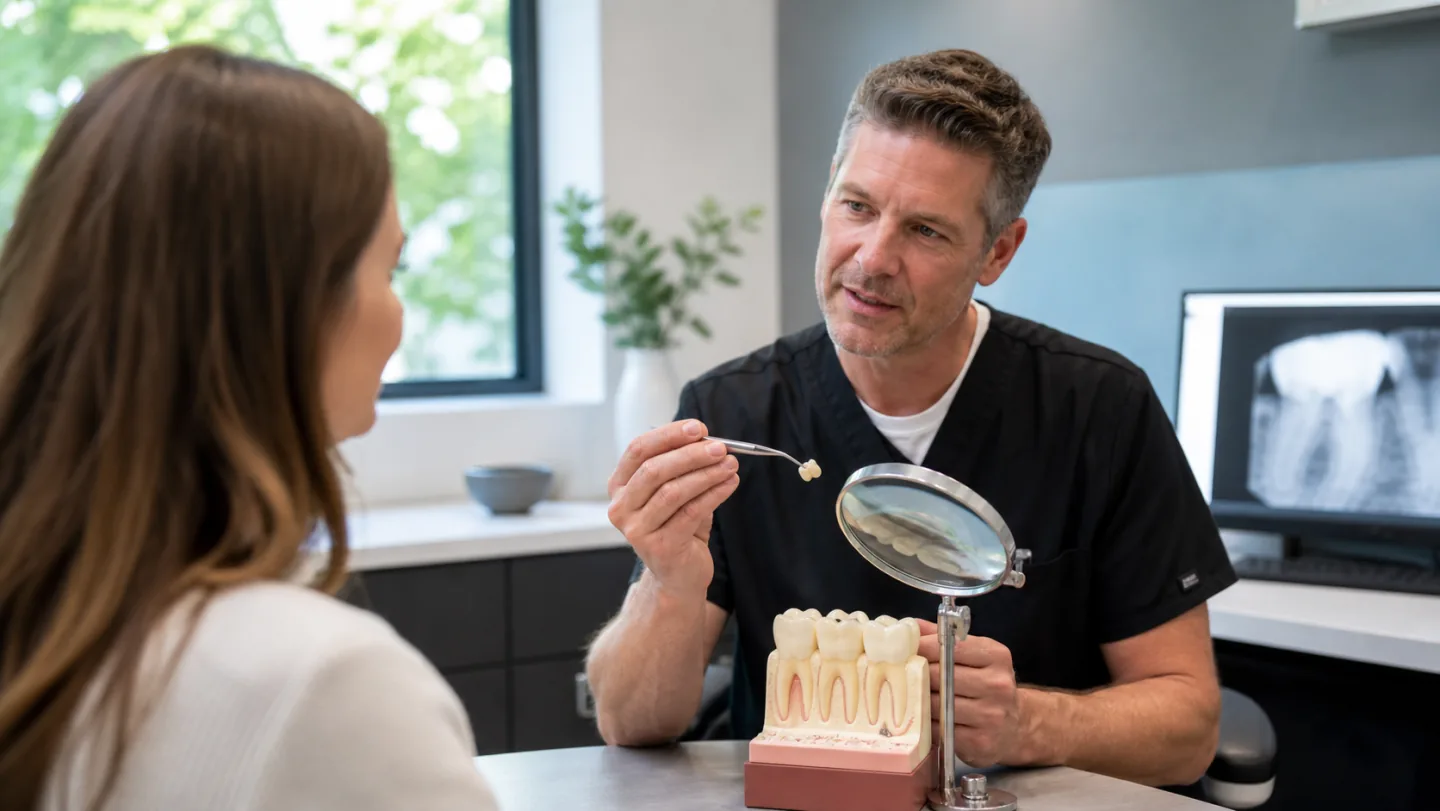
A dentist showing a small ceramic inlay beside a detailed tooth model
Molars that look worn down

Inlays & Onlays for Exchange District Residents

Chewing surfaces can lose their shape gradually, and you may only notice when you happen to look. If you live in the Exchange District, our Winnipeg clinic can examine what has changed.

Let's find a time

Request an appointment

We’ll call to confirm your appointment. For urgent care, please call us directly.

Changes that creep up

Noticing a Tooth Has Lost Its Former Shape

Unlike a sudden break, wear gives you no single moment to remember. One day you may notice a molar seems flatter, a cusp looks thin at its edge, or an old filling now stands out from the enamel around it. It can be difficult to know whether that means anything at all.

A changed shape does not automatically mean you need treatment, and it certainly does not point to a particular restoration on its own. If damage or weakened cusps are found, an inlay or onlay may be one of the options reviewed. Exchange District is an area of Winnipeg, and its residents are examined at Winnipeg North Dental on McPhillips Street.

Explore inlays & onlays
Dental chair with pale blue upholstery in a treatment room with wooden cabinets
A dental chair, sink and wooden cabinets in a treatment room.

Describe what looks different

A flat spot, a thin edge or a change in colour are all worth mentioning, even if they seem minor.

Learn what lies behind it

The dentist can consider your bite and possible grinding when looking at how a tooth has changed.

See if anything is needed

Treatment is not a given. Some changes may just need watching, and you can ask about that.

If repair is advised

How these pieces deal with a weakened surface.

When a worn or damaged back tooth does need restoring, the assessment considers the state of its peaks and walls. Two custom designs may be mentioned at that point.

Damage kept to the central surface

When decay or breakdown is confined to the centre and the cusps remain strong, an inlay can replace the affected part of the surface.

  • Rebuilds the middle of the biting surface.
  • Offers contours formed outside the mouth.
  • Depends on walls that are still dependable.

Weakness that reaches the cusps

A thinned or undermined cusp may call for an onlay, which extends over that weak area and gives it extra coverage without enclosing the whole tooth.

  • Can restore the form of a selected cusp.
  • Keeps uninvolved surfaces as natural tooth.
  • Has to suit the forces your bite produces.

Widespread wear across many teeth is a different matter from one damaged molar, and it may involve a broader conversation. A single restoration may not address its cause.

Looking closer

From a worn-looking tooth to a finished repair.

If examination confirms that an inlay or onlay is sensible for your tooth and you choose to proceed, the sequence would generally go as follows.

Request your visit
  1. 01

    Investigating the change

    Remaining walls, the cusps, any cracks or decay and root health are reviewed, with particular notice paid to how your teeth meet.

  2. 02

    Forming the base

    Damaged material is removed from the numbed tooth, leaving a clean form on which the restoration can rest securely.

  3. 03

    Capturing form and bite

    A scan or impression records the tooth, adjoining contacts and the way you close. You also select a shade, and a temporary may be fitted if needed.

  4. 04

    Restoring the surface

    The custom piece is tried, adjusted for fit and bite, then bonded securely and polished to a smooth finish.

What to watch for

Small observations help.

It is hard to describe slow change, so a few simple notes can be useful. Compare what you recall with what you see now, and do not worry if you are unsure.

A sudden chip, a sharp new edge or pain is different from gradual change. Call the clinic if one of those occurs.

Keep track of

  • Which teeth appear flatter, thinner or differently coloured.
  • Whether you wake with a tired jaw or have been told you grind.
  • Older photos or X-rays, if you happen to have any.
  • Current medications and any significant health conditions.
Blue bench and abstract blue artwork beside a window with striped blinds
Quiet office with a white table, three black chairs and framed landscape art

A window seating area and a quiet consultation office.

Sensitive surfaces

Wear can make a tooth more reactive.

If a tooth has become sharper or more responsive to temperature, it is reasonable to worry about having it touched. Tell the dentist about it, so that they can bear that in mind during the examination.

During the exam

Let the dentist know which tooth tends to react, so it can be approached with that in mind.

During preparation

It is common for this stage to be done with local anesthetic to keep you comfortable.

Over the following days

A little sensitivity can follow bonding. Report it if it is still not getting better.

Slowing future changes

A restored surface still takes pressure.

If wear was a factor for your teeth, it will not disappear because one has been repaired. Bite and grinding can affect how a restoration performs, so they are worth continuing to discuss.

01

Ask about grinding

Have the dentist look for signs of it at your reviews, and ask what could help if it is present.

02

Report changes in feel

Tell us when a bite seems high, an edge turns rough, the piece moves or sensitivity persists.

03

Look after the junction

New decay can affect the outcome, so clean the line around the restoration with care each day.

Long-term results cannot be promised. Tooth structure, preparation, material and hygiene are among the many things that shape them.

Talk with our team
Street view of the clinic entrance with Winnipeg North Dental and its phone number on the sign

Winnipeg North Dental

Unit-5 2358 Mcphillips Street, Winnipeg, MB R2V 4J6
Get directions (opens in a new tab)
Getting a professional opinion

Have the Change Reviewed on McPhillips Street

Exchange District residents can have their teeth examined at Winnipeg North Dental, Unit 5, 2358 McPhillips Street, Winnipeg. Tap the directions link to see how to get here.

Tell the office in your request what you have noticed about the shape of your teeth. Someone will get back to you with a time, and a painful tooth should be raised by phone.

Questions about coverage?

Talk with our team before your visit or learn about CDCP.

A little clarity before your visit

Your questions, answered.

Helpful details about inlays & onlays in Exchange District.

Ask our team
Is a flatter molar a sign that something is wrong?

Not necessarily, because teeth can change with use over time. An examination can determine whether there is damage or weakening that actually needs attention.

Can an onlay rebuild a worn cusp?

An onlay is designed to cover and restore selected weakened cusps, so it may be considered. Whether it suits your tooth depends on the assessment, including your bite.

What if lots of my teeth look worn?

Mention that when you get in touch, since it can change the conversation. A broad pattern calls for looking beyond one tooth, and the dentist can explain what they find.

Do I need treatment if worn teeth do not bother me?

Not always, and it depends on what the examination shows. Ask whether the tooth should be repaired or observed, and what signs would change that advice.

Why does an old filling stand out more than it used to?

Filling material and enamel can change differently as the years pass. The dentist can check whether it is still sound or whether it is failing.

I live in the Exchange District. How would I arrange to have my teeth looked at?

Send a request using this page or phone (204) 338-3003. You would be seen at Unit 5, 2358 McPhillips Street, Winnipeg, MB R2V 4J6, at a time the office has confirmed.

Has the shape changed?

Find out whether a worn tooth needs repair.

Describe what you noticed in a short request for a visit to our Winnipeg clinic, and the office will reply about a time. Please call instead if anything is urgent.

Patient testimonials

Kind words from our patients

★★★★★ 5.0 from 440+ reviews on Google

Close to home

Areas we serve

Convenient dental care on McPhillips Street for families across northwest Winnipeg and nearby communities.

Explore all service areas

A healthier smile is one visit away

Ready for dental care that feels genuinely comfortable?

✓ New patients welcome ✓ Direct insurance billing ✓ Multilingual team

How can we help?

Our dental team is here for you.

Ready to book or have a question? Choose the option that works best for you.

For urgent dental concerns, please call us directly.

Send us a message

Our team will reply during clinic hours.



