Skip to content
Winnipeg North Dental
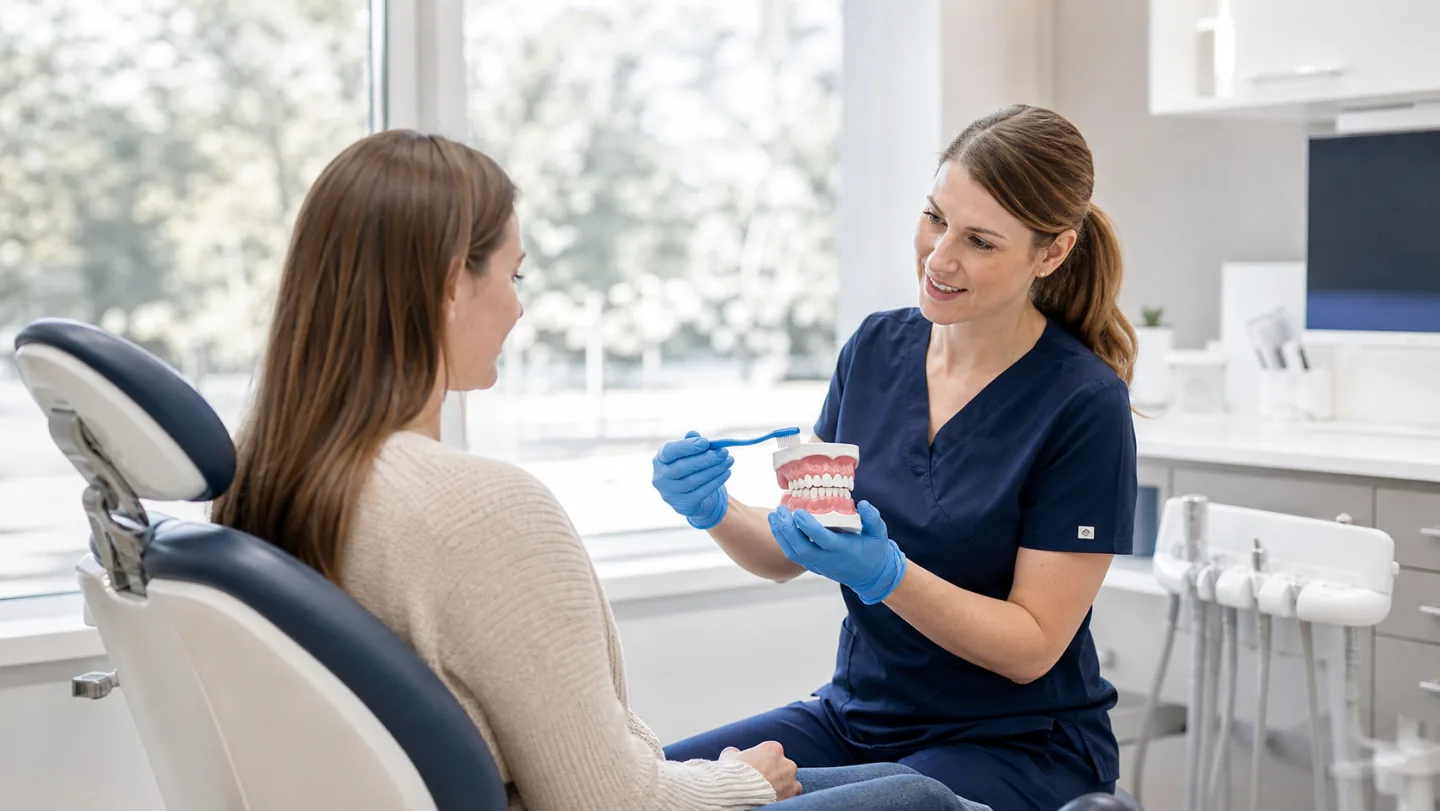
A dental hygienist explaining gum health and home care with a model
You brush. They still bleed.

Gum Disease Treatment for Rivergrove Residents

Doing everything right and still seeing blood is frustrating. Rivergrove residents can visit our McPhillips Street clinic in Winnipeg to find out what home care cannot reach.

Let's find a time

Request an appointment

We’ll call to confirm your appointment. For urgent care, please call us directly.

Where good habits run out

When Careful Brushing Isn’t Enough: Help for Rivergrove Residents

If you brush twice a day and your gums are still puffy, you are probably not lazy about your teeth. Calculus cannot be removed at home, and plaque can hide around crowns, under bridges and in tight spots. Stiff or sore hands can make those places even harder to clean, whatever your intentions.

Pockets below the gumline are another place a brush will not reach. An assessment at Winnipeg North Dental looks for where your routine and your mouth are not lining up, and for other influences on how gums respond. Rivergrove residents can then get practical, specific advice instead of simply being told to floss more.

Explore gum disease treatment
Winnipeg North Dental waiting area with a child’s chair, plants and window blinds
Winnipeg North Dental’s waiting area on McPhillips Street.

Blind spots identified

Find out which surfaces your current routine tends to leave untouched.

Tools for your hands

Your dexterity is considered when choosing how you will clean between teeth.

Dental work included

Crowns and bridges are part of the review of what is difficult to maintain.

What daily cleaning can and cannot do

Sharing the work between you and us.

Plaque control at home matters a great deal, and it has limits. Treatment aims to deal with what you cannot reach, while making your part of the job easier to do well.

Your side of the job

A routine only helps if you can actually carry it out, so it needs to fit your mouth and your hands.

  • Technique is checked on the areas that keep bleeding.
  • Interdental options are matched to tight or open spaces.
  • Cleaning around bridges and crowns gets specific attention.
  • Grip or dexterity problems are worth mentioning when choosing tools.

The clinical side of the job

Certain deposits and sites are beyond what any toothbrush can manage, however carefully it is used.

  • Hardened calculus comes off with professional instruments.
  • Root surfaces inside pockets may need scaling and root planing.
  • Adjunctive therapies are considered where they appear to be suitable.
  • Later readings tell us how well the tissues have responded.

Sometimes the answer also involves other factors, such as tobacco, dry mouth or health conditions. Any treatment is recommended only after an assessment.

A practical appointment

Bring your toothbrush questions along.

This kind of visit is partly detective work. We are trying to find why your effort is not producing the result you expect, and it usually unfolds in this manner.

Request your visit
  1. 01

    Walk us through your routine

    How do you brush, what do you use between your teeth, and where does it bleed? We ask about health, medications and tobacco use as well.

  2. 02

    Find where the trouble sits

    Careful measurements around every tooth locate bleeding, pockets and recession, which often reveals a pattern that looks different from what you assumed.

  3. 03

    Look over restorations and bone

    Crowns, bridges, deposits and mobility are checked, since these can trap plaque or suggest lost support. Images may be used if appropriate.

  4. 04

    Put together a workable plan

    You hear which sites are active and what might address them, then we adjust your home routine to what you can reasonably do each day.

Show and tell

Your bathroom shelf is useful evidence.

It helps us to know exactly what you have been using, including products that seem not to be working. Consider mentioning them, or bringing them in if that is easier.

There is no need to change your routine just for this appointment, because we want to see how things usually are. When booking, ask how long it may take and what it may cost.

What to mention

  • The toothbrush, floss, picks or other aids you currently use.
  • Any spots where food catches or that always seem to bleed.
  • Crowns, bridges or other dental work you find awkward to clean.
  • Arthritis or anything else affecting your grip, plus medications and your CDCP or insurance details.
Spacious Winnipeg North Dental treatment room with a dental chair and storage cabinets
Desk, leather chairs and a potted plant in the Winnipeg North Dental consultation room

Where your routine and findings come together.

Frustrated is allowed

Nobody here will tell you to just try harder.

Being scolded about flossing helps no one. If earlier advice felt unhelpful or impossible to follow, tell us. We can start from what is realistic for you.

Say what has not worked

Tell us about the devices you gave up on, so you are not handed the same advice again.

Practise with us

If a technique feels awkward, ask to have it shown again, so you can feel it for yourself.

Speak up about sore gums

Inflamed tissue can be tender, so a word about a sore patch lets us proceed with care.

Testing the new routine

Did the changes actually help?

New habits are worth checking against real numbers. Follow-up shows whether the adjustments made a difference, and what might need another try.

01

Revisiting the trouble spots

The sites that bled before get measured again, so you are not relying on impressions alone when judging your progress.

02

Fine-tuning your tools

If an aid was too fiddly in practice, say so, and ask what alternative could suit you instead.

03

Professional cleaning on a schedule

Calculus can form again despite good habits, so the timing of your visits is set around your disease history and risk.

Struggling with your new routine at home? A quick phone call to the clinic is a reasonable place to start.

Talk with our team
Clinic sign and storefront windows at Winnipeg North Dental on McPhillips Street

Winnipeg North Dental

Unit-5 2358 Mcphillips Street, Winnipeg, MB R2V 4J6
Get directions (opens in a new tab)
A note for Rivergrove

Where This Care Is Provided

Rivergrove residents can receive gum treatment at Winnipeg North Dental, Unit 5, 2358 McPhillips Street, Winnipeg. Look to the card for the address and a directions link.

Our form passes your request to the clinic, and a time is only set once they have replied. Should you have an urgent problem, please call instead of writing.

Questions about coverage?

Talk with our team before your visit or learn about CDCP.

A little clarity before your visit

Your questions, answered.

Helpful details about gum disease treatment in Rivergrove.

Ask our team
Why do my gums bleed if I brush every day?

Brushing does not reach everything. Plaque between teeth, calculus and deposits under the gums may keep inflammation going, and other factors can change how your tissue reacts. An examination helps identify which apply.

Do crowns and bridges raise my risk of gum problems?

They can make cleaning harder in places, and difficulty cleaning around dental work is one recognized risk factor. Tell us what you have, and we will check how well those areas are being reached.

I have arthritis. Can I still keep my gums clean?

Ask us about it during your visit. Daily-care advice is chosen with your dexterity in mind, so we can talk through which options might feel more manageable in your hands.

Is an electric toothbrush or water flosser what I need?

That depends on your mouth and what you find realistic. Bring your question and your current tools, and your hygienist can talk through whether a change makes sense.

Will a deep cleaning fix it, or do I keep doing this forever?

Scaling and root planing is only recommended if pockets are present, and it may be one stage among several. Periodontitis generally calls for ongoing maintenance, whereas gingivitis can often improve with steady care.

How should Rivergrove residents get in touch?

Call (204) 338-3003, or complete the form on this page and tell us what you already do at home. The McPhillips Street clinic replies to set up a time.

Put your effort to better use

Find out what your brush keeps missing.

Rivergrove residents can send a request for a gum assessment at our Winnipeg clinic, and the clinic will write back about a time.

Patient testimonials

Kind words from our patients

★★★★★ 5.0 from 440+ reviews on Google

Close to home

Areas we serve

Convenient dental care on McPhillips Street for families across northwest Winnipeg and nearby communities.

Explore all service areas

A healthier smile is one visit away

Ready for dental care that feels genuinely comfortable?

✓ New patients welcome ✓ Direct insurance billing ✓ Multilingual team

How can we help?

Our dental team is here for you.

Ready to book or have a question? Choose the option that works best for you.

For urgent dental concerns, please call us directly.

Send us a message

Our team will reply during clinic hours.



