Skip to content
Winnipeg North Dental
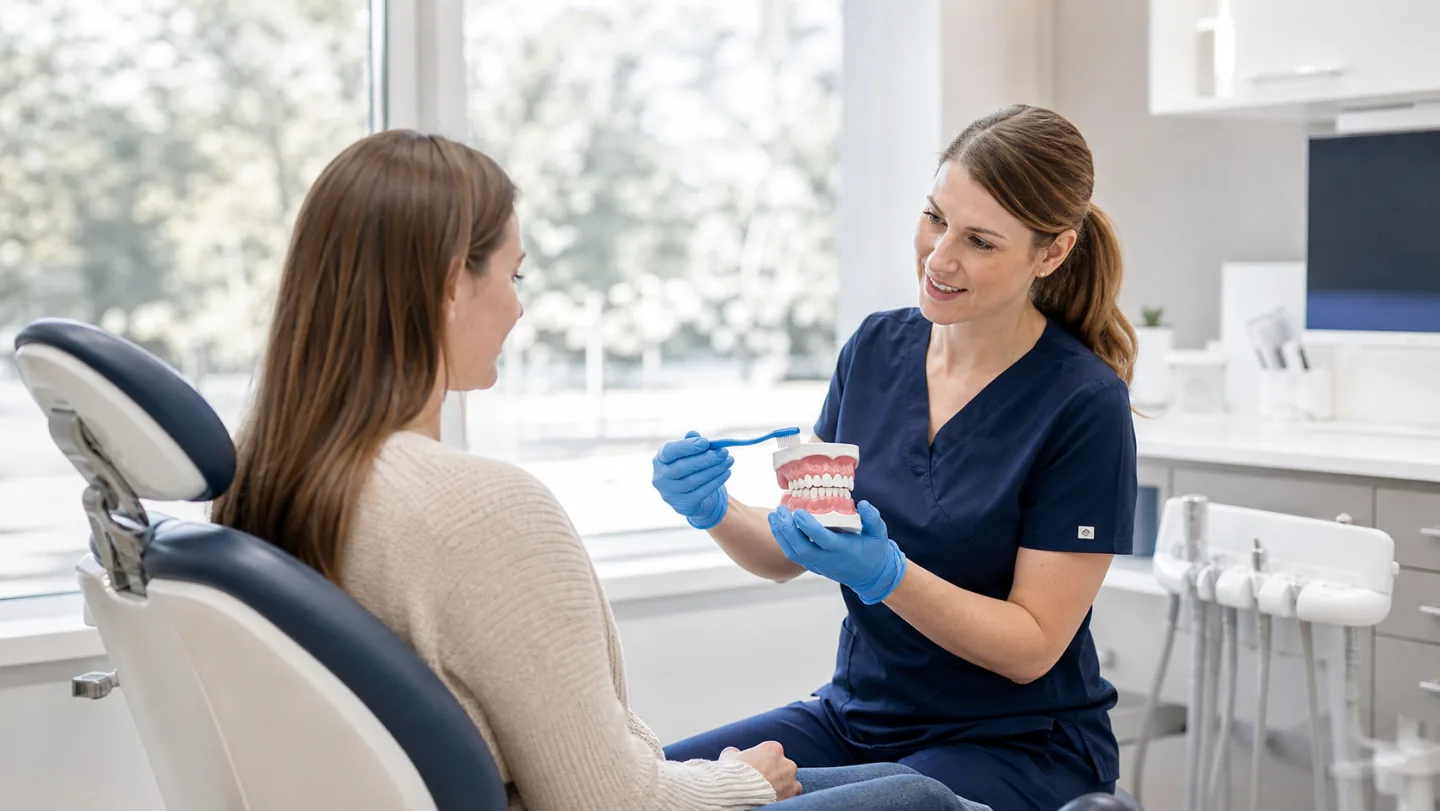
A dental hygienist explaining gum health and home care with a model
Staring at a blank request form?

Gum Disease Treatment for Rivercrest Residents

You do not need the right dental words to ask about your gums. If you live in Rivercrest, outside the City of Winnipeg, a few ordinary sentences are enough to help our McPhillips Street clinic understand why you are getting in touch.

Let's find a time

Request an appointment

We’ll call to confirm your appointment. For urgent care, please call us directly.

Finding the words

What to Write When You Can’t Name What Is Wrong

It is surprisingly hard to describe a gum problem. Is it swollen or just sore? Is that recession, or have your teeth always looked this way? Some people stop right there and close the page, because they feel they ought to know what they are asking for before they ask.

You don’t. Naming the condition is the job of the assessment at Winnipeg North Dental, and it takes measurements to do it. All your message has to convey is what you noticed, roughly when it started and anything that makes it better or worse. Everyday language works perfectly well.

Explore gum disease treatment
Winnipeg North Dental reception with a white and grey counter, clear screens, a navy bench and framed abstract art
A clear screen rising above the white and grey reception counter.

Say what you see

Bleeding, puffiness, a different look: describe it in your own terms.

Say when it started

A rough timeframe is plenty, and nobody needs the exact date.

Leave the diagnosis to the exam

Telling gingivitis from periodontitis takes an examination, not a good guess.

Everyday words, clinical meaning

How what you notice connects to what gets checked.

This is not a way to diagnose yourself. It simply shows how your ordinary description points the team toward findings they will look at more carefully.

What you might write

Each of these is a perfectly good way to describe something that deserves a look at the clinic.

  • There is blood on my toothbrush, floss or food.
  • My gums look red or puffy, or they feel tender.
  • My teeth seem longer, or the spacing has shifted.
  • A bad taste or odour does not go away.

What care may then involve

If gum disease is found, the plan is built from measurements instead of from your original wording.

  • Coaching on a realistic daily routine.
  • Professional removal of hardened deposits.
  • Scaling and root planing, if you have periodontal pockets.
  • Reassessment, followed by maintenance or further care.

Few obvious symptoms? You can say that as well. Periodontitis may progress without significant pain, which makes an exam useful even when your description is short.

After your message arrives

From a few sentences to a clear explanation.

Once your request is confirmed as an appointment, your words become a starting point. The assessment then fills in what no message could.

Request your visit
  1. 01

    Go back over what you wrote

    Expand on your note in person, and add your general health, prescriptions, tobacco use, family history and the dental care you have had.

  2. 02

    Add numbers to your description

    Soft measurements around each tooth turn a vague worry into specifics about pocket depth, bleeding, recession and attachment.

  3. 03

    Add what you could not see

    Tooth mobility, your bite, buildup and any fitting dental images reveal support and problem areas that no description could have captured.

  4. 04

    Get better words for it

    You are told, in plain language, what the pattern means, where disease appears active and what treatment and maintenance may be worth considering.

Your message, in four parts

Three or four plain sentences will do.

A long medical account is not expected. If you are unsure where to begin, the prompts here cover what is most helpful for the clinic to read.

Since you would be coming into Winnipeg, add any days that are difficult and ask how long to allow. Your time is settled only when the clinic confirms it.

Prompts for your request

  • What I have noticed is...
  • It started about... and it seems to happen when...
  • I take these medications, or I have these health conditions...
  • The thing I most want to know is...
Winnipeg North Dental consultation room with a white desk and keyboard, three black chairs and a window with striped blinds
Winnipeg North Dental waiting area with a rug, white chairs and a window with striped blinds

A keyboard resting on a glossy desk, with three black chairs around it.

Not knowing the vocabulary

Awkward questions are welcome in that chair.

Your description does not need to be polished or complete. If you feel embarrassed by what you wrote or how long you waited, the conversation can simply start with whatever feels easiest.

Point instead of naming

Showing the team the spot you mean works every bit as well as knowing what to call it.

Ask for words to be repeated

Unfamiliar terms are worth stopping for, and you can ask to hear them again.

Add anything you left out

If a detail has occurred to you since you wrote, bring it up during your appointment.

A new vocabulary for later

Next time, you will know exactly how to describe it.

One benefit of an assessment is a better way to talk about your gums from then on. You will know which spots need attention, and what any change could mean.

01

Notes you can reuse

Write down your active areas and the terms you learned, ready for your next conversation with the clinic.

02

Changes described sooner

With a sense of your usual state, you may be better able to explain what has shifted.

03

Routine questions asked plainly

Tell the team what feels awkward when cleaning a certain area, so they can suggest a suitable tool.

Maintenance recall will be discussed after your reassessment, so ask for the reasoning in terms that make sense to you.

Talk with our team
Winnipeg North Dental exterior with the clinic logo, the name in raised letters and glass doors

Winnipeg North Dental

Unit-5 2358 Mcphillips Street, Winnipeg, MB R2V 4J6
Get directions (opens in a new tab)
For a Rivercrest request

Who Will Read It, and Where You Will Be Seen

Your request goes to Winnipeg North Dental, and Rivercrest residents come into Winnipeg for care at Unit 5, 2358 McPhillips Street, Winnipeg, MB R2V 4J6. Open the directions link on this card when you are ready.

Writing about something urgent? Stop and telephone instead, because a form message may not be read in time to help.

Questions about coverage?

Talk with our team before your visit or learn about CDCP.

A little clarity before your visit

Your questions, answered.

Helpful details about gum disease treatment in Rivercrest.

Ask our team
How much detail should I put in my request?

A few sentences are enough. Describe what you noticed and any timing concerns. You can cover medical details at your appointment, where they can be discussed properly.

What if I use the wrong word for my symptom?

That really is fine. Your assessment does not rely on your terminology, because the findings come from measurements, an examination and any dental images needed.

Can I just write that my gums seem off?

You can, and it is an honest start. If you can add when it began or what you have seen, please do, but do not let that stop you from asking.

How do I explain symptoms that are hard to describe by phone?

Say what you can, then let the clinic ask questions. A proper answer about your gums will still have to wait for an in-person examination.

Do I have to mention my medical history on the form?

Use your judgment about what you want to include. It will still be reviewed at your visit, since conditions and medications can influence gum risk and healing.

Who should I contact from Rivercrest if I would rather speak to someone?

Call the clinic at (204) 338-3003 and explain what you are noticing in your own words. Your care itself would take place on McPhillips Street in Winnipeg.

In your own words

Write it the way you would say it.

Living in Rivercrest, you can tell our Winnipeg clinic on this form that you would like your gums assessed. Plain language is all it takes to begin.

Patient testimonials

Kind words from our patients

★★★★★ 5.0 from 440+ reviews on Google

Close to home

Areas we serve

Convenient dental care on McPhillips Street for families across northwest Winnipeg and nearby communities.

Explore all service areas

A healthier smile is one visit away

Ready for dental care that feels genuinely comfortable?

✓ New patients welcome ✓ Direct insurance billing ✓ Multilingual team

How can we help?

Our dental team is here for you.

Ready to book or have a question? Choose the option that works best for you.

For urgent dental concerns, please call us directly.

Send us a message

Our team will reply during clinic hours.



