Skip to content
Winnipeg North Dental
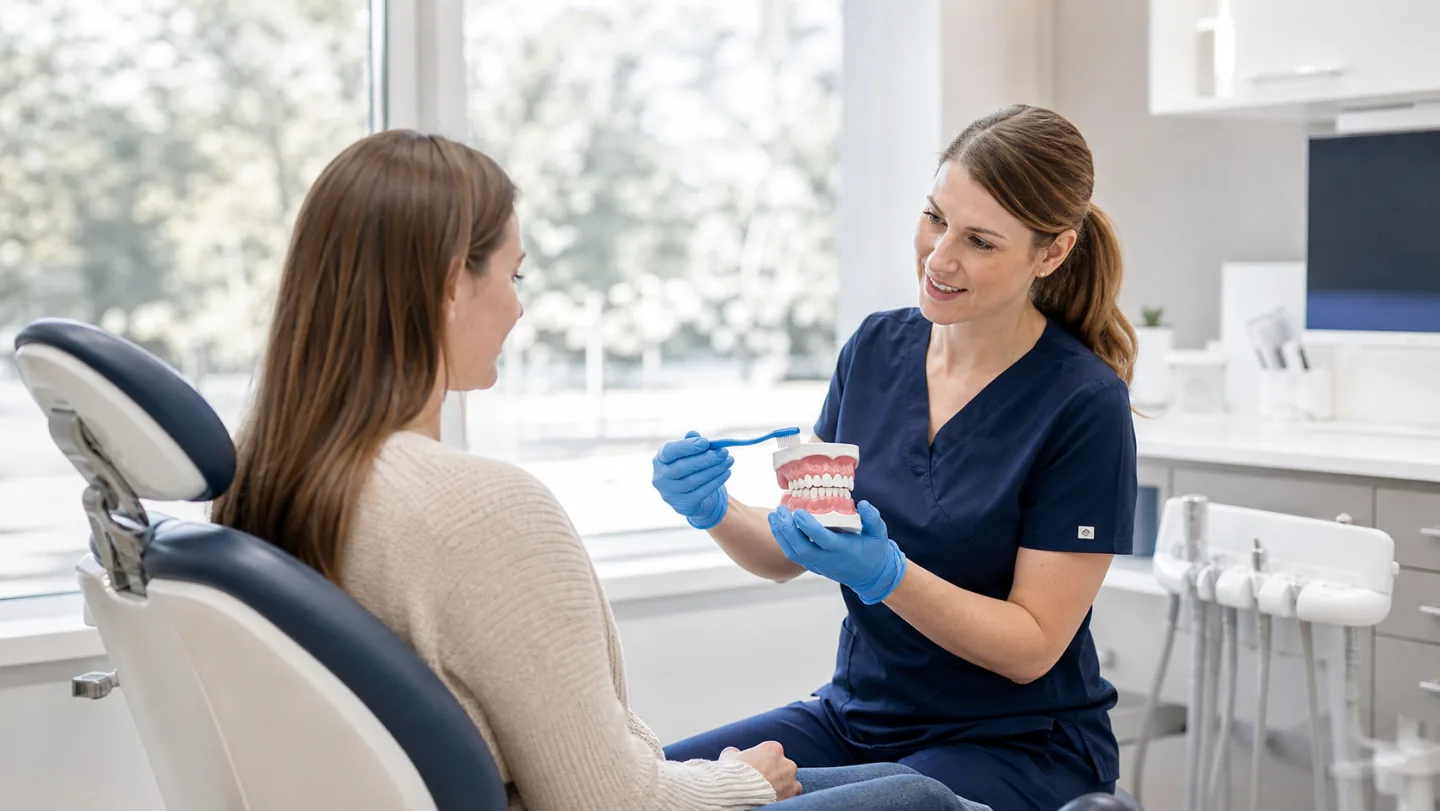
A dental hygienist explaining gum health and home care with a model
Treated before, and it’s back?

Gum Disease Treatment for River Trail Residents

You went through gum treatment, things settled, and now the bleeding or tenderness has returned. River Trail residents can have this rechecked at our clinic on McPhillips Street in Winnipeg.

Let's find a time

Request an appointment

We’ll call to confirm your appointment. For urgent care, please call us directly.

This is more common than it feels

When Gum Problems Return After Treatment

Coming back to symptoms you thought were behind you can be discouraging, and it is easy to conclude that the earlier treatment failed or that you did something wrong. Neither is necessarily true. Periodontitis is generally managed over time, so a change after a period of calm is something to investigate, not a verdict.

Many things can shift between then and now. Maintenance visits may have lapsed. Your health, medications or tobacco use may be different. New dental work may be harder to clean around. Winnipeg North Dental starts by measuring where things stand today, then looks at what may have changed and what level of care fits the current findings.

Explore gum disease treatment
Winnipeg North Dental consultation room with two black chairs at a white desk and daylight through striped blinds
Two black chairs at a white desk, with daylight coming through striped blinds.

Today’s numbers

Fresh measurements show whether disease seems active now, whatever happened in the past.

What has changed

Health, medications, tobacco and dental work all get another look on this occasion.

A blame-free review

The useful question here is what is happening now, and not whose fault it is.

Starting a second round

Same condition, but not necessarily the same plan.

What helped last time may or may not be what you need now. Your current findings set the direction, and the options depend on how your gums have responded so far.

Working out what is new

Comparing past information, if you have any, with current readings can show where change has occurred.

  • Sites where pockets have deepened or bleeding has returned.
  • Bone and tooth support, using images where these are appropriate.
  • Areas that have become difficult to reach, including around restorations.
  • Life changes that could affect how your tissues heal.

Options that may follow

Recommended steps reflect what has been found, and may be simpler or more involved than you expect.

  • Refreshing how you clean, using tools that suit you now.
  • Removing calculus and treating below the gums where it is warranted.
  • A reassessment to see how affected areas have responded this time.
  • Further care or referral, when pockets stay deep despite treatment.

Regenerative procedures may be considered for selected defects, though they are not suitable or predictable in every area. Ask whether anything like that is relevant for you.

Picking the thread back up

An appointment that takes your history seriously.

You already know some of this process, so a return assessment may feel familiar. The difference is that this time your previous treatment forms an important part of the discussion.

Request your visit
  1. 01

    Recount your earlier treatment

    Tell us what was done and when, what has come back, and any changes in your health, medications, tobacco use or family history.

  2. 02

    Remeasure from scratch

    Careful readings at each tooth record pockets, bleeding, recession and attachment as they are now, giving a current baseline for your care.

  3. 03

    Recheck support and problem zones

    Mobility, your bite, new deposits and appropriate images reveal which teeth have the support they need and where maintenance is falling short.

  4. 04

    Decide on a fresh approach

    Go through which areas are currently active, why that may be, and what treatment and maintenance would now be suitable.

Piecing together the past

Bring whatever you remember about last time.

Exact dates are not essential. A rough sense of what you had done, how long ago and how long your gums felt settled afterward can give a helpful starting point for the conversation.

Ask about costs early if your previous treatment used up benefits or strained your budget. Your plan or CDCP will determine what it covers.

Pull these together

  • The name of the office that treated you before, if it was elsewhere.
  • Roughly when your last maintenance or cleaning took place.
  • Any new diagnoses or prescriptions since your last treatment.
  • Any CDCP or insurance information you would like on record.
Two framed blue and black abstract paintings above a navy bench in the Winnipeg North Dental waiting area
Pale blue dental chair and sink counter in a treatment room at Winnipeg North Dental

Two framed abstract paintings hanging above a navy bench.

If you feel discouraged

Going back does not mean you failed.

It takes something to return for treatment you hoped was finished. You will not be asked to justify any gaps. What matters is that you came in, and the discussion can begin from there.

Be honest about lapses

Missed recalls or a slipped routine help explain your findings and will not be held against you.

Share what was hard

If part of your earlier treatment was unpleasant, describe it so that it can be taken into account.

Ask what is realistic

Find out what can reasonably be expected at this point, including what cannot be promised.

Holding steadier this time

Build a routine around what went wrong.

Whatever got in the way before, be it schedule, cost or dexterity, is worth raising now. A maintenance plan you can really stick to may serve you better than an ideal one you cannot.

01

An interval that matches you

After reassessment, you can expect a recall suggestion based on your current stability and your risk.

02

Early warning you recognize

You now know how your gum disease feels when it returns, so report signs sooner.

03

Records you can compare

Each new set of measurements gives you a clearer view of how your gums are trending.

If life gets in the way of a maintenance visit, let the clinic know and ask about rescheduling, so you do not lose track of your care.

Talk with our team
Winnipeg North Dental exterior showing grey siding beside brown panels and glass entry doors

Winnipeg North Dental

Unit-5 2358 Mcphillips Street, Winnipeg, MB R2V 4J6
Get directions (opens in a new tab)
Coming back to care

Where a Recheck Takes Place

Your recheck, as someone living in River Trail, takes place at Winnipeg North Dental: Unit 5, 2358 McPhillips Street, Winnipeg. The directions link on this card will show you the way.

Filling in the form starts a conversation with the clinic but does not yet secure your visit. Please call about anything that cannot wait.

Questions about coverage?

Talk with our team before your visit or learn about CDCP.

A little clarity before your visit

Your questions, answered.

Helpful details about gum disease treatment in River Trail.

Ask our team
Does this mean my first treatment did not work?

Not necessarily. Your treatment may well have helped, and gum disease can become active again over time. Current measurements can show what is going on now.

Why did my gums get worse if I kept brushing?

Brushing matters, but it is only one factor. Calculus, pockets, tobacco, diabetes, dry mouth, medications, genetics and hard-to-clean dental work can all influence how gums behave.

Will I have to go through scaling and root planing again?

Maybe, depending on your findings. Some people may need it in particular areas, some need different care, and others can continue with maintenance. Reassessment guides that decision.

I stopped going to maintenance. Can I just start again?

Contact the clinic and say how long it has been. Your gums may have changed in that time, so ask whether an assessment should come before your next maintenance visit.

When is surgery or a referral considered?

These may be discussed when deep pockets persist after earlier treatment. Your dentist can explain whether your readings suggest going in that direction.

Can River Trail residents come in if treatment happened somewhere else?

Yes, you can request an assessment at our McPhillips Street clinic. Phone (204) 338-3003 or use the form, and mention where you were treated before.

Pick it back up

Get your gums rechecked without the guilt.

River Trail residents can ask for a fresh assessment at our Winnipeg clinic through this form. Let us know roughly when your earlier treatment took place.

Patient testimonials

Kind words from our patients

★★★★★ 5.0 from 440+ reviews on Google

Close to home

Areas we serve

Convenient dental care on McPhillips Street for families across northwest Winnipeg and nearby communities.

Explore all service areas

A healthier smile is one visit away

Ready for dental care that feels genuinely comfortable?

✓ New patients welcome ✓ Direct insurance billing ✓ Multilingual team

How can we help?

Our dental team is here for you.

Ready to book or have a question? Choose the option that works best for you.

For urgent dental concerns, please call us directly.

Send us a message

Our team will reply during clinic hours.



