Skip to content
Winnipeg North Dental
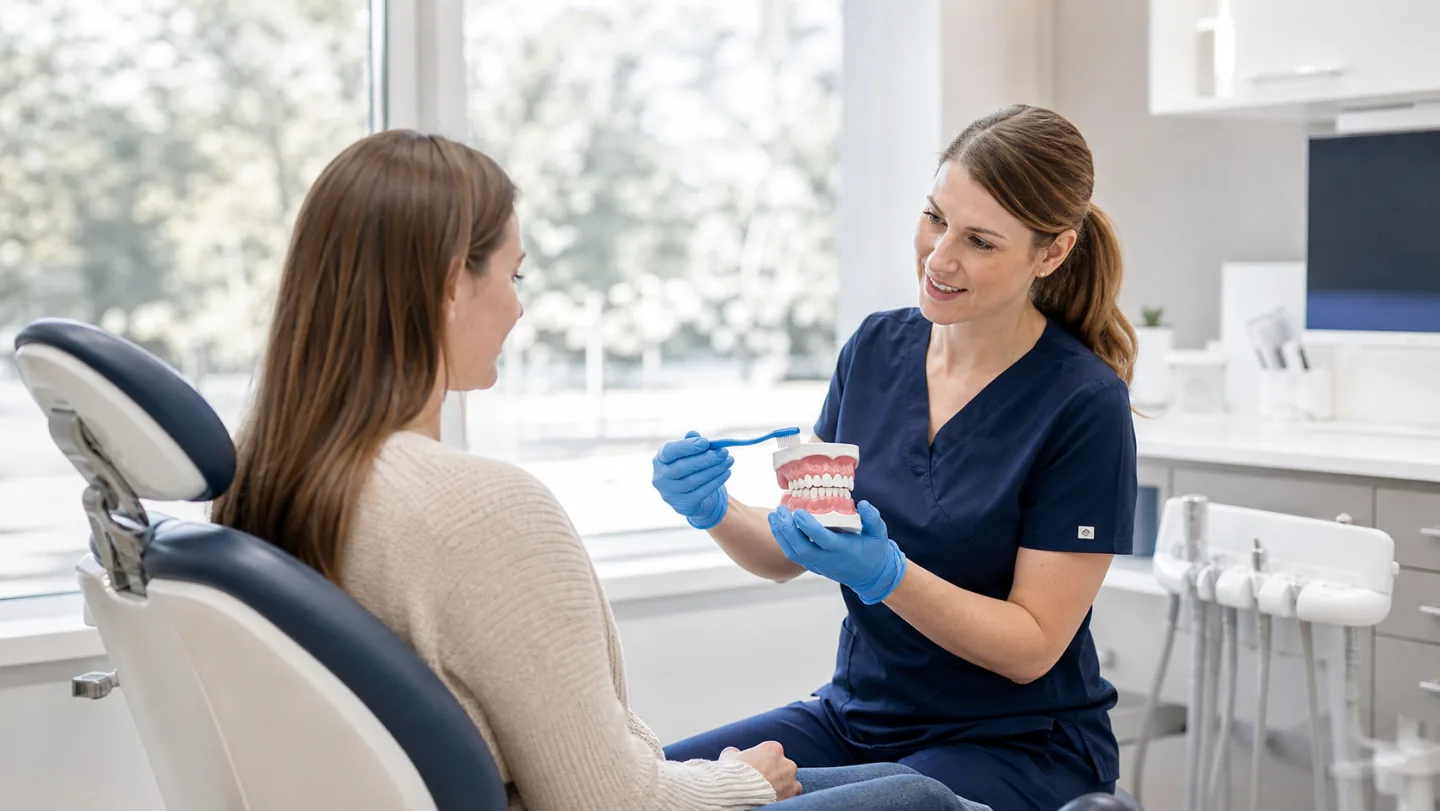
A dental hygienist explaining gum health and home care with a model
Your gum numbers went up

Gum Disease Treatment for Bridgwater Residents

Hearing that a few readings are higher than last time can be worrying, especially if nobody explained why. Bridgwater residents can request a periodontal assessment at Winnipeg North Dental on McPhillips Street to understand what increased numbers may point to and what can be done about them.

Let's find a time

Request an appointment

We’ll call to confirm your appointment. For urgent care, please call us directly.

Reading a rising number

What a Deeper Reading Can and Cannot Tell You

The numbers called out during gum charting are measurements of the space between gum and tooth at different points. A shallow space is typical of healthy tissue. A larger one can mean the gum is swollen, or that attachment has been lost and a true periodontal pocket has formed.

Those two causes call for different responses, so a higher reading is a reason to look closer rather than a verdict. Bleeding at the site, the position of the gum edge, attachment level and bone on suitable images all help sort out whether disease is active and how far it has gone.

Explore gum disease treatment
Winnipeg North Dental consultation room with a white desk, keyboard, black chairs and a calm seascape painting on a pale wall
A high-backed black chair with a headrest pulled up to the consultation desk.

Numbers in context

Each reading is weighed with bleeding, recession and bone, not judged alone.

Swelling or loss?

The assessment helps tell puffy gum apart from lost attachment.

Plain explanations

You can ask what any number means for that particular tooth.

Responding to the change

Care depends on why the numbers rose.

If deeper readings reflect inflammation alone, the focus is calming the gum. If they reflect lost support, care moves below the gumline.

When swollen gum is behind it

Readings can drop again once inflammation settles.

  • Tightening up daily plaque removal at the affected teeth.
  • Professional cleaning to clear buildup feeding the swelling.
  • Choosing interdental tools that fit those spaces.
  • Re-probing after the gum has had time to firm up.

When a true pocket has formed

Attachment loss usually needs treatment below the gum.

  • Scaling and root planing to clean root surfaces in the pocket.
  • Comparing healing readings with the earlier ones.
  • More advanced care or referral if a site stays deep.
  • Maintenance visits at an interval suited to your risk.

Readings from different offices may be taken in slightly different ways. Fresh measurements give a consistent starting point for tracking any further change.

Re-measuring properly

A complete chart, explained as it is taken.

Rather than focusing only on the teeth with higher numbers, the visit builds a full picture of your gums.

Request your visit
  1. 01

    Describe what you were told

    Tell us which teeth had higher readings, if you know, and any symptoms you have noticed. The discussion covers your health, medicines, tobacco use and gum disease in the family.

  2. 02

    Probe every site

    Each tooth is measured at several points for depth, bleeding, gum recession and attachment.

  3. 03

    Assess what lies beneath

    Mobility, the bite, calculus and suitable dental images show bone support and areas that are difficult to clean.

  4. 04

    Make sense of the numbers

    You hear which readings point to active disease, which do not and what treatment and maintenance would be advised.

Older charts, if you have them

Earlier charts help show the trend.

If the office that noted the higher readings can share them, they help show how quickly things changed. Not having them is no obstacle.

Time and cost questions can be put to the clinic once it contacts you. What your plan covers is up to your benefits provider.

What helps decode the change

  • Which teeth were flagged, if you were told.
  • Any older gum charts or X-rays you can obtain.
  • Anything new on your prescription list or in your health since that charting.
  • Dental plan details if you have them.
Winnipeg North Dental treatment room with a blue treatment chair, overhead arm, wall monitor and light wood lower cabinets
Winnipeg North Dental reception desk with a white front, clear shield, plants and a doorway behind with a blue accent wall

Frosted-glass upper cabinets above a counter, with a monitor on the wall.

Understanding the score

A number is easier to face once explained.

Being told your readings went up without context can leave you guessing. Having each one explained turns it into something you can act on.

Hear the numbers

Ask for the readings to be called out and what range is typical.

See them side by side

If earlier readings are available, you can ask how they compare.

Take a breather

If probing feels tender, ask for a pause or a lighter touch.

Tracking the trend

Follow-up readings show which way things go.

After treatment, remeasuring tells you whether the higher numbers have come down, stayed put or need more attention.

01

Before and after

Healing readings are compared against the chart that started it all.

02

Personal recall

Your maintenance spacing reflects history, stability and risk rather than a standard calendar.

03

Early warnings

Regular charting helps spot any site that begins to deepen again.

If a tooth starts to feel loose or the gum swells before your next check, call the clinic.

Talk with our team
Winnipeg North Dental exterior showing a tooth-shaped logo, the clinic name and phone number above frosted windows

Winnipeg North Dental

Unit-5 2358 Mcphillips Street, Winnipeg, MB R2V 4J6
Get directions (opens in a new tab)
Where the re-measuring happens

Clinic Details for Your Assessment

Bridgwater is in Winnipeg, and residents who choose us for gum care are seen at Winnipeg North Dental, Unit 5, 2358 McPhillips Street, Winnipeg. This card’s directions link shows the clinic on a map.

The form sends a request, and the clinic replies to find a time that works. Phone if a problem is urgent.

Questions about coverage?

Talk with our team before your visit or learn about CDCP.

A little clarity before your visit

Your questions, answered.

Helpful details about gum disease treatment in Bridgwater.

Ask our team
What numbers are considered normal in gum charting?

Healthy gum spaces are typically shallow, and bleeding is minimal. What matters is how your readings combine with bleeding, attachment and bone levels.

Can a higher reading go back down?

If it was caused by swollen gum, it can improve as inflammation settles. Where attachment has been lost, treatment aims to reduce pocket depth and keep it stable.

Does a rising number mean I will lose that tooth?

Not necessarily. It means the site needs attention. Tooth stability depends on how much support remains and how the area responds to care.

Why were my readings different at another office?

Probing technique and angle can vary slightly, and inflammation changes from day to day. A full new chart gives a consistent reference.

Is surgery likely if my pockets are deeper?

Many pockets are first treated with scaling and root planing. Surgery or referral is considered only for sites that remain deep after reassessment.

How do Bridgwater residents ask about higher gum readings?

Phone (204) 338-3003 or use the form and mention that your readings went up. The clinic will reach out to book a time.

Get answers about the numbers

Find out what your readings really mean.

Bridgwater residents can request a periodontal assessment at our McPhillips Street clinic in Winnipeg, and the clinic will be in touch about scheduling.

Patient testimonials

Kind words from our patients

★★★★★ 5.0 from 440+ reviews on Google

Close to home

Areas we serve

Convenient dental care on McPhillips Street for families across northwest Winnipeg and nearby communities.

Explore all service areas

A healthier smile is one visit away

Ready for dental care that feels genuinely comfortable?

✓ New patients welcome ✓ Direct insurance billing ✓ Multilingual team

How can we help?

Our dental team is here for you.

Ready to book or have a question? Choose the option that works best for you.

For urgent dental concerns, please call us directly.

Send us a message

Our team will reply during clinic hours.



