Skip to content
Winnipeg North Dental
A dentist explaining a complete denture to a mature patient
Top and bottom in different shape?

Dentures for River Trail Residents

Few mouths lose teeth evenly. You might have a strong lower set and a failing upper one, or the reverse. Here’s how a denture on one arch is approached, and how the teeth opposite figure in, at our McPhillips Street clinic.

Let's find a time

Request an appointment

We’ll call to confirm your appointment. For urgent care, please call us directly.

A mismatched mouth

A Denture Opposite Natural Teeth, for River Trail Residents

When people imagine dentures, they often picture a full set, upper and lower. Plenty of mouths don’t work that way. One arch may need replacing while the other still holds natural teeth, crowns or an older partial, and that combination raises its own questions.

A denture has to meet whatever sits across from it. That’s why your bite and the way your jaws relate are recorded and tested before the appliance is processed. An exam looks at both arches, so you’re not only discussing the side that’s bothering you.

Explore dentures
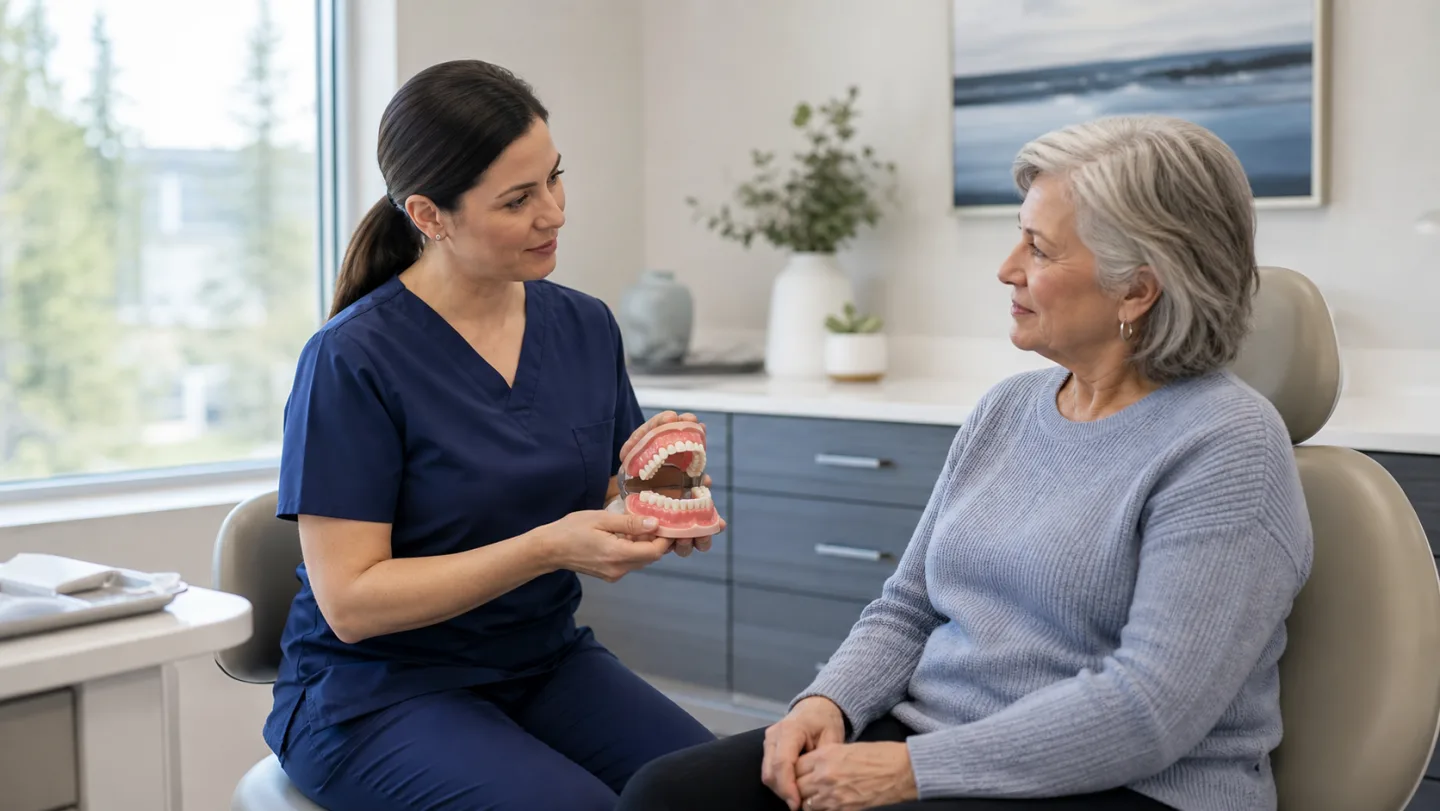
Close view of a dental professional in navy scrubs presenting upper and lower model dentures to a patient
Stock image: upper and lower model dentures shown to a patient.

Both arches get considered

Planning looks at how the new denture will meet the teeth across from it, not just at the gap.

Your bite gets tested

Bite records and a try-in show how things come together before the appliance is finished.

Your natural teeth still count

Teeth in the opposite arch still need their usual care, along with regular review at dental visits.

One arch, or part of one

The arch being replaced sets the design.

Depending on what remains on that side, you may hear about either of these. It’s also possible to wear different designs on the top and bottom.

Replacing every tooth in that arch

A complete denture can be made for the upper or the lower alone, deriving its support from underlying tissues and the shape of your jaw.

  • An upper tends to act unlike a lower, given how each arch is built and moves.
  • Its teeth are set to work with what’s opposite.
  • Chewing evenly on both sides can improve its stability.

Replacing some teeth in that arch

If that arch still has useful teeth, a partial denture can replace the selected missing ones, using those teeth and the oral tissues for planned support.

  • Which teeth can be kept is a matter for your exam.
  • It should be removed to clean those teeth thoroughly.
  • Further tooth loss might mean revisiting the design.

Your examination will reveal which design may suit you, and whether something other than a denture ought to be discussed.

Checking how they meet

Getting one arch to work with the other.

Expect several appointments, as getting the fit, the bite and the look right is gradual work. Here’s the general order.

Request your visit
  1. 01

    Examining top and bottom

    Expect the dentist to go over both arches: gums and soft tissue, whichever teeth remain, how the jaws line up, and anything you already wear.

  2. 02

    Capturing the meeting point

    Your mouth’s contours get captured by impression or scan. Your closing position is noted separately, so the denture reflects how you really bite.

  3. 03

    Trying the bite for real

    You’ll wear a trial version so your bite, speech, smile and the placement of each tooth can be judged. Your own impression of it counts here.

  4. 04

    Fine-tuning the finished piece

    On the day you receive it, the dentist looks for spots that press, tests how well it stays put and how it works, then sets up return visits.

Think about both sides

Describe how you chew right now.

If you’ve been favouring one side, or biting in an unusual way to protect certain teeth, that’s useful for the dentist to hear. Habits you barely notice may matter here.

Since treatment may include more than a denture, ask how estimates and appointment times would be handled once your needs are clear.

Things worth noting

  • Teeth on either arch that are sore, loose or recently treated.
  • The side you tend to chew on, and why.
  • Any old partial or denture, even if it’s sitting unused.
  • Medications, health changes, and any CDCP or benefit details.
Winnipeg North Dental treatment room with a light blue chair, sink and wood cabinets
Consultation desk and chairs in front of window blinds at Winnipeg North Dental

A treatment room, and a desk in a consultation room.

An odd feeling at first

Half natural and half denture takes learning.

It’s natural to feel a difference between the side you were born with and the side that’s new. Mention anything that strikes you as strange, even when it’s hard to describe.

Share the load

Take smaller bites, and try chewing on both sides at once instead of relying on your stronger side.

Speak up about high spots

If one area seems to hit first when you bite, or a sore place develops, ask for it to be checked and adjusted.

Allow your tongue some time

Certain sounds may need practice as your tongue adapts to new contours, and reading aloud at home can help.

Two arches to look after

A split routine, morning and night.

You now have natural teeth to care for and an appliance to maintain, and they don’t get cleaned in the same way. Over time, either side could change how the bite feels.

01

Natural teeth, usual care

Keep up your normal brushing and cleaning for the teeth you’ve kept. They remain just as important as they were.

02

Denture, separate care

Take it out and clean it using a suitable brush and cleanser, and store it according to the directions you were given.

03

Bite checks over time

Tissues, tooth wear and new dental work can all change how your arches meet, so reviews remain useful.

If a tooth on either arch starts hurting, or the denture breaks, please deal with it by calling the clinic.

Talk with our team
Winnipeg North Dental shopfront with blue and white cladding and a walkway in front

Winnipeg North Dental

Unit-5 2358 Mcphillips Street, Winnipeg, MB R2V 4J6
Get directions (opens in a new tab)
Taking the next step

Denture Planning for River Trail Residents

River Trail residents have this care at our clinic on McPhillips Street in Winnipeg. The full address is Winnipeg North Dental, Unit 5, 2358 McPhillips Street, with a directions link alongside.

You’re welcome to phone or to use the form. Requests are confirmed by the clinic afterward, so please wait to hear back before planning around a time.

Questions about coverage?

Talk with our team before your visit or learn about CDCP.

A little clarity before your visit

Your questions, answered.

Helpful details about dentures in River Trail.

Ask our team
Can I have a denture on top and my own teeth on the bottom?

A complete denture can replace a full upper or lower arch on its own. Whether that’s suitable for your mouth depends on an examination, including the condition of your opposing teeth.

Do the teeth across from a denture matter that much?

They do, since the denture and those teeth have to come together when you bite and chew. That’s part of what the bite records and the try-in stage are there to check.

Could I wear a full denture on one arch and a partial on the other?

Ask about it at your exam. The design of each arch depends on the teeth remaining there, so the two may not end up the same.

Why does my lower feel so different from my upper?

Anatomy and movement aren’t the same on top and bottom, so the two arches rarely feel alike. If yours doesn’t feel secure, the dentist can look at why and explain your options.

Should I get the bad teeth on my other arch fixed first?

Treatment order is worked out after looking at your whole mouth, so bring it up at your assessment. It’s fair to ask how one stage would affect the other.

Will my natural teeth wear down my new denture?

Wear can affect how a denture works over time, and it’s one of the things reviewed at your visits. Ask what to watch for in your own situation.

How do River Trail residents book a consultation?

Send the form on this page or ring (204) 338-3003 to ask for a visit at Unit 5, 2358 McPhillips Street in Winnipeg. A clinic team member will reply to set it up.


One arch or two

Have both arches looked at together.

If you live in River Trail, you can request a denture consultation at our Winnipeg clinic. Expect a reply so that a time can be arranged.

Patient testimonials

Kind words from our patients

★★★★★ 5.0 from 440+ reviews on Google

Close to home

Areas we serve

Convenient dental care on McPhillips Street for families across northwest Winnipeg and nearby communities.

Explore all service areas

A healthier smile is one visit away

Ready for dental care that feels genuinely comfortable?

✓ New patients welcome ✓ Direct insurance billing ✓ Multilingual team

How can we help?

Our dental team is here for you.

Ready to book or have a question? Choose the option that works best for you.

For urgent dental concerns, please call us directly.

Send us a message

Our team will reply during clinic hours.