Skip to content
Winnipeg North Dental
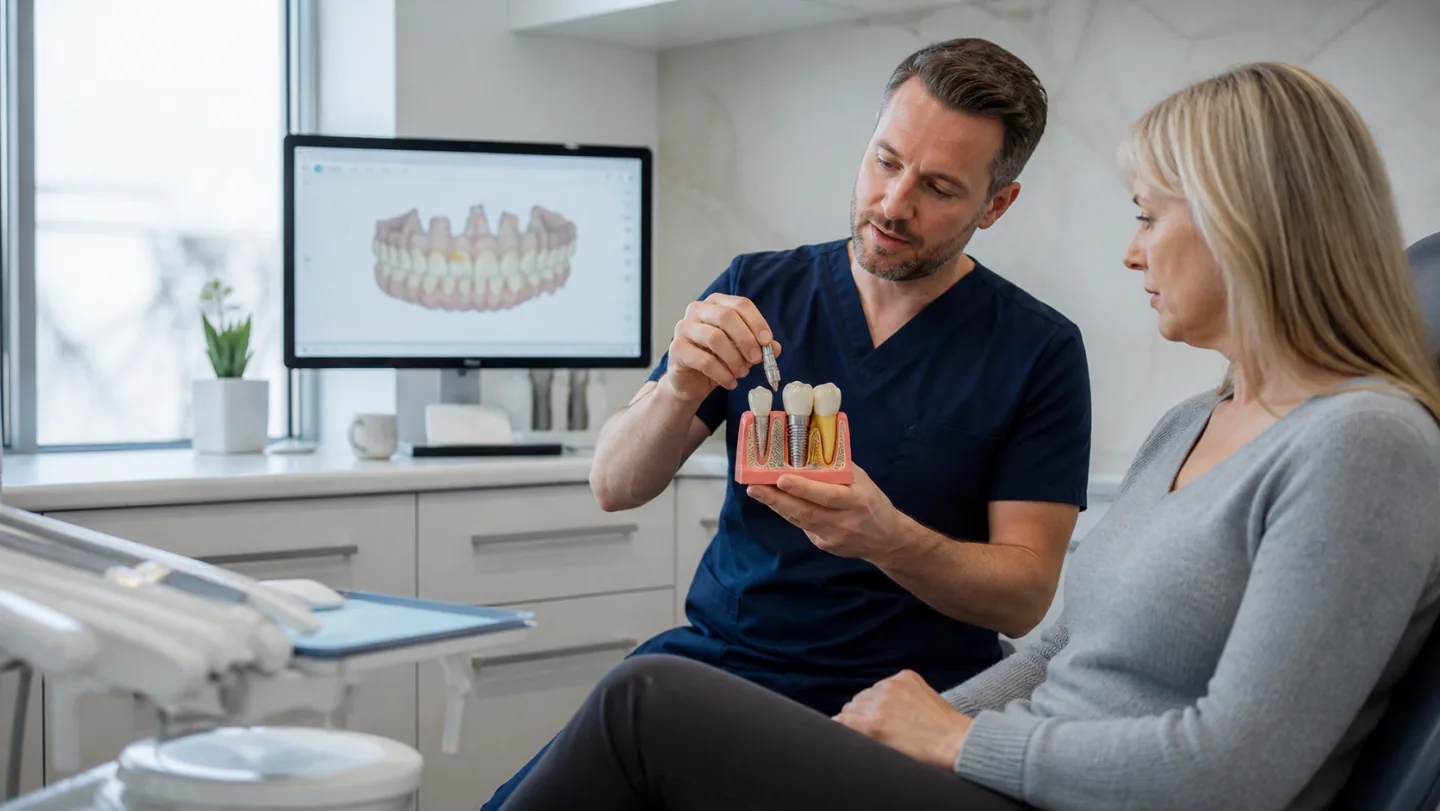
A dentist explaining a single dental implant with a jaw model and scan
Chewing on one side?

Dental Implants for Waterford Green Residents

Steak gets cut smaller. Raw apples quietly leave the shopping list. If a missing tooth has reshaped the way you eat, Waterford Green residents can have it looked at in our McPhillips Street clinic in Winnipeg.

Let's find a time

Request an appointment

We’ll call to confirm your appointment. For urgent care, please call us directly.

Mealtime workarounds

When Dinner Has Become a Series of Small Adjustments

Most people who lose a tooth don’t stop eating the foods they enjoy all at once. They slice things thinner, move food across to the stronger side, and eventually stop ordering whatever used to cause trouble. Because the change is so gradual, it can take a while to register.

If you live in Waterford Green and recognize that pattern, an assessment can show whether an implant is a sensible way to rebuild that part of your bite. An implant sits in the jaw and supports a separate crown, bridge or denture on top, and that top portion is shaped with your bite in mind. Whether it suits you depends on what the examination and imaging reveal.

Explore dental implants
A glossy white desk with a keyboard, black office chairs and a painted seascape on the wall
A seascape print above the desk in a consultation room.

Your eating habits count

The list of foods you now avoid gives the clinician practical clues about which part of your bite isn’t pulling its weight.

Designed around the bite

The visible restoration is planned so upper and lower teeth meet in a workable way and the area can still be cleaned.

An honest forecast

Nobody can promise how any restoration will feel to you, so expect a frank talk about what treatment may and may not change.

From the jaw up

What would be doing the chewing.

Thinking about chewing makes the structure of an implant easier to follow, because each layer has a different job when you bite down.

Beneath the gumline

The implant itself goes into bone during a surgical step. Over a healing period, bone forms around it, and that foundation is what the rest will rely on.

  • Imaging reveals how much bone is available.
  • A graft is added only if the plan calls for it.
  • The site is protected and watched as it heals.
  • Healing sets the pace, so timing differs by person.

Above the gumline

A connector called an abutment joins the implant to whichever restoration suits your situation, whether that is one crown, an implant bridge, or denture support.

  • Its shape reflects the space you have to work with.
  • The opposing teeth influence how it is designed.
  • Room for cleaning is part of the design too.
  • Your bite gets reviewed after it is fitted.

Implants aren’t the only way to restore chewing. Bridges and removable dentures may also fit, and it’s reasonable to want those compared.

Your assessment

Starting with how you actually eat.

It helps if the appointment begins with your daily reality and then moves to the clinical picture, so that any recommendation answers the problem you came in with.

Request your visit
  1. 01

    Describe your meals

    Mention what you’ve dropped from your diet and which side you rely on. Small details such as cutting up sandwiches are worth including.

  2. 02

    Check the working teeth

    Your bite, gums and the teeth that have been doing extra duty are examined, along with the empty space itself.

  3. 03

    Scan where appropriate

    Three-dimensional imaging can display your jaw’s anatomy and bone volume if an implant remains a realistic option.

  4. 04

    Talk through the options

    Risks, phases and alternatives can then be weighed against what you would most like to be able to eat comfortably again.

The week before you come

Keep a short food diary.

You probably adapted so long ago that some of your habits feel normal now. Writing down a few days of meals can bring them back to the surface.

A diary isn’t a test of your diet. It simply gives the conversation something concrete to work from.

Jot down

  • Foods you’ve given up or now cut into small pieces.
  • Which side you chew on, and for how long that has been true.
  • Any tenderness on the side doing most of the work.
  • What you take each day, plus any recent shifts in your health.
A navy upholstered bench below two abstract blue paintings in a bright waiting room
A pale blue dental chair reclined in front of wood-toned cabinets and a wall monitor

A navy bench in the waiting room, and a pale blue chair in a treatment room.

Without embarrassment

Nobody will be grading your lunch.

Plenty of people feel awkward admitting that they’ve been avoiding crunchy food or eating alone because of a gap. You can say as much or as little about that as you wish.

Soft-food stretches

Ask what you’ll be able to eat around surgery, since that may shape how you plan your meals and your week.

Tender spots

If the stronger side has started to ache from overuse, point it out so it gets looked at during the exam.

Speaking up mid-visit

Should something feel uncomfortable while you’re in the chair, let the clinician know straight away.

Back at the table

A new tooth needs ongoing attention.

A restoration you chew on every day has to stay clean and meet the opposing teeth properly. Implants cannot decay, though the gums and bone supporting them can become diseased if plaque stays put.

01

Checking the bite

How the restoration meets its opposite number should be reviewed, because uneven pressure is something worth correcting.

02

Daily cleaning

Food can trap around a restoration just as it does around teeth, so learn which tools reach the spots you’ll be dealing with.

03

Reporting changes

Soreness under pressure, bleeding, or a crown that shifts are all reasons to contact the clinic about your implant.

For swelling or anything that feels urgent, phone (204) 338-3003 and don’t rely on the form.

Talk with our team
A white sign reading Winnipeg North Dental above glass double doors and tall blinded windows

Winnipeg North Dental

Unit-5 2358 Mcphillips Street, Winnipeg, MB R2V 4J6
Get directions (opens in a new tab)
Where it’s done

Chewing and Implant Assessments for Waterford Green

Your exam and any treatment happen at Winnipeg North Dental, Unit 5, 2358 McPhillips Street, Winnipeg, MB. Waterford Green is one of the Winnipeg areas whose residents can request a visit here.

Sending the form asks for an appointment but doesn’t hold one. Expect the clinic to get back to you about a suitable time.

Questions about coverage?

Talk with our team before your visit or learn about CDCP.

A little clarity before your visit

Your questions, answered.

Helpful details about dental implants in Waterford Green.

Ask our team
I live in Waterford Green. How do I ask about chewing problems and implants?

Call (204) 338-3003 or send the form on this page, mentioning that a missing tooth is affecting how you eat. Appointments are at 2358 McPhillips Street, Winnipeg.

Will an implant let me eat everything I used to?

That can’t be promised. It depends on your bite, your remaining teeth, the type of restoration and how healing goes, so ask what is realistic for your own mouth.

Could chewing on one side be hurting my other teeth?

Teeth doing extra work are worth checking, particularly if they’re sore or have worn. An exam can look at those teeth and the way your bite comes together.

What can I eat while the implant is healing?

The area needs protecting during this stage, and instructions depend on your treatment. Request specific eating advice for your situation before the surgery date arrives.

Do implants feel different from natural teeth when biting?

People describe this differently, and an implant isn’t identical to a natural tooth. Raise it during your consultation, and report any change in bite or discomfort with pressure later on.

Would a bridge or denture help me chew instead?

Either could be an alternative depending on which teeth remain and how they’re spaced. Comparing them against an implant in your own case is a normal part of planning.

Tired of working around it?

Bring your food list to an assessment.

If eating has become a chore, Waterford Green residents are welcome to send a request to our Winnipeg clinic. A staff member will follow up to arrange a time with you.

Patient testimonials

Kind words from our patients

★★★★★ 5.0 from 440+ reviews on Google

Close to home

Areas we serve

Convenient dental care on McPhillips Street for families across northwest Winnipeg and nearby communities.

Explore all service areas

A healthier smile is one visit away

Ready for dental care that feels genuinely comfortable?

✓ New patients welcome ✓ Direct insurance billing ✓ Multilingual team

How can we help?

Our dental team is here for you.

Ready to book or have a question? Choose the option that works best for you.

For urgent dental concerns, please call us directly.

Send us a message

Our team will reply during clinic hours.



