Skip to content
Winnipeg North Dental
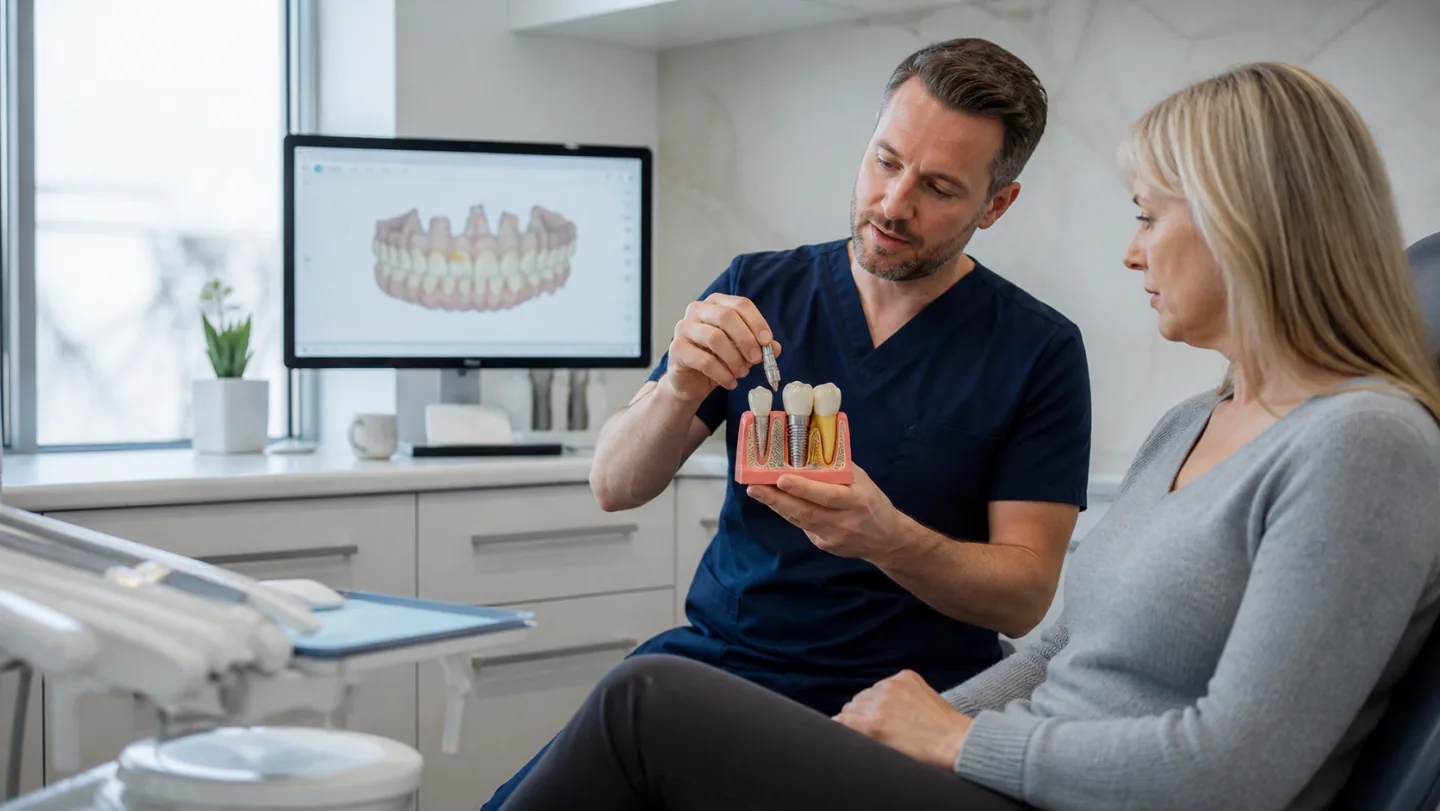
A dentist explaining a single dental implant with a jaw model and scan
One tooth at a time, for years

Dental Implants for St. Vital Residents

Some people lose teeth gradually, a molar here and a premolar there, each one handled on its own. If you’re in St. Vital and you can see that pattern in your own mouth, it may help to step back and think about a plan for the long run.

Let's find a time

Request an appointment

We’ll call to confirm your appointment. For urgent care, please call us directly.

Seeing the pattern

When Each Loss Was Handled Separately

Treating every lost tooth as an isolated event can leave a mix of gaps, older bridges and partial dentures that don’t work well together. An implant assessment is a chance to look at the whole mouth: which teeth remain healthy, why the others were lost, and what replacements would make sense over time.

Understanding the cause matters, because gum disease, decay, cracks or heavy bite forces can also affect the success of an implant. St. Vital is an area in Winnipeg, and the full examination and imaging would take place at our McPhillips Street clinic, where the dentist can explain what the findings mean.

Explore dental implants
A quiet room with a white desk, leather office chairs and a seascape painting on the wall
Office chairs around a white desk in the consultation room.

Look for the cause

Why teeth were lost can shape both the remaining teeth’s care and any implant plan.

Think in sections

Implants can support single crowns, bridges or dentures, so several gaps may be planned together.

Healthy gums first

Gum tissue that can be kept clean and stable is part of what makes an implant suitable.

Building a long-range plan

Today’s gap and the ones that may follow.

A plan for gradual tooth loss balances what needs doing now against what might come later, so today’s work doesn’t box in tomorrow’s choices.

Addressing what caused the losses

If gum disease or another ongoing problem played a role, getting it under control is typically discussed before implant surgery.

  • Gum health is assessed around the remaining teeth.
  • Infection in the area affects implant timing.
  • Bite forces and grinding are considered too.
  • Smoking and medical factors are part of the review.

Choosing how to replace the gaps

Depending on how many teeth are missing and where, the discussion might cover separate implant crowns, implant bridges or implant-supported dentures.

  • Each implant must sit where its tooth can function.
  • Fewer implants than missing teeth is sometimes planned.
  • Existing bridges or partials may be part of the picture.
  • Work can be phased rather than done all at once.

Suitability for implants is decided by examination and imaging. Some areas may suit implants while others are better served another way.

Phases of implant care

What each implant goes through.

Even within a larger plan, every implant follows the same broad sequence. Biology, not the appointment book, decides how quickly it moves.

Request your visit
  1. 01

    Map the mouth

    Imaging and records show where each future tooth should be and what bone and anatomy surround it.

  2. 02

    Surgical step

    Implants are placed in a surgical appointment, with grafting where the plan requires additional bone.

  3. 03

    Healing and monitoring

    Each site integrates on its own timeline, which varies with stability, grafting and your health.

  4. 04

    Restoration and upkeep

    Abutments and restorations are fitted, followed by a bite review and regular hygiene maintenance.

Recalling each lost tooth

Piece together your dental history.

Try to recall roughly when each tooth was lost and why, if you know. Note any bridges, partials or crowns you have and how they’re holding up.

If you have older X-rays or records from past dental care, ask whether they would be useful to the assessment.

Questions for the dentist

  • What seems to have caused my teeth to be lost?
  • Which of my remaining teeth look most at risk?
  • Could several gaps be replaced as one plan?
  • Which part would you suggest dealing with first?
Natural light through striped blinds onto white chairs, a navy bench and potted greenery
A turquoise dental chair with a white overhead light arm and wood-finish cabinetry

White chairs and potted plants by the window in the waiting area.

A judgement-free start

Where you are now is the starting point.

Many people feel uneasy about a mouth with several missing teeth. The aim of the visit is to understand the situation and talk through choices, not to dwell on how it came about.

Go at your own pace

A longer plan can be taken in stages, and you can ask how to break it into steps.

Ask about each option

Implants, bridges and dentures each have advantages and limits worth hearing out.

Share your concerns

Worries about surgery, appointments or upkeep are all fair to bring up.

Protecting what you have

Keeping implants and remaining teeth healthy.

Implants can’t decay, but gum and bone around them can still break down if plaque collects. The same daily cleaning and maintenance visits that protect your implants also help the teeth you still have.

01

Steady maintenance

Regular hygiene care and bite reviews help catch problems early across the whole mouth.

02

Thorough daily cleaning

Ask how to clean around each type of restoration you end up with.

03

Call about warning signs

Movement in a restoration, a changed bite or discomfort on pressure is a reason to contact the clinic.

For bleeding, swelling, drainage or an unpleasant taste that persists around an implant, please call (204) 338-3003.

Talk with our team
The Winnipeg North Dental entrance with a black door frame and a sign showing 204-338-3003

Winnipeg North Dental

Unit-5 2358 Mcphillips Street, Winnipeg, MB R2V 4J6
Get directions (opens in a new tab)
Where your assessment happens

Long-Range Implant Planning for St. Vital Residents

The whole-mouth examination is done at Winnipeg North Dental, Unit 5, 2358 McPhillips Street, Winnipeg. There’s a link to directions alongside.

A submitted form isn’t a confirmed booking. Clinic staff reply afterward to work out a day with you.

Questions about coverage?

Talk with our team before your visit or learn about CDCP.

A little clarity before your visit

Your questions, answered.

Helpful details about dental implants in St. Vital.

Ask our team
Can a St. Vital resident have their whole mouth assessed for implants?

Yes. Request a visit on this page or call (204) 338-3003, and mention that several teeth are missing. A dentist at our McPhillips Street clinic in Winnipeg would carry out that full review.

If gum disease cost me teeth, can I still have implants?

Possibly, though gum health needs to be assessed first. Inflamed or unstable gums can affect implants, so controlling gum disease is usually part of the conversation.

Do I need an implant for every tooth I’ve lost?

Not necessarily. Several missing teeth may be replaced with a bridge or denture supported by fewer implants, depending on the bone and the design.

Can my existing partial denture stay while we plan?

Ask about that at the assessment. Whether and how it can be worn during treatment depends on the plan and how healing progresses.

Can the work be spread out over time?

Plans for several gaps are often staged. Ask which areas would make sense to address first and how the rest could follow.

Will implants stop me losing more teeth?

Implants replace teeth that are gone; they don’t protect the others on their own. Caring for your remaining teeth and gums remains important.

Plan for the long run

Book a whole-mouth look.

St. Vital residents can send an assessment request from this page, and the clinic will contact you to arrange it.

Patient testimonials

Kind words from our patients

★★★★★ 5.0 from 440+ reviews on Google

Close to home

Areas we serve

Convenient dental care on McPhillips Street for families across northwest Winnipeg and nearby communities.

Explore all service areas

A healthier smile is one visit away

Ready for dental care that feels genuinely comfortable?

✓ New patients welcome ✓ Direct insurance billing ✓ Multilingual team

How can we help?

Our dental team is here for you.

Ready to book or have a question? Choose the option that works best for you.

For urgent dental concerns, please call us directly.

Send us a message

Our team will reply during clinic hours.



