Skip to content
Winnipeg North Dental
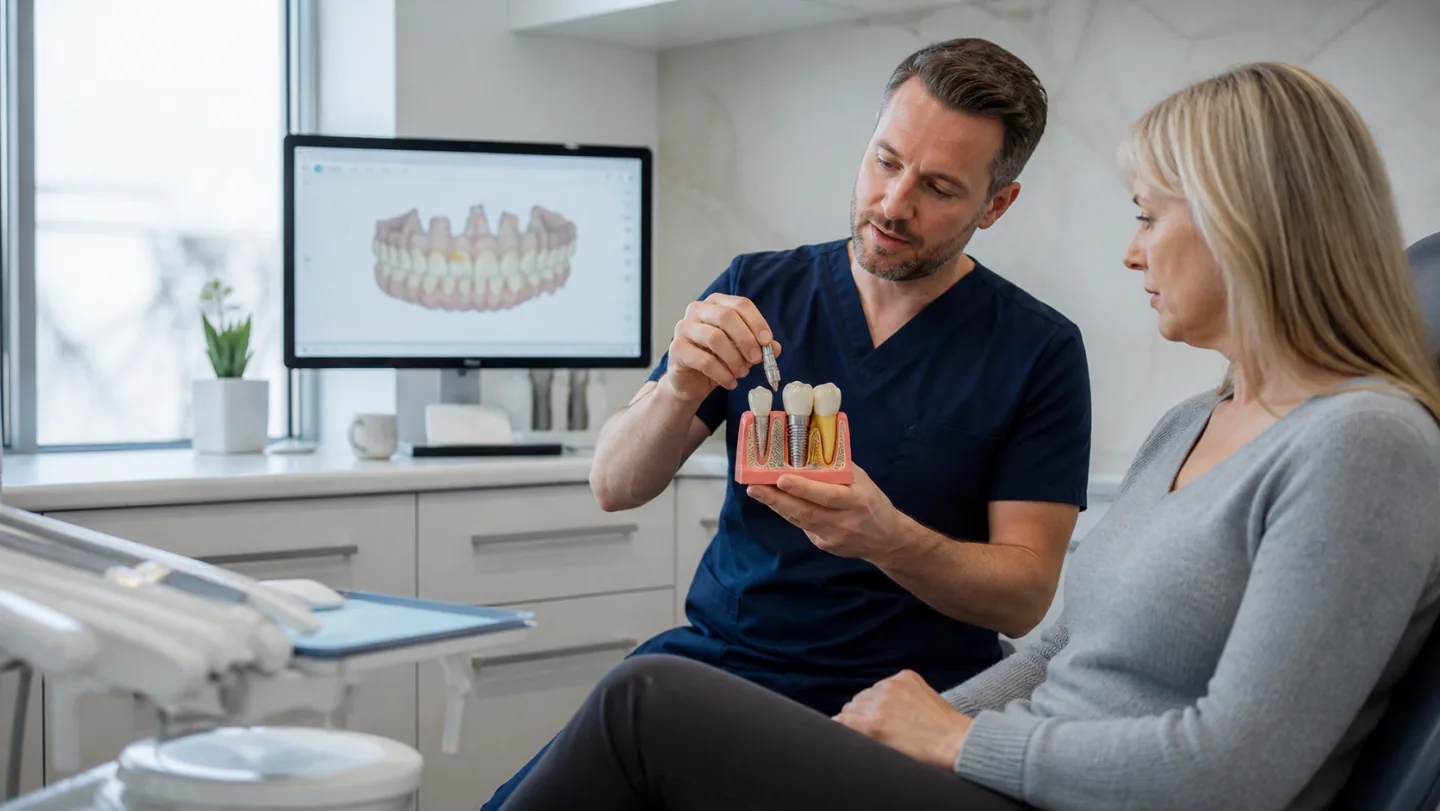
A dentist explaining a single dental implant with a jaw model and scan
Why the scan comes before surgery

Dental Implants for Sage Creek Residents

If you’re the kind of person who wants to understand the reasoning behind each step, this page is for you. Sage Creek residents considering an implant can read why three-dimensional imaging plays such a central part in planning, and what it can and can’t tell you.

Let's find a time

Request an appointment

We’ll call to confirm your appointment. For urgent care, please call us directly.

Seeing beneath the gum

What Imaging Adds to an Implant Decision

From the outside, a gap is just a space. Underneath, the volume and shape of the bone, the position of nerves and sinuses, and the roots of adjoining teeth all influence where an implant could go. Three-dimensional imaging helps the dentist study that anatomy before choosing a position.

Still, a scan is only one input. Gum health, infection, medications, smoking, growth, bite and the shape of the final restoration also affect risk and timing. Sage Creek is an area in Winnipeg, and the imaging and examination would both be done at Winnipeg North Dental on McPhillips Street.

Explore dental implants
A dental operatory with a blue chair, white equipment arm and a monitor mounted near the cabinets
A monitor mounted above the counter in an operatory.

Anatomy in three dimensions

Imaging helps show bone volume and important structures around the planned site.

The tooth comes first

The final tooth’s position is set during planning, and the implant is placed to serve it.

Not the whole story

Health, gums, bite and your hygiene habits still matter just as much as the scan.

Reading the results

What a scan can settle, and what it can’t.

Imaging answers some planning questions directly. Others need the examination, your history and a conversation about goals.

Questions imaging helps answer

Scans give the dentist a picture of the bone and surrounding structures that a visual examination can’t provide.

  • Whether bone volume suits the planned implant.
  • Where sensitive structures lie close to the site.
  • Whether grafting might be needed for support.
  • How the implant can line up with the final tooth.

Questions it leaves open

Some factors only show up through examination, medical history and discussion with you.

  • How healthy and stable your gums are.
  • Which medications or conditions affect healing.
  • How your bite and any grinding load the area.
  • Whether you can maintain the restoration well.

Even with a detailed scan, suitability is decided by the full assessment. Plans can occasionally change once surgery reveals more.

From scan to finished tooth

Where imaging fits in the sequence.

Imaging happens at the very start, but the information it provides carries through every later stage.

Request your visit
  1. 01

    Records, imaging and design

    The scan and other records are used to plan the restorative position before any surgery is booked.

  2. 02

    Guided by the plan

    The implant is placed surgically according to that position, with a graft when bone falls short.

  3. 03

    Bone integration

    Healing follows, with the site protected and reviewed; timing varies with grafting, stability and health.

  4. 04

    Abutment and restoration

    The connecting part and the visible tooth are fitted, then the bite and hygiene are checked.

Before your imaging visit

Make a note of past scans.

If you’ve had dental X-rays or scans elsewhere, mention where and roughly when. It may also help to list any past treatment near the gap.

Share your medical history and medications too. Imaging covers anatomy, but health factors affect the plan just as much.

Questions for after the scan

  • What does my bone look like at the site?
  • Are there structures the implant needs to avoid?
  • Is a graft likely based on these images?
  • What else besides the scan affects my suitability?
A consultation space with a white desk, keyboard and mouse, and black high-back office chairs
A reception counter with a white top and grey front panel, plants and a framed blue painting

A white desk with chairs on either side in the consultation room.

Understanding helps

Ask to have the findings explained.

Seeing your own anatomy can make the plan feel more concrete. If something in the explanation isn’t clear, it’s reasonable to ask for it in plainer terms.

Ask what each finding means

Knowing how a finding changes the plan helps you weigh your options.

Ask about alternatives

If imaging shows limitations, ask what other replacements might suit you.

Take your time

You don’t need to decide right after seeing the results.

Beyond the planning

Keeping the implant healthy for years.

An implant cannot decay, but the gum and bone that support it can still become inflamed and diseased when plaque is left behind. Daily cleaning, professional maintenance and control of risk factors protect what the plan built.

01

Hygiene appointments

Regular professional care and bite reviews continue once the restoration is in.

02

Home care

Ask how to clean around the restoration you receive, since designs differ.

03

Signs to report

A loose part, discomfort under pressure or a shift in bite should be raised with the clinic.

Call (204) 338-3003 about bleeding, swelling, drainage or a bad taste that persists around an implant.

Talk with our team
Exterior of Winnipeg North Dental showing a logo sign, phone number and a glass double door

Winnipeg North Dental

Unit-5 2358 Mcphillips Street, Winnipeg, MB R2V 4J6
Get directions (opens in a new tab)
Imaging and assessment

Implant Planning for Sage Creek Residents

Scans and examinations take place at Winnipeg North Dental, Unit 5, 2358 McPhillips Street, Winnipeg. The directions link here gives you the route.

This form asks for an appointment but doesn’t schedule one. The clinic will contact you to set the time.

Questions about coverage?

Talk with our team before your visit or learn about CDCP.

A little clarity before your visit

Your questions, answered.

Helpful details about dental implants in Sage Creek.

Ask our team
How does a Sage Creek resident arrange implant imaging?

Ask for an assessment through this page or phone (204) 338-3003. The examination and any imaging are done at our McPhillips Street clinic in Winnipeg.

Why can’t you plan an implant from a regular checkup alone?

Implant planning needs a clear picture of bone volume and the surrounding anatomy in three dimensions, which helps set a safe position that suits the final tooth.

Will imaging tell me for sure whether I can have an implant?

Imaging is important but not decisive on its own. Gum health, medical factors, bite and hygiene are also part of the decision.

What happens if the scan shows too little bone?

Grafting may be considered, or another type of replacement may be discussed. The options depend on your situation.

Is the restoration really designed before the implant goes in?

Yes. Working out the final tooth first lets the implant be positioned to emerge where the restoration can function and be cleaned.

Can the plan change after the scan?

It can. New information during treatment, healing or grafting needs can lead to adjustments, which the dentist would explain.

Know before you decide

Start with a proper look.

Sage Creek residents can request an implant assessment here, and the clinic will follow up to arrange it.

Patient testimonials

Kind words from our patients

★★★★★ 5.0 from 440+ reviews on Google

Close to home

Areas we serve

Convenient dental care on McPhillips Street for families across northwest Winnipeg and nearby communities.

Explore all service areas

A healthier smile is one visit away

Ready for dental care that feels genuinely comfortable?

✓ New patients welcome ✓ Direct insurance billing ✓ Multilingual team

How can we help?

Our dental team is here for you.

Ready to book or have a question? Choose the option that works best for you.

For urgent dental concerns, please call us directly.

Send us a message

Our team will reply during clinic hours.



