Skip to content
Winnipeg North Dental
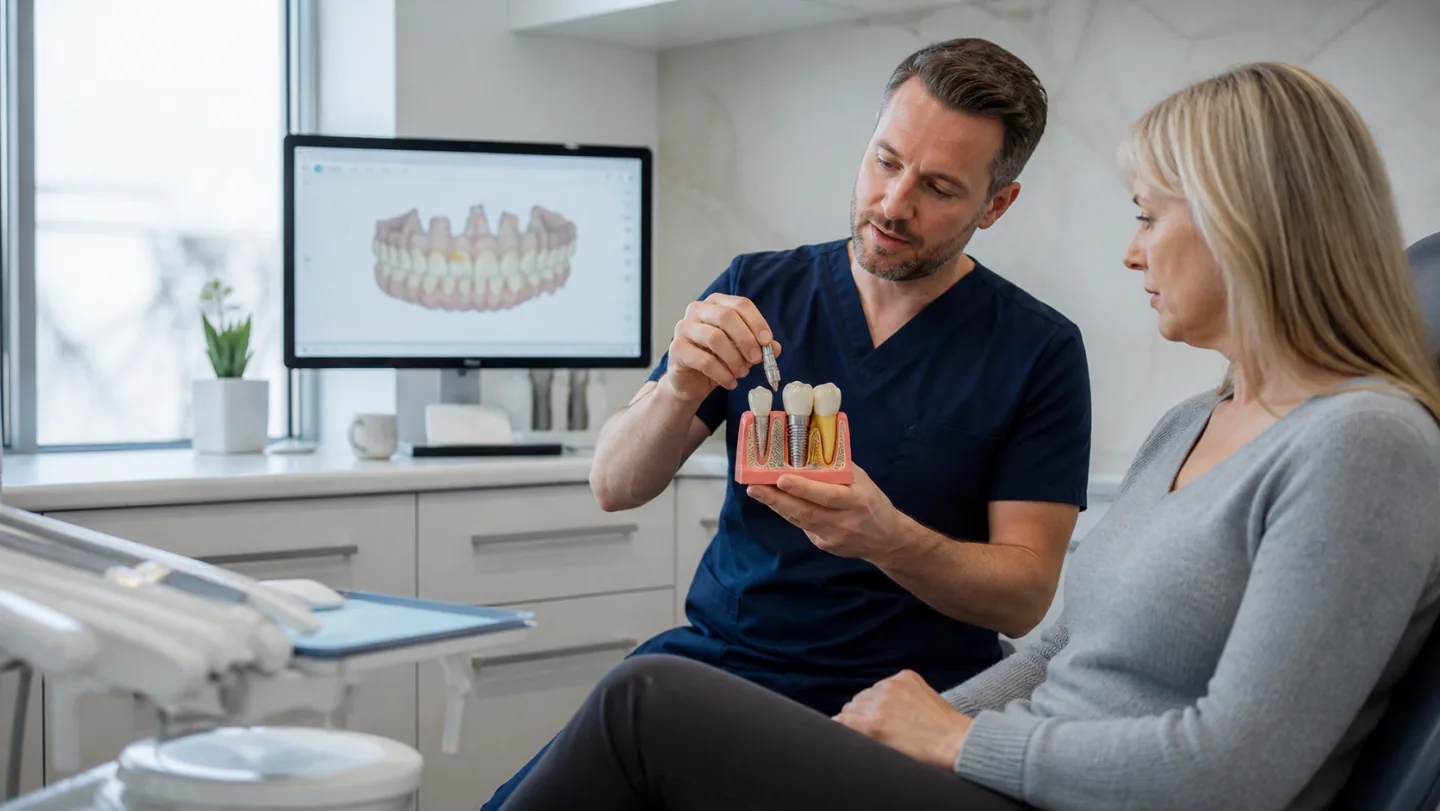
A dentist explaining a single dental implant with a jaw model and scan
Upper jaw or lower jaw?

Dental Implants for River Trail Residents

An implant planned for one part of your mouth faces different anatomy from one planned elsewhere. River Trail residents can have their own site assessed at our McPhillips Street clinic in Winnipeg.

Let's find a time

Request an appointment

We’ll call to confirm your appointment. For urgent care, please call us directly.

Location inside your mouth

Where the Tooth Was Affects How It’s Replaced

If you’ve read that an upper molar is a very different job from a lower one, or heard the words sinus and nerve and started to worry, this page is for you. Your jaw isn’t uniform. The bone, the structures around it and the forces it handles all vary from one site to the next.

These differences don’t decide anything by themselves, and they’re no reason to panic. They are why three-dimensional imaging comes up during planning, so anatomy around your site can be seen before anyone suggests a position. For River Trail residents, this assessment takes place at our clinic on McPhillips Street in Winnipeg.

Explore dental implants
A computer keyboard on a white desk, with black chairs on both sides and striped blinds behind
Striped blinds behind a white consultation room desk.

Sites aren’t interchangeable

Advice a friend got for their tooth might not hold true for a different area of your own mouth.

Anatomy gets mapped

Imaging shows bone volume and the surrounding structures that planning has to respect in that part of the jaw.

Function matters too

A tooth’s location affects how much force it handles and how visible it is, which shapes the restoration.

A general sketch

Two jaws, different considerations.

These are broad points to help you ask better questions. They aren’t a description of your particular case, because bone and anatomy differ between individuals as well as between sites.

In the upper jaw

Upper back teeth sit below the sinus, a hollow space above the bone. How much bone lies beneath it can be an important part of the conversation.

  • Imaging helps show the distance to the sinus.
  • A graft may be discussed if bone is limited.
  • Upper front teeth are often visible when you speak.
  • Appearance and gum shape may need extra thought.

In the lower jaw

A nerve that provides feeling to the lip and chin runs through the lower jaw. Its position is one reason careful imaging comes before implant placement.

  • The nerve’s position helps guide planning.
  • Back teeth handle considerable chewing force.
  • Bone shape can vary along the jaw.
  • Access for cleaning can be harder farther back.

Please don’t diagnose yourself from a sketch like this. Risks that are relevant to your site are something to review directly at your assessment.

At your assessment

Pinpointing your particular site.

Everything centres on the specific space you’re asking about. Tell the clinician which tooth or area you have in mind, including any previous problems there.

Request your visit
  1. 01

    Point out the area

    Show where the missing or failing tooth is, and explain how long it has been that way and what led to it.

  2. 02

    Check the neighbours

    Adjacent teeth, the teeth that bite against the space, and gums in the area are all examined for their condition.

  3. 03

    Image the region

    A three-dimensional view gives a clearer idea of the bone and of any structures an implant must keep clear of.

  4. 04

    Discuss site-specific risks

    You’ll be able to ask what the anatomy means for your options, your timing and the possibility of grafting.

Before you arrive

Think about that area’s history.

Past events in that part of the mouth may be relevant, even if they happened a long time ago. A brief note will help you recall details you might otherwise forget.

If you’ve ever had numbness or sinus troubles linked to dental work, mention that too, however minor it seemed at the time.

Cast your mind back

  • When that tooth was lost or last treated.
  • Any past infections, surgery or grafting in the area.
  • Frequent sinus symptoms, if the site is in your upper jaw.
  • Medications and medical conditions you’re managing now.
A reclined pale blue patient chair with a light overhead arm in a room with wood-tone cabinets
An abstract blue painting above a navy bench and potted plant next to the reception counter

A reclined patient chair, and a painting and bench by reception.

When anatomy sounds scary

Big words don’t have to frighten you.

Hearing about sinuses and nerves can be unsettling, particularly when you’re reading on your own late at night. Asking what these mean for you can make them far less abstract.

Point at the picture

Ask to have the important structures shown to you on your image, so you can see what is being discussed.

Risks explained plainly

You’re entitled to understand what could go wrong at your site before agreeing to anything surgical.

Slowing it down

Let the clinician know if you’d like a moment or a repeat of something that didn’t quite land.

After placement

Tell us what you’re noticing.

Healing proceeds differently from site to site. Follow the instructions you’re given for your area, and keep every appointment that checks on how the implant and tissues are doing.

01

Hard-to-reach spots

Implants far back in the mouth can be trickier to clean, so ask about tools that make the job easier.

02

Unusual sensations

Tell the clinic about anything that seems out of the ordinary around your implant or the area next to it.

03

Long-term reviews

Your hygiene visits and bite checks give the clinician chances to watch for changes around the restoration over time.

Please call (204) 338-3003 for urgent concerns, including any swelling, and avoid leaving these for the online form.

Talk with our team
Winnipeg North Dental’s frontage, with wide window blinds, navy-grey siding and a wall-mounted logo

Winnipeg North Dental

Unit-5 2358 Mcphillips Street, Winnipeg, MB R2V 4J6
Get directions (opens in a new tab)
Getting your site reviewed

Site-Specific Implant Advice for River Trail Residents

Anyone from River Trail looking into an implant would be assessed and treated at Winnipeg North Dental, Unit 5, 2358 McPhillips Street, Winnipeg.

Requests sent online are answered by the clinic so a time can be agreed on. Nothing is booked at the point you press send.

Questions about coverage?

Talk with our team before your visit or learn about CDCP.

A little clarity before your visit

Your questions, answered.

Helpful details about dental implants in River Trail.

Ask our team
As a River Trail resident, how do I get a specific tooth site assessed?

Use the form or dial (204) 338-3003, then name the area that concerns you. Your assessment would be at 2358 McPhillips Street in Winnipeg.

Is an implant harder in the upper or the lower jaw?

Neither is simply harder. Each has its own anatomy and demands, and your bone quantity matters a great deal. Imaging and an exam are needed for any answer about your own site.

Could an implant get into my sinus?

Position relative to the sinus is one thing imaging helps with when planning upper back teeth. Ask what the clinician sees in your case and which risks they would review with you.

Can an implant affect the nerve in my lower jaw?

Nerve position is part of why lower implants are planned with imaging. Nerve injury is a recognized risk of surgery in this region, so have this discussed for your site beforehand.

Do front and back implants differ?

They often do. Front teeth carry more visual concerns, while back teeth handle heavier chewing and can be tougher to clean. The restoration’s design takes these factors into account.

Is a bone graft more likely in one spot?

It depends on your own anatomy and how long the tooth has been missing, among other factors. Only an assessment and imaging can show whether your bone is enough for the plan.

Which tooth is it?

Have your exact site looked at.

River Trail residents can ask for an implant assessment at our McPhillips Street clinic. Staff will reply so you can settle on a date together.

Patient testimonials

Kind words from our patients

★★★★★ 5.0 from 440+ reviews on Google

Close to home

Areas we serve

Convenient dental care on McPhillips Street for families across northwest Winnipeg and nearby communities.

Explore all service areas

A healthier smile is one visit away

Ready for dental care that feels genuinely comfortable?

✓ New patients welcome ✓ Direct insurance billing ✓ Multilingual team

How can we help?

Our dental team is here for you.

Ready to book or have a question? Choose the option that works best for you.

For urgent dental concerns, please call us directly.

Send us a message

Our team will reply during clinic hours.



