Skip to content
Winnipeg North Dental
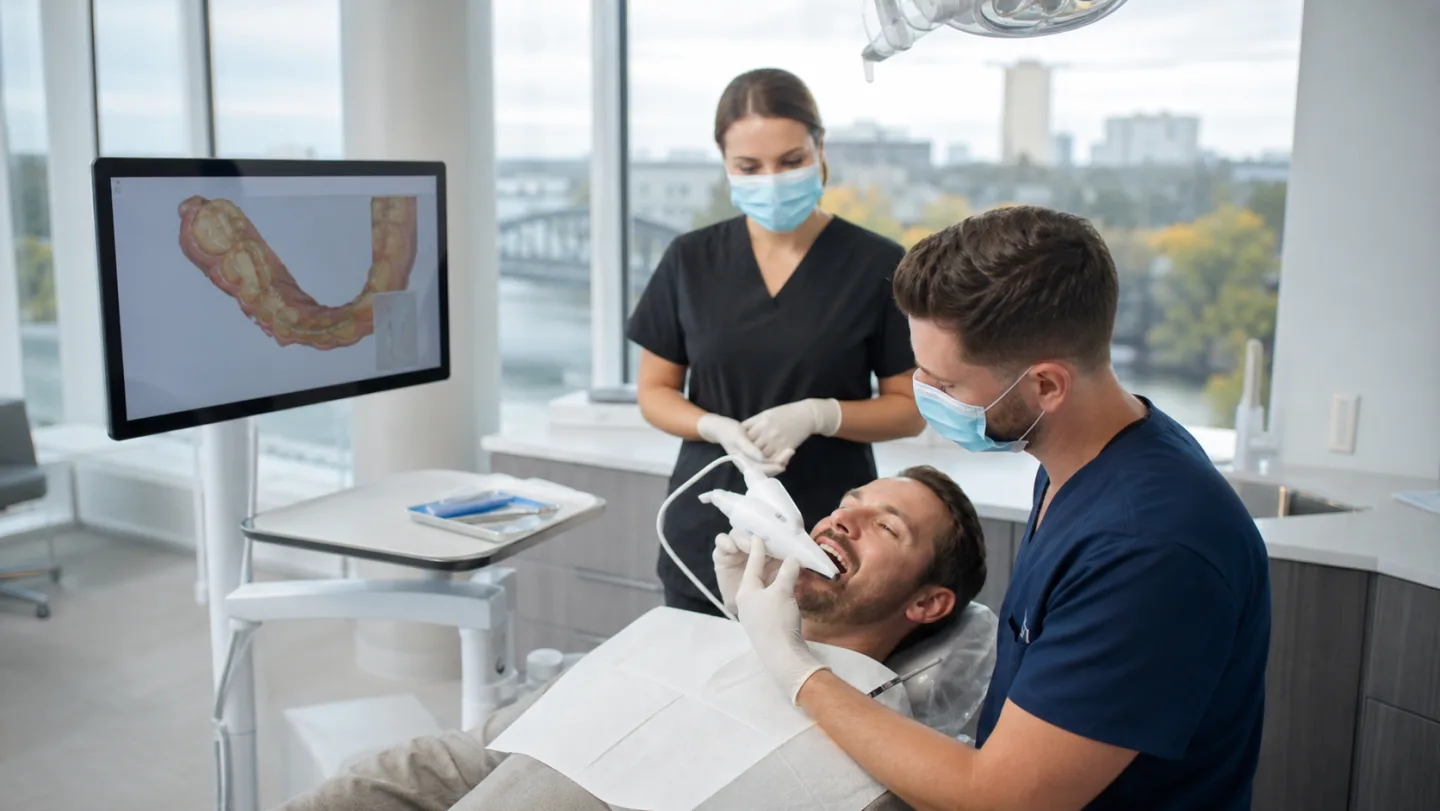
A dentist using a digital scanner while planning a custom dental crown
Your tongue keeps finding it

Dental Crowns for West End Winnipeg Residents

Something back there feels rough or different, and your tongue will not leave it alone. If you live in West End Winnipeg, here is what that spot could be, when a crown may enter the picture, and how it can be examined at our McPhillips Street clinic.

Let's find a time

Request an appointment

We’ll call to confirm your appointment. For urgent care, please call us directly.

That new sharp spot

Your Tongue Is a Surprisingly Good Detector

Tongues pick up tiny changes in the mouth, sometimes well ahead of anything you can see. A rough patch could be a chipped tooth, a filling that has worn down, or the edge of an existing crown. It might be harmless, but it is hard to judge from the inside, and a mirror seldom shows much.

West End Winnipeg residents can have that spot checked at Winnipeg North Dental, on McPhillips Street in Winnipeg. If the tooth has lost enough structure or an old crown has started to fail, a new crown may be suggested. Often, though, something simpler will solve it.

Explore dental crowns
Reception counter at Winnipeg North Dental with a small sculpture, a potted cactus and a frosted glass door beyond
A small metal sculpture and potted plant on a counter, with frosted glass doors behind.

Hard to self-diagnose

From the inside of your mouth, chips, worn fillings and crown edges can all feel much the same.

Not always a crown

Many rough spots turn out to need a small repair or a simple smoothing, or nothing at all.

Sharp edges count

Anything cutting your tongue or cheek gives you a good enough reason to phone the clinic.

Narrowing it down

What that rough patch could turn out to be.

An examination usually answers this quickly. The right course follows from what is actually there, and from how much sound tooth surrounds it.

If it is your natural tooth

A change in a natural tooth might be small, or it may be a clue to a wider weakness.

  • A chipped edge on a tooth that is otherwise sound.
  • A crack that may call for reinforcement.
  • Worn enamel with a flattened surface.
  • A cavity that has opened up without any warning.

If it is earlier dental work

Old restorations can change gradually, and they can also fail at their edges.

  • A filling that is breaking down at its margin.
  • A chip in the surface of an existing crown.
  • A crown edge exposed where the gum has changed.
  • A crown that has begun to loosen slightly.

A crown is more likely to come into the picture when damage is extensive or an old crown can no longer protect the tooth. Smaller problems may be handled with a smaller repair.

If it does need a crown

From rough spot to smooth new surface.

Custom crowns usually run from preparation and record-taking through to placement at a later date. How much time passes between these appointments depends on the material and the wider plan.

Request your visit
  1. 01

    Identifying the spot

    With the tooth, its root, your gums and your bite all in view, and X-rays if suitable, the dentist finds out what you felt and whether a crown fits.

  2. 02

    Reshaping the tooth

    Local anesthetic goes first, and shaping next. Afterward, the scan or impression, the record of your bite and shade information are taken.

  3. 03

    A smoother stopgap

    A temporary may cover the tooth in the interim, and it can feel a little different to your tongue. Brush softly near it, and avoid sticky food.

  4. 04

    Checking the new edges

    Before the crown is finally cemented, its fit, contacts, bite and appearance are all checked, and rough areas can be refined at this point.

What to mention

Helping the dentist find what your tongue found.

It is surprisingly hard to point out a spot that only your tongue knows. A few simple notes can help guide the examination directly to the right place.

Try not to file or smooth the area yourself. Point it out at the appointment, or phone if it is cutting into your tongue.

Useful things to note

  • Roughly which tooth it is: upper or lower, left or right.
  • When it started, and whether something hard was involved.
  • Whether the tooth has a filling or crown already.
  • Whether floss catches or snaps at that location.
Bright consultation room at Winnipeg North Dental with a landscape painting, white desk and leather chairs
Yellow-edged potted plant next to a white chair and window blinds in the Winnipeg North Dental waiting area

A landscape painting above a desk, and a yellow-edged plant in a ribbed planter.

A small complaint

Nobody will think you are fussing.

It might seem silly to book for something you can barely describe. Yet changes in the mouth are precisely what an exam is meant to investigate, and a tiny concern is a perfectly good reason to come. If a tooth needs to be prepared, local anesthetic is normally used.

Often a quick look

An exam of the area may be all you need before you can hear the reason and decide what to do.

If shaping is required

With your tooth frozen, what comes through is generally pressure or buzzing, not sharpness.

A new feel at first

After crown work, the tooth may be sensitive or the gum tender for a while, and that should get better.

Afterward

Keep paying attention to how it feels.

Your tongue remains a useful early warning, because natural tooth at a crown’s margin can still decay. Remaining structure, bite, grinding, hygiene, gum changes and trauma also influence how long a crown serves.

01

Notice new edges

If the surface or rim of a crown begins to feel different, have it checked without waiting for discomfort.

02

Clean it thoroughly

Good brushing and daily between-tooth cleaning are how you protect the seam along the crown’s edge.

03

Get regular exams

Attend the examinations recommended to you, where the areas your tongue cannot reach also get monitored.

Let the clinic know if your bite feels high, the crown shifts, floss repeatedly shreds, food begins to trap, or sensitivity lingers.

Talk with our team
Winnipeg North Dental building front, with dark grey panels, brown siding at the edge and a glass entry

Winnipeg North Dental

Unit-5 2358 Mcphillips Street, Winnipeg, MB R2V 4J6
Get directions (opens in a new tab)
Show someone the spot

Tooth and Crown Checks on McPhillips Street for West End Winnipeg Residents

West End Winnipeg residents are seen at Winnipeg North Dental, Unit 5, 2358 McPhillips Street, Winnipeg, for this kind of concern. This section links to directions for your visit.

For pain or a sharp edge cutting your mouth, phone (204) 338-3003, not the form. Online requests stay unconfirmed until the clinic gets back to you.

Questions about coverage?

Talk with our team before your visit or learn about CDCP.

A little clarity before your visit

Your questions, answered.

Helpful details about dental crowns in West End Winnipeg.

Ask our team
How can I tell whether it is a chip or just tartar?

From your side, you often cannot. Hard deposits and chips can feel similar, so the simplest way to find out is to have the dentist take a look.

Can a sharp edge just be smoothed?

Sometimes that is all it takes, although it depends on what the edge turns out to be. Have it examined and do not try to file it down at home.

What if the rough edge is on an old crown?

A chip or a change at the margin can have several causes. The dentist can check whether the crown is still doing its job or needs further attention.

Should I worry about a rough spot that does not hurt?

No need to panic, but it is still worth having looked at. Some problems stay comfortable for quite a while, and early details are easier to act on.

What if the rough spot is cutting my tongue?

That is a reason to pick up the phone and ring the clinic. Mention how sore it is, and ask how soon the tooth should be looked at.

How do West End Winnipeg residents get a rough spot checked?

Phone (204) 338-3003 or put the details in the form on this page. Your exam happens at our clinic on McPhillips Street, and they confirm any time.

Let someone else look

Have that spot your tongue found examined.

Send us a request for a McPhillips Street visit, and the clinic will write or call back about the timing.

Patient testimonials

Kind words from our patients

★★★★★ 5.0 from 440+ reviews on Google

Close to home

Areas we serve

Convenient dental care on McPhillips Street for families across northwest Winnipeg and nearby communities.

Explore all service areas

A healthier smile is one visit away

Ready for dental care that feels genuinely comfortable?

✓ New patients welcome ✓ Direct insurance billing ✓ Multilingual team

How can we help?

Our dental team is here for you.

Ready to book or have a question? Choose the option that works best for you.

For urgent dental concerns, please call us directly.

Send us a message

Our team will reply during clinic hours.



