Skip to content
Winnipeg North Dental
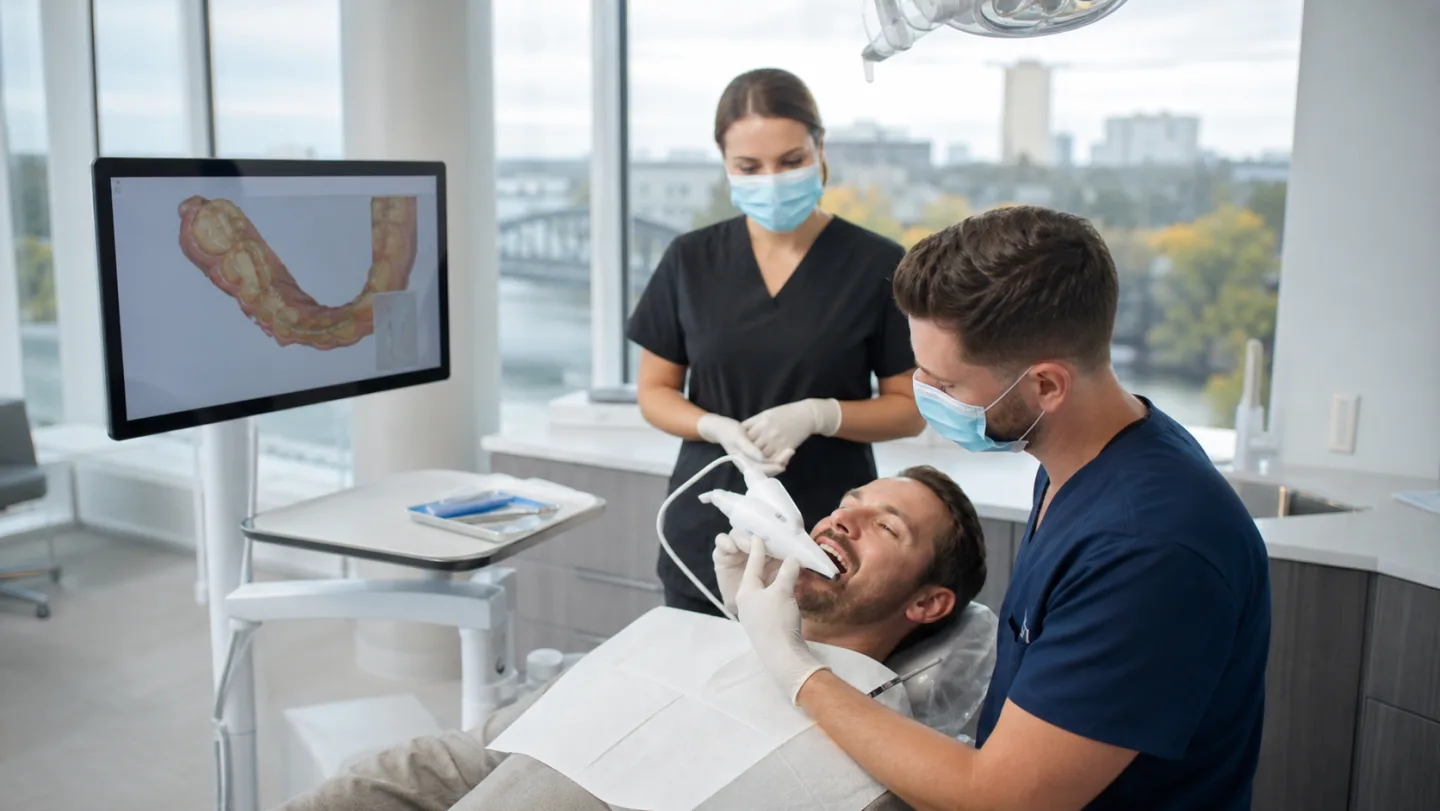
A dentist using a digital scanner while planning a custom dental crown
Bringing your dental history along

Dental Crowns for St. Andrews Residents

If the tooth in question has been treated before, its past matters. St. Andrews residents can use this page to gather that history ahead of a crown assessment on McPhillips Street in Winnipeg.

Let's find a time

Request an appointment

We’ll call to confirm your appointment. For urgent care, please call us directly.

A tooth arrives with a backstory

What Your Tooth’s Past Can Tell a Dentist

Plenty of teeth that end up being considered for a crown have already been through something: a big filling, a fracture, internal treatment. Knowing roughly what happened and when gives the dentist useful background, even though the examination itself decides what is suitable.

St. Andrews is outside the City of Winnipeg, and residents come into Winnipeg for this care, which is provided at Winnipeg North Dental on McPhillips Street. Sorting out your history before that first trip is a small job that can make the conversation in the chair more productive.

Explore dental crowns
White desk with a keyboard and black chairs in a Winnipeg North Dental consultation room, with window blinds behind
A keyboard resting on a white desk, with black office chairs on both sides.

Recall the events

Dates can be approximate. What was done to this tooth, and roughly when, is the part that helps.

Name the previous office

Having the name and number of your last dental office handy makes a records question simple to answer.

Expect a fresh look

Old notes are background. Tooth, root, gums and bite are still evaluated before a crown is confirmed.

Worth writing down

The history that bears on a crown decision.

Gaps and rough dates are fine here. Think of it as a short summary of why this particular tooth has come to need attention.

Earlier work on the tooth

Restorations give clues about how much natural structure may be left beneath the surface.

  • A large filling, or several replaced over the years.
  • Internal treatment, meaning a past root canal.
  • An older crown that is now being reconsidered.
  • A partial restoration such as an inlay or onlay.

Things that have happened since

Recent changes tell a dentist what prompted the visit, and they often shape which questions come first.

  • A piece that chipped or broke away.
  • A knock to the mouth, however minor it seemed.
  • Sensitivity that has appeared or changed recently.
  • Grinding that you, or someone else, has noticed.

Your recollection guides the conversation but cannot show the tooth’s present condition. X-rays and an examination are what establish that.

Where history meets treatment

How custom crown care unfolds after the paperwork.

A custom crown usually takes clinical preparation, detailed records of the tooth and a later appointment to place it. The material and overall plan influence how far apart those stages fall.

Request your visit
  1. 01

    Reviewing past and present

    What you have shared sits alongside a current evaluation of root, gums, bite and tooth, using whichever X-rays are appropriate. Only then is a crown confirmed as suitable.

  2. 02

    Creating new records

    Once numb, the tooth is reduced and shaped. A digital scan or an impression follows, along with shade details and a bite record for the lab work.

  3. 03

    A short-term cover

    A temporary may go on so the shaped tooth stays protected and neighbouring spacing holds. Sticky foods are out, and cleaning around it should be gentle.

  4. 04

    Trying the final piece

    Appearance, contacts, fit and bite each get checked with the crown in place. Any adjusting comes first, and cementation comes last.

Ask about records

Questions about old files and X-rays.

Whether earlier records would be useful depends on the tooth and on what they contain. Rather than assuming either way, raise it when you request your visit.

It also helps to find out how your own crown details will be recorded here, in case you ever need them in the future.

Record questions to raise

  • Would recent X-rays from my previous office be useful to you?
  • How would records from another office be requested, if you need them?
  • Should I bring anything with me from past dental treatment?
  • What will my file note about this crown once it is finished?
Reception counter at Winnipeg North Dental with an orchid, a snake plant and a glass partition
Pale blue dental chair beside wood-toned cabinets in a Winnipeg North Dental treatment room

An orchid on the reception counter, and pale blue upholstery in a treatment room.

A patient with a past

A complicated tooth is an ordinary thing to bring in.

Some people feel awkward about a tooth with a patchwork of past repairs, or about gaps in what they can remember. Neither should stop you. Start with what you know, and leave the rest to be learned from the examination.

Foggy memory is fine

If you cannot recall who treated a tooth or what they did, just say that. It is a perfectly common answer.

Freezing at preparation

An old repair does not change the usual approach of numbing the tooth first, though pressure or vibration may still be felt as it is shaped.

Tell them about past trouble

An earlier visit that went badly is relevant too, so mention whatever made it hard.

Adding to the record

Your crown becomes part of the tooth’s story.

Afterward, the natural tooth at the margin remains able to decay, even though crown material itself cannot. Long-term results also rest on grinding, bite, how much supporting structure exists and how well the area is cleaned.

01

Note it for yourself

Jot down which tooth was crowned and when. Your future self will be glad to have this next time someone asks.

02

Clean along the edge

Brush thoroughly where the crown meets the tooth, and clean between those teeth every day as well.

03

Keep examinations going

Attending recommended exams allows the gums, crown and tooth beneath to be monitored over time.

Report a high bite, movement, repeated floss shredding, food trapping or sensitivity that is not settling as expected.

Talk with our team
Winnipeg North Dental’s white sign band with logo and phone number, above dark-framed windows and a glass door

Winnipeg North Dental

Unit-5 2358 Mcphillips Street, Winnipeg, MB R2V 4J6
Get directions (opens in a new tab)
Coming into Winnipeg

Crown Assessments in Winnipeg for St. Andrews Residents

For St. Andrews patients, every crown appointment is held at Winnipeg North Dental, Unit 5, 2358 McPhillips Street, Winnipeg. Open the directions link when you come to plan your way in.

For a painful or broken tooth, phone (204) 338-3003 and do not rely on the form, which only sends a request. The clinic follows up to confirm a time.

Questions about coverage?

Talk with our team before your visit or learn about CDCP.

A little clarity before your visit

Your questions, answered.

Helpful details about dental crowns in St. Andrews.

Ask our team
I do not remember what was done to this tooth. Is that a problem?

Not at all. Tell the dentist what you can. An examination and appropriate X-rays will show a good deal about its current state.

Do I need my old X-rays before asking about a crown?

You can request an assessment without them. Ask the clinic whether any earlier images would help in your case, and how they could be obtained.

Why does past treatment affect the choice of a crown?

The recommendation depends partly on how much healthy structure remains and why the tooth was weakened. Earlier fillings and internal treatment are part of that picture.

My tooth already has a crown from years ago. Can that be assessed too?

Yes, you can ask to have it looked at. Describe what you have noticed, such as movement, trapped food or a change in sensitivity, when you make your request.

Would I still need X-rays if I bring recent ones?

That is a question for the dentist, who decides which images are appropriate after looking at what you have and at the tooth.

How should a St. Andrews resident mention earlier treatment when asking for a visit?

Note it briefly on the form, or say so when you phone (204) 338-3003. A line such as this tooth was treated at another office is plenty to start with.

Bring what you have

Share your tooth’s history at an assessment.

Request a visit to the McPhillips Street clinic. Once the clinic has your request, you will hear back about timing.

Patient testimonials

Kind words from our patients

★★★★★ 5.0 from 440+ reviews on Google

Close to home

Areas we serve

Convenient dental care on McPhillips Street for families across northwest Winnipeg and nearby communities.

Explore all service areas

A healthier smile is one visit away

Ready for dental care that feels genuinely comfortable?

✓ New patients welcome ✓ Direct insurance billing ✓ Multilingual team

How can we help?

Our dental team is here for you.

Ready to book or have a question? Choose the option that works best for you.

For urgent dental concerns, please call us directly.

Send us a message

Our team will reply during clinic hours.



