Skip to content
Winnipeg North Dental
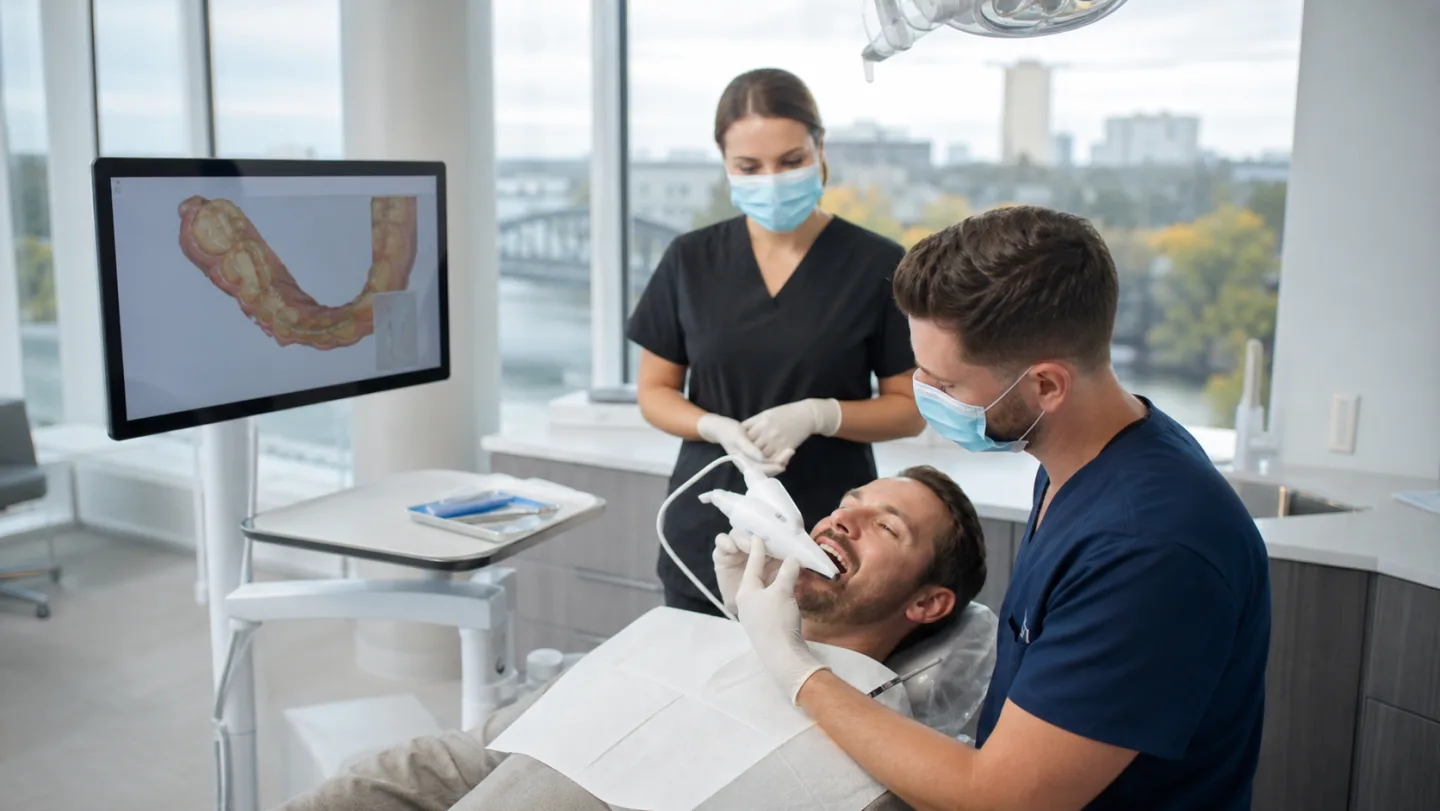
A dentist using a digital scanner while planning a custom dental crown
It hurts when I bite down

Dental Crowns for North End Winnipeg Residents

A tooth that twinges on one particular chew can leave you unsure whether to worry. If you live in North End Winnipeg, have it looked at on McPhillips Street, where a crown may or may not turn out to be the answer.

Let's find a time

Request an appointment

We’ll call to confirm your appointment. For urgent care, please call us directly.

From symptom to explanation

When Chewing Hurts: Where Crowns Fit In, for North End Winnipeg Patients

Pain on chewing, or a sharp reaction to something cold, can come from several places. A crack, deep decay, a failing filling, gum problems or an irritated nerve can all be involved, and they do not all call for the same treatment. Searching your symptoms online seldom sorts them out, because the same sensation can have different causes.

A crown makes sense when the tooth needs reinforcement and has a foundation able to carry one. It does not treat every cause of pain, and some teeth need other care first. To find out which applies, the tooth has to be examined, and that happens at Winnipeg North Dental on McPhillips Street in Winnipeg.

Explore dental crowns
Reclined teal dental chair with its instrument tray at Winnipeg North Dental
A treatment room at the clinic, with a teal chair and instrument arm.

Find the cause first

Treatment follows the diagnosis, so the source of your discomfort gets identified first.

Pain now?

For significant pain or swelling, call the clinic instead of sending the online form.

Note the pattern

What sets it off, and how long it lasts, gives the dentist useful clues.

Possible directions

The same twinge can lead to different plans.

Your dentist narrows down what is going on by examining the tooth and, where appropriate, taking X-rays. Findings then point toward a suitable next step.

When a crown might follow

These are situations in which the tooth needs more support than a filling alone can reliably offer.

  • A crack that calls for reinforcement of the tooth.
  • A broken filling with little natural tooth left around it.
  • Heavy wear leaving the tooth needing a new chewing surface.
  • A back tooth that has just finished root canal therapy.

When something else comes first

Other findings may mean the priority is treating the source of the problem, whether or not a crown comes later.

  • An inflamed nerve needing evaluation for root canal therapy.
  • Decay that can be managed with a smaller restoration.
  • Gum concerns that call for their own assessment.
  • A bite issue affecting how the tooth is being loaded.

A crown does not settle an inflamed nerve by itself. Ask your dentist to explain what is causing the symptom and how each suggested treatment addresses it.

If the findings point to a crown

What treating that sore tooth would involve.

Most custom crowns are placed across at least two treatment visits. The planned material and your circumstances determine how the timing comes together.

Request your visit
  1. 01

    Track down the source

    The tooth, root, gum tissue and bite are examined, with X-rays as appropriate. Only then does the dentist confirm whether a crown is suitable.

  2. 02

    Freeze and shape

    Numbing makes the preparation work more comfortable, and the tooth is reduced to make room. Bite, shade and a scan or impression are then recorded.

  3. 03

    Protect the tooth

    You may go home with a temporary while the permanent crown is being produced. Keep sticky foods away from it and clean there gently.

  4. 04

    Test the fit

    When your crown is ready, its fit, contacts, bite and look are assessed. The dentist corrects anything needed and cements it.

Be your own detective

A few details can narrow things down.

It can be hard to pinpoint which tooth is hurting, and that is very common. Do not worry if you cannot. Simply share what you have noticed, because even partial details can help guide the examination.

Until the source is known, an estimate may be difficult to give. Once treatment options are clear, ask for one and bring your insurance or CDCP details.

Try to note

  • Which foods, drinks or actions bring the discomfort on.
  • Whether the feeling fades right away or tends to linger.
  • When it began, and whether anything happened around that time.
  • Any medications you take, including what you use for the pain.
Blue upholstered bench and framed abstract art in the Winnipeg North Dental waiting room
Winnipeg North Dental front desk seen from the waiting side, with a rug and bench

The waiting room and reception desk at Winnipeg North Dental.

A tooth that is already sore

Tell us where it hurts before anything touches it.

If a tooth is already painful, the thought of having it examined can make you tense. Pointing out the spot and describing how it reacts can help the dentist take care around it.

Before an examination

Let the dentist know which touch, tap or temperature you are bracing against.

Before preparation

Treatment normally starts with local anesthetic, after which you may feel pressure or vibration.

After preparation

Some sensitivity can persist for a short time, and it ought to improve as the area settles.

Once it is treated

If the old symptom comes back.

Treatment should change how a tooth feels, but it is still worth paying attention afterward. If something seems different from what you were told to expect, let the clinic know.

01

A bite that feels off

Contact that seems too heavy on a new crown needs to be checked and adjusted, because the tooth should not simply be left to adapt.

02

Ongoing sensitivity

Reactions that are not improving as expected are worth reporting, as the nerve can sometimes become inflamed before or after placement.

03

Daily cleaning

Brush thoroughly and clean between your teeth, since the natural tooth can decay at the crown’s margin.

Recommended examinations also help the dental team keep track of a tooth with a history of symptoms.

Talk with our team
Winnipeg North Dental’s double glass doors and tinted windows, seen from the sidewalk

Winnipeg North Dental

Unit-5 2358 Mcphillips Street, Winnipeg, MB R2V 4J6
Get directions (opens in a new tab)
Having it looked at

North End Winnipeg Residents Can Be Seen on McPhillips Street

Residents of North End Winnipeg receive their crown assessments and treatment at Winnipeg North Dental, Unit 5, 2358 McPhillips Street, in the same city. If you need help finding it, use the directions link.

Sending the form is a request, with the time confirmed afterward by the clinic. When a tooth is very sore or something feels urgent, phone (204) 338-3003 instead.

Questions about coverage?

Talk with our team before your visit or learn about CDCP.

A little clarity before your visit

Your questions, answered.

Helpful details about dental crowns in North End Winnipeg.

Ask our team
My tooth hurts when I chew. Do I need a crown?

Not necessarily. Chewing pain can have several causes, and a crown only suits some of them. An examination is the way to find out what is causing it and what could help.

Why is my tooth suddenly sensitive to cold?

Several things can cause that, including decay, a crack, or an irritated nerve. Note how long the feeling lasts and tell the dentist, who can look for the source.

Can a crown stop a tooth from hurting?

It depends on the source. A crown can reinforce a damaged tooth, but an inflamed nerve needs its own evaluation. Ask how your recommended treatment deals with the cause of your symptom.

Could I need a root canal as well as a crown?

In some cases, yes. Deep decay, cracks or earlier damage may inflame the nerve. Your dentist reviews the tooth and X-rays, then explains whether root canal therapy is part of the plan.

The pain went away. Should I still get it checked?

It is reasonable to ask for an examination, because a change in symptoms does not reveal what caused them. Tell the clinic what you felt and when it stopped.

Who do I contact from North End Winnipeg if it is getting worse?

Please phone (204) 338-3003 rather than using the form, so the clinic hears about it directly. For less pressing concerns, the online form lets you request an assessment on McPhillips Street.

Stop guessing

Have that sore tooth properly examined.

Request an assessment at our clinic on McPhillips Street, and someone will follow up. If it is urgent, please call.

Patient testimonials

Kind words from our patients

★★★★★ 5.0 from 440+ reviews on Google

Close to home

Areas we serve

Convenient dental care on McPhillips Street for families across northwest Winnipeg and nearby communities.

Explore all service areas

A healthier smile is one visit away

Ready for dental care that feels genuinely comfortable?

✓ New patients welcome ✓ Direct insurance billing ✓ Multilingual team

How can we help?

Our dental team is here for you.

Ready to book or have a question? Choose the option that works best for you.

For urgent dental concerns, please call us directly.

Send us a message

Our team will reply during clinic hours.



