Skip to content
Winnipeg North Dental
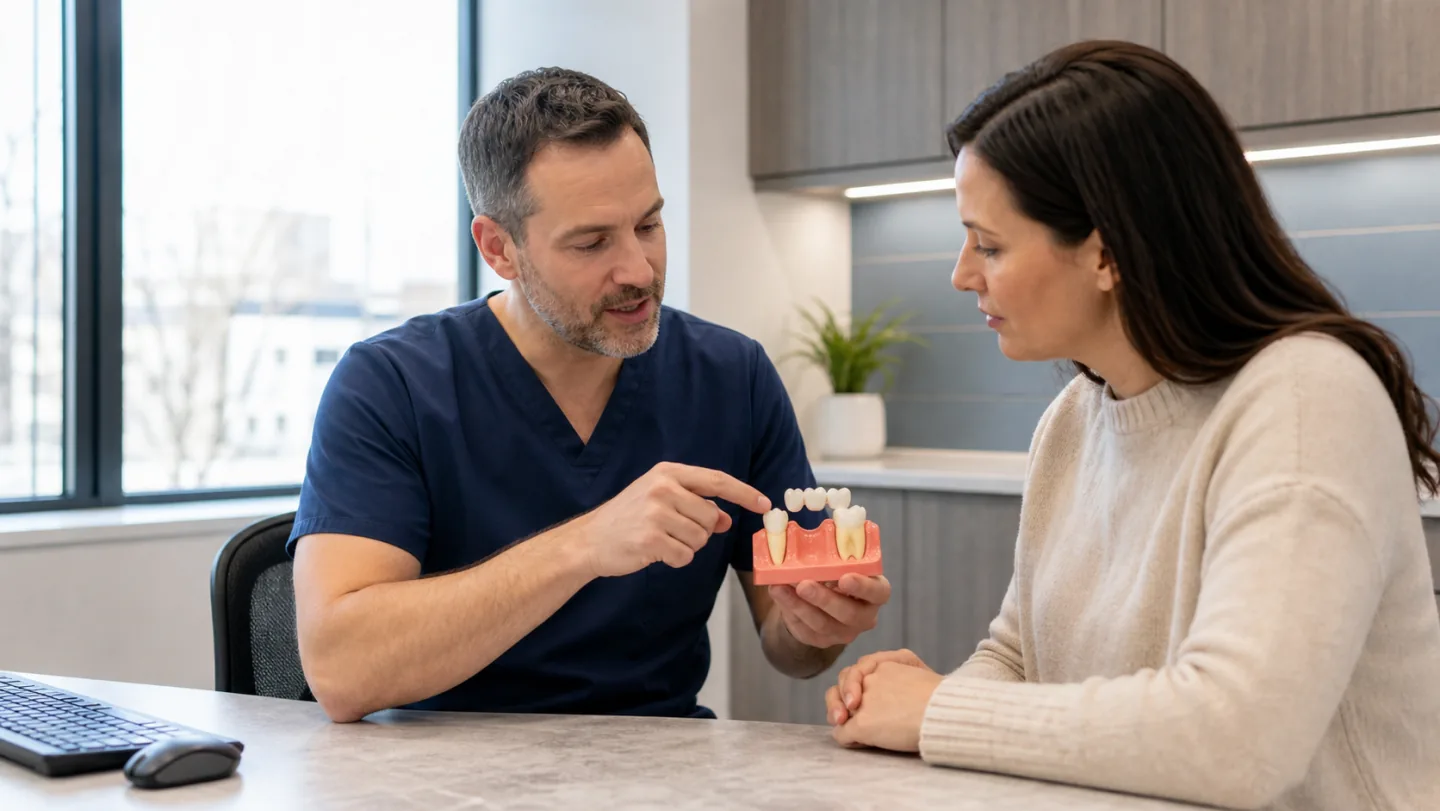
A dentist explaining how a fixed bridge can replace a missing tooth
Crown or bridge? Sorting out the words

Dental Bridges for Waterford Green Residents

The two terms get used as if they meant the same thing, and they do not. One covers a tooth you still have. The other spans a space where a tooth used to be, and it often relies on crowns to do so.

Let's find a time

Request an appointment

We’ll call to confirm your appointment. For urgent care, please call us directly.

Covering versus spanning

How Crowns and Bridges Differ, for Waterford Green Patients

A crown fits over one tooth that remains in your mouth, usually because it has been weakened or treated. A bridge answers another problem altogether: a tooth is gone, and a custom artificial one needs something to hold it in that space.

The overlap is what causes the mix-up. In a tooth-supported bridge, crowns placed on the neighbouring teeth carry the replacement between them, and all of it is joined together. If you live in Waterford Green and have heard both words at once, your appointment would be at our clinic on McPhillips Street in Winnipeg, where your dentist can point to what each one would mean for you.

Explore dental bridges
Black office chairs around a white desk, below a framed coastal painting, at Winnipeg North Dental
Black chairs at a white desk in a Winnipeg North Dental consultation room.

Is the tooth still there?

That one question usually separates the two. A remaining tooth may take a crown, while an empty space may call for a bridge.

Often used together

Crowns can serve as the anchors of a bridge, so one plan may legitimately include both terms.

Different cleaning

You can floss beside a lone crown in the usual way. Joined bridge units need another route underneath.

The two compared

One restores a tooth. The other replaces it.

Seeing the purposes next to each other tends to clear things up, even though the materials and the fabrication can look alike.

What a single crown does

Think of it as custom coverage for a natural tooth that has been weakened or treated and can still be kept.

  • It sits on one tooth and stands alone.
  • Your own root stays in place beneath it.
  • Nothing has to span an empty space.
  • Regular floss can still pass on each side.

What a bridge adds

Here the aim is filling a space, so the plan has to account for the support on either end and the load it will carry.

  • Artificial teeth are joined to their supports as one fixed unit.
  • Support may come from crowned neighbours or from implants.
  • A longer span changes the mechanical demands.
  • The underside needs a realistic way to be cleaned daily.

Sometimes the honest answer is neither one on its own. A damaged tooth might need a crown today and something else later, and an examination is what settles which applies.

If the plan includes crowns

Where crowns fit in the building of a bridge.

For a tooth-supported design, the crowns are not a separate project. They are built into the same piece, and that shapes each stage below.

Request your visit
  1. 01

    Judge the would-be anchors

    Your dentist looks at the gums, roots, alignment and any existing dental work on the teeth beside the space, along with how your bite meets them.

  2. 02

    Shape teeth to receive crowns

    Where the design depends on natural neighbours, those teeth are shaped to accept crowns. Implants that have already healed would be checked for connection instead.

  3. 03

    Record what the lab needs

    What goes off for fabrication is a scan or impressions, a record of how you bite, and the shade selected. During the wait, a temporary bridge might shield prepared teeth.

  4. 04

    Try the joined piece

    Before it is attached for good, the team reviews contacts, margins, bite, appearance and how easily you can clean around it.

Clearing up your plan

Bring the wording you were given.

If a past estimate or an earlier conversation mentioned crowns, units or a bridge, jot down what you remember. It gives your dentist a starting point for explaining what those words referred to.

Coverage can treat these items differently, so you may want to ask for an estimate that names each part once a design is proposed. What you pay depends on your plan and on the treatment provided.

Useful to have with you

  • Any earlier treatment estimate that used these terms.
  • Which teeth already have crowns, if you know.
  • Everything you currently take, written out.
  • The card for your dental plan, or your CDCP letter.
Pale blue dental chair with an overhead arm and wood-toned cabinets at Winnipeg North Dental
White and pale blue reception counter with plants at Winnipeg North Dental

A pale blue dental chair and the reception counter at Winnipeg North Dental.

No need to know the jargon

Asking what a word means is a good use of your visit.

Nobody expects you to arrive fluent in dental terms. If an explanation goes by too quickly, stop and ask for it again in plainer language, or ask to see which tooth is being talked about.

Ask to have it pointed out

Seeing the actual teeth involved often does more than any definition could.

Find out what changes permanently

Preparing a natural tooth for a crown is a significant step, so understand it before you say yes.

Raise any nerves early

Tell us if appointments unsettle you, and your comfort can be talked over before work begins.

Once the two are joined

Crowned anchors still need your attention.

Being covered does not take a natural tooth out of the picture. It remains living tooth at the edges, and those edges are what your daily cleaning has to reach.

01

Thread beneath the joined part

To get below the replacement tooth, you might use super floss, a threader, a water flosser or a small interdental brush. Our team can demonstrate the right one.

02

Watch the crown margins

Decay can begin where an anchor crown meets the natural tooth. Examinations at regular intervals are a chance to look at those spots.

03

Report a change in feel

Call us about any movement, a chipped surface, a rough edge or a bite that seems altered.

Bleeding, swelling, a lingering bad taste or food that keeps getting caught around the bridge are also worth mentioning.

Talk with our team
Winnipeg North Dental sign and phone number above glass doors on a blue and white facade

Winnipeg North Dental

Unit-5 2358 Mcphillips Street, Winnipeg, MB R2V 4J6
Get directions (opens in a new tab)
From Waterford Green to our clinic

Have Your Crown or Bridge Question Answered in Person

Waterford Green is in Winnipeg, and your care would take place at Winnipeg North Dental, Unit 5, 2358 McPhillips Street, Winnipeg, MB. This page’s directions link will map the way for you.

Tell us by phone or form that you would like a crown or bridge explained. The form sends a request rather than holding a time, and the clinic follows up with you.

Questions about coverage?

Talk with our team before your visit or learn about CDCP.

A little clarity before your visit

Your questions, answered.

Helpful details about dental bridges in Waterford Green.

Ask our team
Is a bridge just several crowns stuck together?

That description is partly right for a tooth-supported design, where crowns on the neighbours hold an artificial tooth between them. Implant-supported and one-sided designs are built differently, though.

My tooth is broken but still there. Which one would apply?

A tooth that can be kept is more likely to be considered for a crown, while a bridge comes into play once a tooth is missing. An examination has to determine whether yours can be saved.

Do crowns have to be placed on healthy neighbouring teeth?

In a tooth-supported bridge, the anchors are prepared to take crowns when required, even if they look fine. That is one reason to ask about all your alternatives, including implant support.

Can a tooth that already has a crown become a bridge anchor?

Perhaps. Your dentist would review the existing crown along with the root and gums beneath it, and then explain whether it could be used as it is or would need to be replaced.

Could an implant replace the need for crowns on my neighbours?

Implant-supported bridges replace several teeth without preparing natural teeth as anchors, and a single implant carries its own crown. Bone, health, healing and timing all affect the choice.

Why is a crown easier to floss than a bridge?

Floss can slide down either side of a lone crown. Bridge units are joined, so it cannot pass between them, and you have to come in from underneath with a threader or similar tool.

How do Waterford Green residents get this explained?

Send the form on this page or call (204) 338-3003, and say you are unsure whether you need a crown or a bridge. Your assessment would be at our McPhillips Street clinic in Winnipeg.

Clear up the confusion

Find out which one your tooth calls for.

If you live in Waterford Green, ask for an assessment at our McPhillips Street clinic, and a team member will reply about timing.

Patient testimonials

Kind words from our patients

★★★★★ 5.0 from 440+ reviews on Google

Close to home

Areas we serve

Convenient dental care on McPhillips Street for families across northwest Winnipeg and nearby communities.

Explore all service areas

A healthier smile is one visit away

Ready for dental care that feels genuinely comfortable?

✓ New patients welcome ✓ Direct insurance billing ✓ Multilingual team

How can we help?

Our dental team is here for you.

Ready to book or have a question? Choose the option that works best for you.

For urgent dental concerns, please call us directly.

Send us a message

Our team will reply during clinic hours.



